


Expanded Metal Mesh Standard Size
In industrial filtration and structural engineering, selecting the correct expanded metal mesh standard size is a critical step that influences both the mechanical integrity and the operational efficiency of a system. Expanded metal is a unique material produced by simultaneously slitting and stretching a solid sheet of metal, creating a diamond-shaped pattern without the material loss associated with traditional punching or perforation. For engineers and procurement teams, understanding the technical specifications and standard dimensions is essential for ensuring compatibility with filter housings, support structures, and fluid dynamics requirements.
At Kaifil, we specialize in high-performance Perforated & Expanded Metal solutions tailored for demanding industrial environments. This guide provides a technical overview of standard sizing, material considerations, and engineering parameters necessary for informed decision-making in filtration applications.
Understanding Technical Terminology in Expanded Metal
To accurately specify an expanded metal mesh standard size, one must first master the industry-standard terminology used to define the geometry of the mesh. Unlike woven wire cloth, expanded metal dimensions are governed by the relationship between the diamond openings and the strands of metal.
SWD and LWD (Short Way of Design and Long Way of Design)
The most fundamental measurements are the SWD and LWD.
- SWD (Short Way of Design): This is the distance from the center of a bond to the center of the next bond measured across the short axis of the diamond.
- LWD (Long Way of Design): This is the distance from the center of a bond to the center of the next bond measured across the long axis of the diamond.
These measurements define the pitch of the mesh. It is important to note that the "opening size" (the actual clear space) is slightly smaller than the SWD and LWD because it excludes the width of the metal strands.
Strand Width and Thickness
- Strand Thickness: This refers to the thickness of the base metal sheet used to produce the mesh.
- Strand Width: This is the amount of metal fed into the precision dies between slits.
The combination of strand width and thickness determines the overall cross-sectional area of the mesh, which directly impacts its structural strength and the percentage of open area.
Expanded Metal Mesh Standard Size Categories
Standardization in the industry helps streamline manufacturing and ensures consistency across different production batches. While custom sizes are frequent in OEM filtration, most applications begin with a reference to standard industrial categories: light-duty, medium-duty, and heavy-duty (grating).
Light-Duty and Micro-Mesh
In high-precision filtration, such as pharmaceutical or chemical processing, micro-mesh is often required. Standard sizes in this category may feature an SWD as small as 0.031 inches (0.8mm) and an LWD of 0.062 inches (1.6mm). These sizes are typically used as primary filter media or as a support layer for fine wire mesh in composite filter cartridges.
Medium-Duty Industrial Mesh
This is the most common category for industrial strainers, vent guards, and protective screens. Standard SWD dimensions often range from 0.250 inches to 1.0 inch. For example, a common industrial specification is "1/2# 18," where 1/2 inch refers to the nominal SWD and 18 refers to the gauge of the steel.
Standard Sheet Dimensions
Beyond the mesh geometry, the overall sheet size is also standardized. Common stock sizes include:
- 48 inches x 96 inches (4' x 8')
- 48 inches x 120 inches (4' x 10')
- 60 inches x 120 inches (5' x 10')
When designing filtration components, engineers should consider these standard sheet sizes to minimize scrap and reduce total cost. However, for custom filter cartridges, Kaifil provides precision-cut strips and cylinders tailored to the specific diameter and length required by the application.
Material Selection and Dimensional Stability
The choice of material significantly affects the expanded metal mesh standard size and its performance over time. Industrial filtration often demands materials that can withstand corrosive fluids, high temperatures, and mechanical stress.
Stainless Steel (304 and 316L)
Stainless steel is the gold standard for filtration. Grade 304 provides excellent general-purpose corrosion resistance, while Grade 316L is preferred for marine, chemical, and pharmaceutical applications due to its superior resistance to pitting and chloride-induced stress corrosion cracking. When expanding stainless steel, the material's work-hardening properties must be accounted for to ensure the final mesh meets the specified tolerances.
Aluminum and Carbon Steel
Aluminum is used where weight reduction is a priority, though it offers lower mechanical strength compared to steel. Carbon steel is a cost-effective option for hydraulic oil filtration or air intake systems where corrosion is managed through coatings or the presence of non-corrosive fluids.
Tolerances
Standard industrial tolerances for expanded metal typically allow for a variance of +/- 5% on SWD and LWD, and +/- 10% on strand width. For high-precision filtration components, tighter tolerances may be required to ensure a perfect fit within a filter housing or to maintain a specific flow rate.
Engineering Considerations for Filtration Performance
Selecting an expanded metal mesh standard size is not merely a matter of physical fit; it is an engineering decision that impacts the entire filtration process. Key factors include the percentage of open area, pressure drop, and structural support.
Open Area Calculation
The percentage of open area determines the flow capacity and the velocity of the fluid passing through the mesh. It is calculated based on the relationship between the strand width and the SWD. A higher open area reduces the pressure drop across the filter but may compromise the structural integrity if the mesh is subjected to high differential pressures.
Structural Support for Fine Media
In many advanced filtration systems, expanded metal is not the primary filter medium but serves as a rigid support for finer wire mesh or synthetic membranes. In these cases, the SWD and LWD must be chosen to provide maximum support points for the fine media to prevent pleat collapse or media migration under high-pressure conditions.
Directionality of Flow
The orientation of the diamonds (LWD vs. SWD) can influence fluid turbulence. In certain hydraulic applications, the angle of the strands in "raised" expanded metal can be used to deflect flow or promote mixing, whereas "flattened" mesh is preferred for a smooth, low-profile surface.
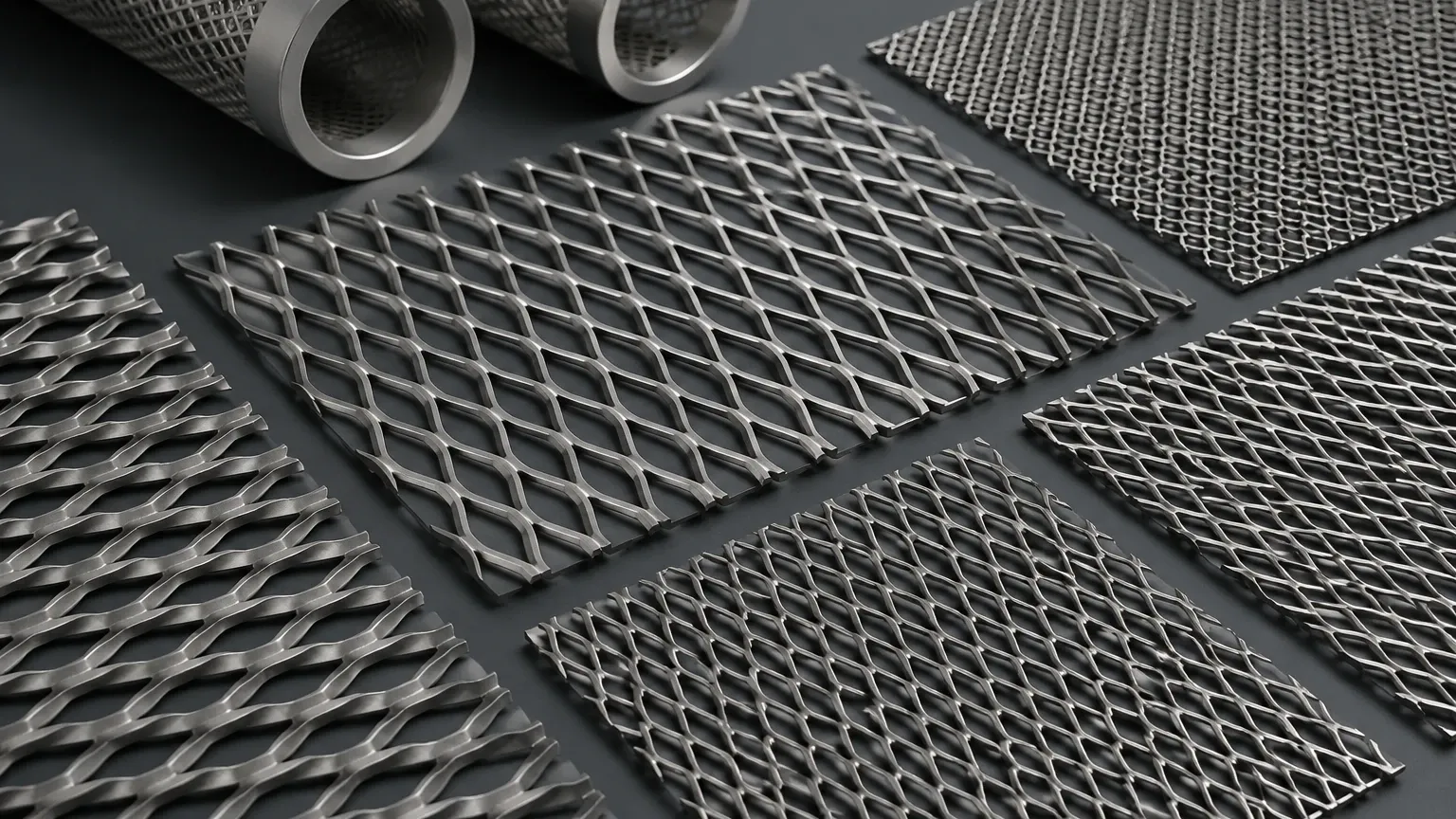
Flattened vs. Raised Expanded Metal
When specifying an expanded metal mesh standard size, it is vital to distinguish between raised (standard) and flattened mesh.
Raised Expanded Metal
This is the product as it comes off the expanding machine. The strands and bonds are set at a uniform angle to the plane of the sheet. This creates a three-dimensional texture that increases the surface area and provides excellent mechanical grip. In filtration, raised mesh is often used for heavy-duty pre-filters or debris guards.
Flattened Expanded Metal
Flattened mesh is produced by passing the raised expanded metal through a cold-roll reducing mill. This process flattens the strands and bonds into the same plane as the sheet.
- Advantages: It provides a smooth surface, which is easier to clean and safer to handle.
- Dimensional Change: Flattening typically increases the LWD slightly while keeping the SWD relatively constant. It also reduces the overall thickness of the mesh to approximately the original thickness of the base metal. For precision filter cartridges, flattened mesh is often the preferred choice because it allows for more accurate pleating and assembly.
Customization vs. Standard Sizes in OEM Applications
While standard sizes offer the advantage of shorter lead times and lower costs for general applications, many industrial filtration challenges require customized solutions. OEM manufacturers often find that a standard size does not perfectly match their flow rate requirements or housing dimensions.
When to Customize
1. Specific Micron Ratings: When the mesh acts as the primary filter, the opening size must be precisely controlled to meet specific particle retention targets.
2. Non-Standard Alloys: Applications involving highly aggressive chemicals may require specialty alloys like Hastelloy or Monel, which are rarely available in "off-the-shelf" standard sizes.
3. Integrated Components: For manufacturers of hydraulic or chemical processing equipment, receiving expanded metal in pre-cut, deburred, or pre-formed cylindrical shapes can significantly reduce assembly time and labor costs.
Kaifil works closely with engineering teams to bridge the gap between standard specifications and custom performance requirements. By controlling the expansion ratio and strand geometry, we can develop filtration components that optimize the balance between durability and filtration accuracy.
Conclusion and Technical Confirmation
Choosing the right expanded metal mesh standard size requires a comprehensive understanding of both the material's physical properties and the operational demands of the filtration system. Before finalizing a purchase or design specification, engineers should confirm the following:
- The exact SWD and LWD required for the application.
- Whether raised or flattened mesh is more suitable for the flow characteristics.
- The chemical compatibility of the base material with the process fluid.
- The required tolerances for integration into larger assemblies.
By focusing on these technical details, procurement and engineering teams can ensure long-term reliability and cost-effective performance. For more information on specific configurations and material options, you can Review product options and application support to find the ideal solution for your industrial filtration needs.
