


Expanded Metal Mesh
In the landscape of industrial filtration and structural support, expanded metal mesh stands as one of the most versatile and resource-efficient materials available to engineers. Unlike perforated metal, which involves punching holes out of a solid sheet and creating scrap, expanded metal is produced through a process of simultaneous slitting and stretching. This manufacturing method results in a continuous, jointless piece of metal that retains its structural integrity while providing a high strength-to-weight ratio. For technical professionals in chemical processing, hydraulic systems, and water treatment, understanding the nuances of expanded metal mesh is critical for optimizing filtration efficiency and equipment longevity.
At Kaifil, we specialize in providing precision-engineered Perforated & Expanded Metal solutions tailored to the rigorous demands of industrial environments. This guide examines the technical characteristics, material selection criteria, and engineering considerations necessary for integrating expanded metal mesh into high-performance filtration systems.
The Manufacturing Process and Structural Integrity
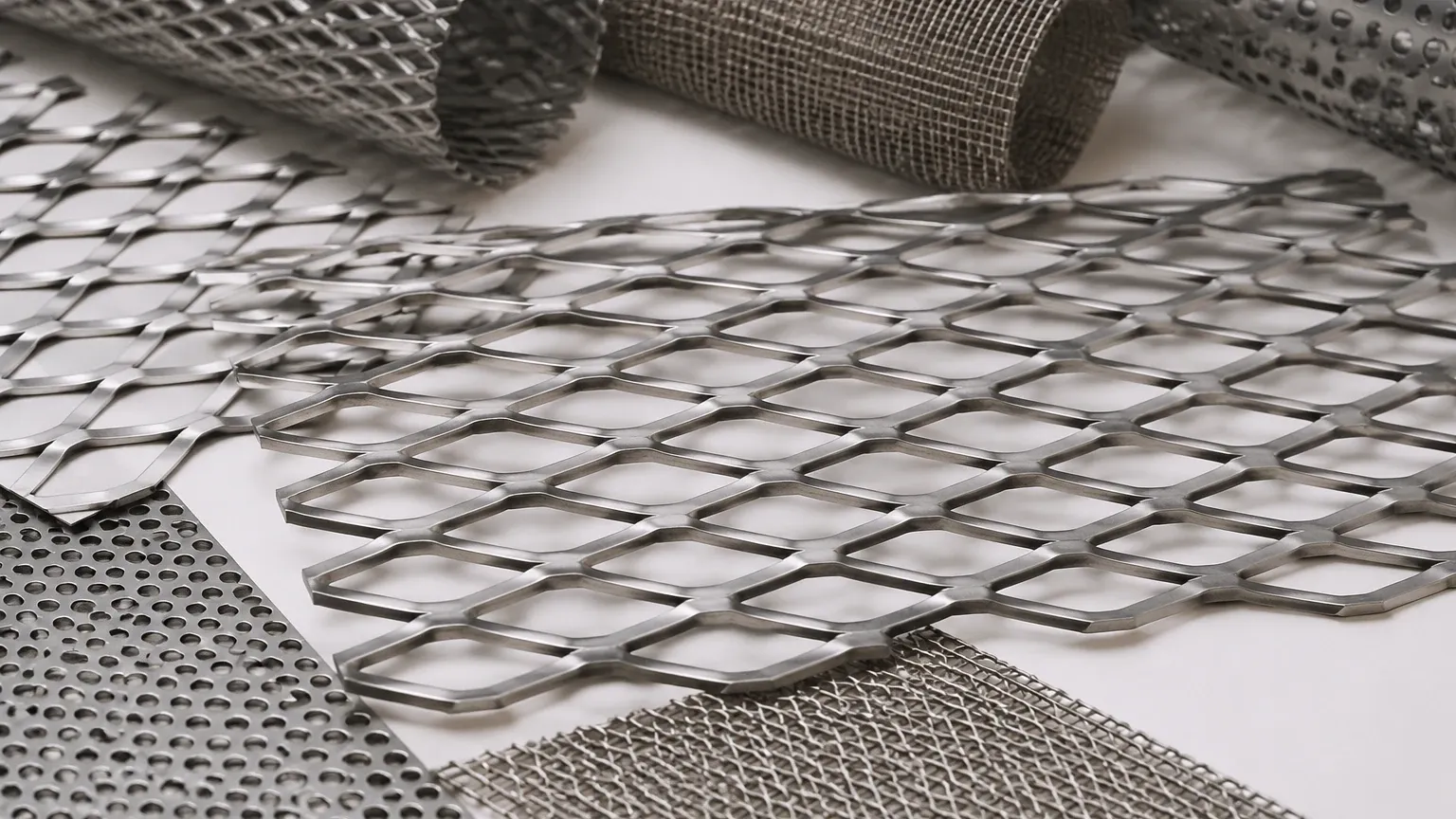
The production of expanded metal mesh is a cold-forming process. A metal sheet or coil is fed through an expanding machine equipped with a specialized knife set. As the knife slits the metal, it simultaneously stretches it into a diamond-shaped pattern. Because the strands and bonds are formed from a single piece of material, there are no welds or joints to fail under mechanical stress.
This continuous structure offers several mechanical advantages:
1. Uninterrupted Conductivity: The lack of breaks in the material ensures excellent electrical and thermal conductivity, which is essential in certain chemical and electronic applications.
2. Structural Rigidity: The diamond-shaped trusses act as a structural framework, distributing loads more evenly than woven wire mesh.
3. Material Efficiency: Since no material is lost during the expansion process, it is often a more cost-effective alternative to perforated metal for applications requiring high open areas.
Engineers must distinguish between "raised" and "flattened" expanded metal. In its standard (raised) form, the strands are set at an angle to the plane of the sheet, creating a three-dimensional surface that can enhance turbulence or provide mechanical grip. Flattened expanded metal is created by passing the raised sheet through a cold-roll reducing mill. This process flattens the strands and bonds into a single plane, resulting in a smooth, flush surface that is ideal when the mesh serves as a support layer for delicate filter media, such as fine wire cloth or non-woven felts.
Key Technical Specifications for Engineers
When specifying expanded metal mesh for a filtration project, several geometric parameters must be defined to ensure the component meets performance expectations. Standard industry terminology includes:
* SWD (Short Way of Design): The distance from the center of one bond to the center of the next bond measured across the short diamond diagonal.
* LWD (Long Way of Design): The distance from the center of one bond to the center of the next bond measured across the long diamond diagonal.
* SWO (Short Way of Opening): The actual width of the opening measured from the inside of the bonds.
* LWO (Long Way of Opening): The actual length of the opening measured from the inside of the bonds.
* Strand Width: The amount of metal fed under the knives to create one strand.
* Strand Thickness: The gauge or thickness of the original base metal.
For filtration applications, the percentage of open area is the most critical metric. It determines the flow rate and the pressure drop across the filter. A higher open area allows for greater throughput but may compromise the structural support of the mesh. Engineers must balance these factors based on the viscosity of the fluid, the expected flow velocity, and the mechanical pressure exerted on the filter assembly.
Material Selection for Corrosive and High-Temperature Environments
The performance of expanded metal mesh is heavily dependent on the alloy from which it is fabricated. In industrial filtration, where exposure to corrosive chemicals, high temperatures, and high pressures is common, stainless steel is the primary material of choice.
Stainless Steel 304 and 304L
Grade 304 is the standard "18/8" stainless steel. It provides excellent corrosion resistance in most atmospheric conditions and is widely used in food and beverage processing. However, for applications involving welding—such as forming expanded metal into cylindrical filter cartridges—304L (low carbon) is often preferred to prevent carbide precipitation and ensure the integrity of the heat-affected zone.
Stainless Steel 316 and 316L
For more aggressive environments, such as marine applications or chemical processing involving chlorides, Grade 316 is required. The addition of molybdenum enhances its resistance to pitting and crevice corrosion. Like the 304 series, the 316L variant is utilized for welded components to maintain corrosion resistance across the entire structure.
Specialty Alloys and Carbon Steel
In less demanding applications, such as air filtration or simple debris straining, galvanized carbon steel or aluminum may be used to reduce costs. However, in hydraulic systems or pharmaceutical processing, where purity and durability are paramount, stainless steel remains the authoritative standard. At Kaifil, we assist engineering teams in selecting the appropriate alloy based on the specific pH levels, temperature ranges, and chemical compositions of their process fluids.
Role of Expanded Metal Mesh in Filtration Systems
Expanded metal mesh rarely acts as the primary filtration surface for fine particulate; instead, it serves critical roles as a support or protective component within a multi-layer filter element.
Support for Primary Media
Fine wire mesh or synthetic fiber media lack the rigidity to withstand high differential pressures. Expanded metal mesh provides a robust skeleton. By placing a layer of flattened expanded metal behind a fine filter cloth, the medium is prevented from pleat-collapsing or bursting under the force of the fluid flow. The diamond pattern of the expanded metal ensures that the maximum surface area of the primary media remains exposed to the flow.
Protective Cages and Cores
In cylindrical filter cartridges, expanded metal is often used as the outer cage or the inner core. As an outer cage, it protects the delicate filter media from mechanical damage during installation or handling. As an inner core, it prevents the media from collapsing inward under external pressure. The high open area of expanded metal ensures that these structural components do not significantly contribute to the overall pressure drop of the system.
Pre-Filtration and Coarse Straining
In systems where large debris must be removed before the fluid reaches fine filtration stages, expanded metal mesh can serve as a standalone pre-filter. Its rugged construction allows it to capture large contaminants without deforming, and its smooth surface (when flattened) makes it easier to clean via backwashing or mechanical scraping.
Customization and OEM Capabilities
Industrial applications often require non-standard dimensions or unique configurations that off-the-shelf products cannot satisfy. Customization is a core component of Kaifil’s service model. For engineers, this means the ability to specify not just the material and mesh size, but also the final form factor.
Customization options include:
* Precision Cutting: Shearing the mesh to exact tolerances for integration into existing housings.
* Cylindrical Forming: Rolling and welding expanded metal into precise diameters for use as filter cores.
* Surface Finishes: Electropolishing or passivating stainless steel mesh to meet the stringent hygiene standards of the pharmaceutical and food industries.
* Layer Integration: Sintering or mechanically bonding expanded metal with multiple layers of wire mesh to create a composite filter element with specific micron ratings and high mechanical strength.
By working with an OEM manufacturer, purchasing teams can ensure that the expanded metal components arrive ready for assembly, reducing on-site fabrication time and ensuring consistency across large production runs.
Selection Criteria: A Checklist for Engineers
Before finalizing a specification for expanded metal mesh, technical professionals should confirm the following parameters to avoid common pitfalls in filtration performance:
1. Chemical Compatibility: Does the selected alloy (e.g., SS316L) withstand the specific chemicals and concentrations present in the process?
2. Pressure Requirements: What is the maximum differential pressure the mesh must support? This will dictate the required strand thickness and bond width.
3. Flow Characteristics: What is the target flow rate? Use the open area percentage to calculate the potential impact on system pressure.
4. Surface Finish: Does the application require a flattened surface to prevent abrasion of adjacent layers, or is a raised surface acceptable for increased turbulence?
5. Dimensional Tolerances: Are the SWD and LWD dimensions consistent enough for the intended housing? In precision filtration, even minor variations can lead to bypass or fitment issues.
6. Cleaning Protocols: Will the filter be cleaned via ultrasonic baths, chemical CIP (Clean-In-Place), or manual pressure washing? The material must be durable enough to withstand these cycles without losing structural integrity.
Conclusion
Expanded metal mesh is a fundamental component in the design of durable and efficient industrial filtration systems. Its unique combination of material efficiency, structural rigidity, and high open area makes it an ideal choice for support structures, protective cages, and coarse strainers. By selecting the correct material grade and geometric specifications, engineers can significantly improve the performance and service life of their filtration equipment.
Kaifil remains committed to supporting global industries with high-quality, customized metal filtration solutions. Whether you are designing a new hydraulic system or optimizing a chemical processing line, our technical expertise in expanded metal and perforated solutions ensures that your filtration requirements are met with precision and reliability. For detailed product specifications and engineering support, explore our range of Perforated & Expanded Metal options to find the ideal fit for your application.
