


Expanded Metal Square
In the landscape of industrial filtration and structural engineering, the selection of media support and primary filtration components requires a deep understanding of material geometry and mechanical properties. While diamond-shaped openings are the most common configuration in expanded metal manufacturing, the expanded metal square pattern offers specific functional advantages in applications where uniform load distribution, aesthetic consistency, and specific flow characteristics are required.
For engineers and procurement specialists, choosing the right Perforated & Expanded Metal involves more than just selecting a material; it requires an analysis of how the mesh geometry interacts with fluid dynamics and structural stresses. This guide examines the technical fundamentals of expanded metal square configurations, their role in industrial filtration, and the critical evaluation criteria for high-performance applications.
Understanding Expanded Metal Square Geometry
Expanded metal is produced through a process of simultaneously slitting and stretching a solid metal sheet. Unlike perforated metal, which involves punching out material and creating waste, expanded metal is manufactured without any loss of material, making it a highly cost-effective and environmentally efficient solution.
The Manufacturing Process
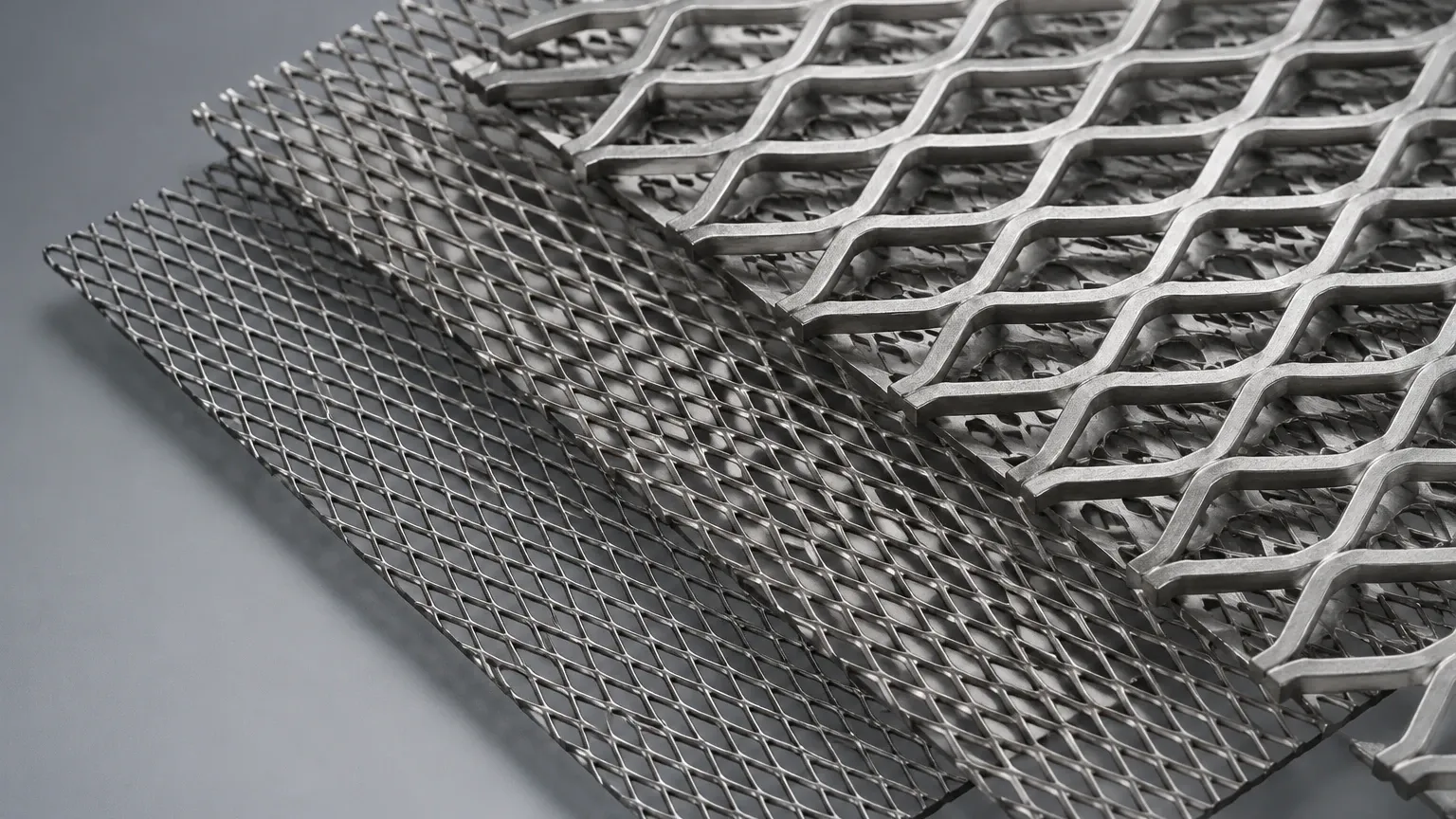
To create an expanded metal square pattern, the precision machinery uses specialized knives that slit the metal in a specific sequence while the sheet is pulled. The result is a series of interconnected strands and bonds. While the standard "diamond" shape is the natural result of this stretching process, the "square" designation refers to a geometry where the length and width of the openings are nearly equal, or where the visual profile mimics a square grid.
Standard vs. Flattened Expanded Metal
When specifying an expanded metal square for industrial use, engineers must decide between two primary finishes:
1. Standard (Raised) Expanded Metal: The strands are set at a sharp angle to the plane of the sheet. This creates a three-dimensional surface that provides excellent grip and can influence fluid turbulence. In filtration, the raised strands can act as a pre-filter by trapping larger particles before they reach the finer mesh layers.
2. Flattened Expanded Metal: After the expansion process, the sheet is passed through a cold-roll reducing mill. This flattens the strands and bonds into a single plane. Flattened expanded metal square is often preferred for filter support cores because it provides a smooth surface that will not puncture or abrade delicate filter media, such as fine wire mesh or synthetic membranes.
Material Selection and Engineering Properties
Kaifil specializes in stainless steel filtration solutions, and for expanded metal square components, material selection is the primary determinant of service life. The choice of alloy must align with the chemical environment, temperature fluctuations, and mechanical loads of the application.
Stainless Steel 304 and 316L
* Type 304: The most common grade, offering excellent formability and good corrosion resistance for general industrial applications. It is widely used in food and beverage filtration where sanitization is frequent but chemical exposure is moderate.
* Type 316L: Containing molybdenum, this grade offers superior resistance to chlorides and pitting. It is the standard for marine environments, pharmaceutical processing, and aggressive chemical filtration. The "L" (low carbon) designation is critical if the expanded metal square will be welded, as it prevents carbide precipitation that can lead to intergranular corrosion.
Mechanical Strength and Durability
The interconnected nature of expanded metal gives it a higher strength-to-weight ratio than solid sheet metal. Because the strands are not woven or welded but are part of a single piece of metal, the structure cannot unravel. This integrity is vital in high-pressure hydraulic systems where the filter core must withstand significant differential pressure without deforming.
Key Technical Specifications for Engineers
When requesting a quote or designing a component using expanded metal square, several technical parameters must be defined to ensure the product meets performance expectations.
LWD and SWD
* LWD (Long Way of Design): The distance from a point on one bond to a corresponding point on the next bond across the long axis of the opening.
* SWD (Short Way of Design): The distance across the short axis. In a true "square" configuration, these dimensions are engineered to be as close as possible, providing a balanced open area.
Strand Width and Thickness
The strand width refers to the amount of metal between the openings, while the thickness refers to the gauge of the original sheet. These two factors combined determine the overall weight and the structural rigidity of the mesh. Increasing the strand width will decrease the open area but increase the burst strength of the filter component.
Percentage of Open Area
For filtration applications, the open area is perhaps the most critical calculation. It dictates the flow rate and the pressure drop across the filter. An expanded metal square typically offers a high percentage of open area (often between 60% and 80%), which minimizes resistance to fluid flow while providing the necessary mechanical support for the primary filter media.
The Role of Expanded Metal Square in Filtration Systems
In industrial filtration, expanded metal is rarely used as the sole filtration medium for fine particles. Instead, it serves several specialized roles that enhance the overall efficiency of the system.
Support Cores and Cages
In stainless steel filter cartridges, the expanded metal square is often rolled into a cylinder to form the inner support core or the outer protective cage. The square pattern provides a rigid framework that prevents the pleats of a wire mesh filter from collapsing under the force of the fluid stream. Because the square pattern distributes stress evenly in both horizontal and vertical directions, it is particularly effective in pulsating flow environments.
Pre-Filtration and Debris Guards
In large-scale water treatment or chemical processing, expanded metal square panels act as debris guards. They protect sensitive downstream equipment—such as pumps and fine membrane filters—from large contaminants, sticks, or stones. The square geometry is often preferred here because it is less likely to "blind" (clog) than a diamond pattern when dealing with certain types of fibrous debris.
Flow Diffusers
In some reactor designs, expanded metal is used to diffuse the flow of gas or liquid across a catalyst bed. The angled strands of standard expanded metal can be oriented to break up laminar flow and promote mixing, ensuring that the fluid interacts uniformly with the treatment media.
Performance Evaluation and Quality Standards
To ensure the reliability of filtration components, engineers should evaluate expanded metal square based on several quality benchmarks.
Flatness and Camber
For automated assembly processes, the flatness of the expanded metal sheet is critical. "Camber" refers to the bow in a sheet; excessive camber can make it difficult to roll the metal into precise cylinders for filter cartridges. High-quality manufacturing ensures that sheets are leveled and squared to tight tolerances.
Edge Conditions and Burrs
In the expansion process, the edges of the strands can be sharp. For filtration applications, especially those involving human contact or delicate membranes, the metal must be deburred. Furthermore, engineers must specify whether they require "random sheared" edges (where the mesh is cut mid-pattern) or "bond sheared" edges (where the cut follows the solid bonds), as this affects the structural integrity of the final weld.
Material Certification
In the pharmaceutical and food industries, traceability is non-negotiable. Suppliers should provide Mill Test Reports (MTRs) confirming the chemical composition of the stainless steel to ensure it meets AISI or ASTM standards. This prevents the risk of premature failure due to sub-standard alloy composition.
Common Risks and Procurement Considerations
While expanded metal square is a robust material, certain risks can arise if the specification is not aligned with the application environment.
1. Stress Corrosion Cracking: In high-chloride environments, the "bonds" of the expanded metal can become sites for stress concentration. Selecting 316L or higher alloys is essential to mitigate this risk.
2. Vibration Fatigue: In systems with high-frequency pulsations, the strands of the mesh can undergo fatigue. Ensuring the strand width is sufficient for the mechanical load is a key design step.
3. Inconsistent Openings: Lower-quality expansion processes can result in variations in the SWD and LWD across a single sheet. This leads to uneven flow distribution and potential bypass in filtration systems.
What to Confirm Before Purchasing
Before moving forward with a custom order, purchasing teams should confirm the following with their manufacturer:
* Exact Dimensions: Specify SWD, LWD, strand width, and thickness.
* Finish Requirements: Determine if the material should be standard, flattened, pickled, or electropolished.
* Forming Needs: If the expanded metal needs to be rolled or welded into a specific shape, confirm the manufacturer’s ability to maintain tolerances during secondary processing.
* Compliance: Ensure the material meets industry-specific certifications (e.g., FDA compliance for food contact).
Conclusion
The expanded metal square is a fundamental component in modern industrial filtration, providing the essential balance between structural strength and high flow capacity. By understanding the nuances of its geometry, material properties, and manufacturing tolerances, engineers can design filtration systems that are not only efficient but also durable enough to withstand the rigors of demanding chemical and industrial environments. Whether used as a support core for a stainless steel filter cartridge or as a robust debris guard, the expanded metal square remains a versatile and cost-effective choice for precision engineering.
For those seeking specialized configurations or integrated filtration components, reviewing Perforated & Expanded Metal options with a manufacturer that understands the technical demands of filtration is the most effective way to ensure long-term performance and lower total cost of ownership.
