


Expanded Perforated Metal
In industrial filtration and structural engineering, the selection of supporting media is as critical as the selection of the primary filter membrane. Engineers and procurement specialists often evaluate Perforated & Expanded Metal solutions to provide the necessary mechanical strength, flow characteristics, and durability required for demanding environments. While these two types of metal processing are distinct in their manufacturing and physical properties, they are frequently grouped together when designing filter cartridges, strainers, and protective screens.
Understanding the technical nuances between perforated and expanded metal is essential for optimizing filtration performance. This guide examines the engineering considerations, material selection, and application-specific advantages of using Perforated & Expanded Metal in industrial systems, providing the factual basis needed for informed decision-making.
The Role of Perforated and Expanded Metals in Industrial Filtration
Industrial filtration systems, particularly those used in chemical processing, hydraulic systems, and water treatment, operate under significant pressure differentials. The primary filter media—often fine stainless steel wire mesh or fiber felt—lacks the inherent rigidity to withstand these forces without deforming. This is where expanded perforated metal components serve as the backbone of the filter assembly.
These materials typically function in three capacities:
1. Internal Support Cores: Providing a rigid structure around which filter media is wrapped, preventing collapse under inward pressure (differential pressure).
2. Outer Protective Cages: Shielding delicate filter layers from mechanical damage during installation, cleaning, or high-velocity fluid impact.
3. Primary Filtration: In applications involving coarse particles or high-viscosity fluids, the perforated or expanded sheet itself may serve as the primary strainer.
By selecting the correct metal structure, engineers can balance the need for structural integrity with the requirement for a high open area to minimize pressure drop across the system.
Technical Comparison: Manufacturing Processes and Structural Differences
To choose between expanded and perforated options, one must understand how each is produced, as the manufacturing method dictates the mechanical behavior of the final product.
Perforated Metal Manufacturing
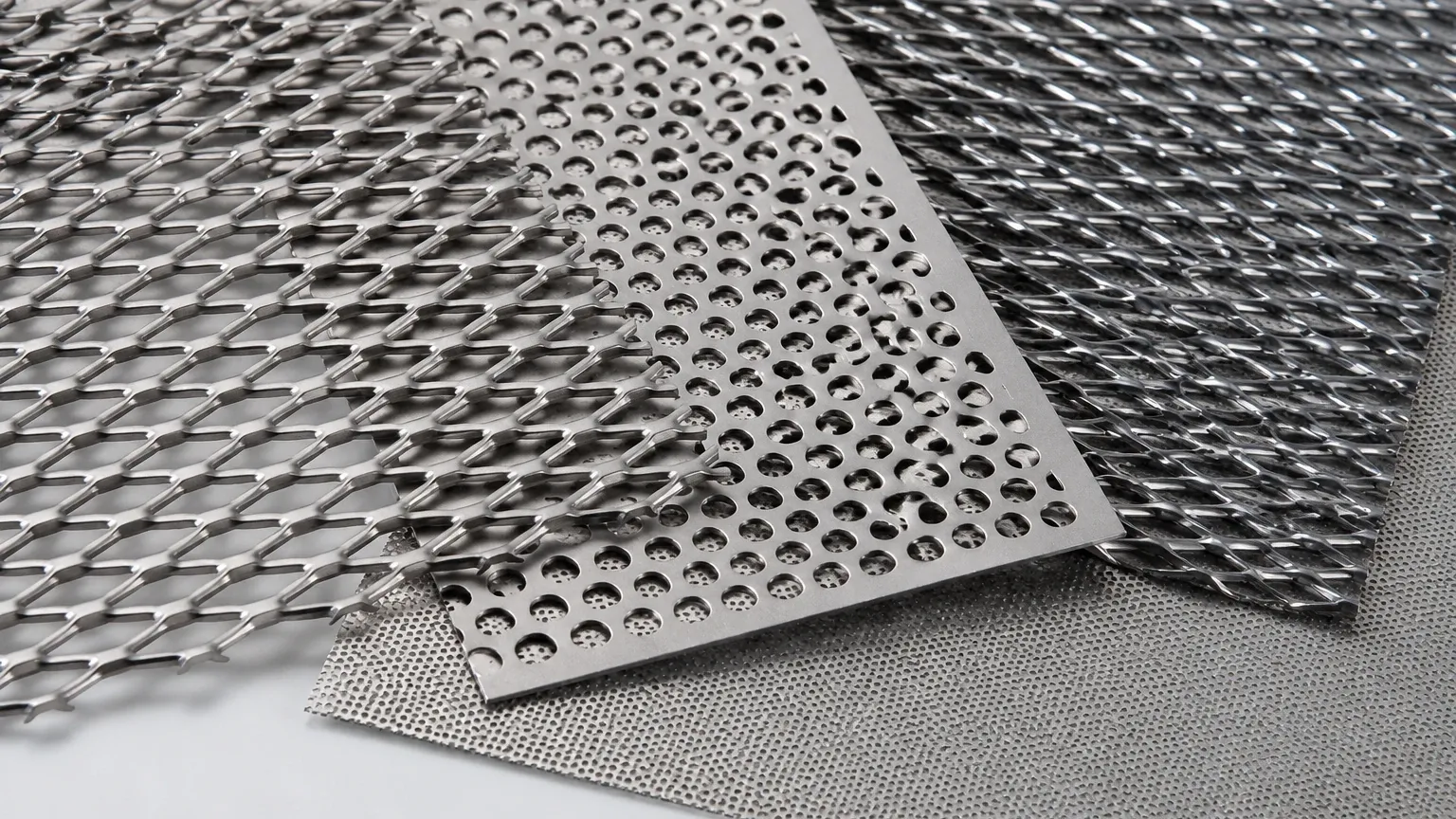
Perforated metal is produced by punching a series of holes into a solid metal sheet or coil. This process uses high-speed CNC presses or rotary pin perforators. The material removed from the holes (the "slug") is typically recycled.
* Precision: Perforation allows for extremely high precision in hole size and placement. Engineers can specify exact hole diameters, shapes (round, square, slotted, or hexagonal), and patterns (staggered or straight).
* Flatness: Because the sheet remains a single piece of metal with holes removed, it generally maintains better flatness and dimensional stability than expanded metal.
* Margins: Perforated sheets can be manufactured with "blank margins" (unperforated edges), which simplifies the welding and assembly process when forming filter cylinders.
Expanded Metal Manufacturing
Expanded metal is created by simultaneously slitting and stretching a metal sheet. This process does not remove any material, making it a highly cost-effective and zero-waste alternative. The result is a mesh-like structure with diamond-shaped openings.
* Structural Integrity: The "bonds" (the points where the strands intersect) are not welded but are part of the original solid metal. This provides excellent strength-to-weight ratios.
* Raised vs. Flattened: Standard expanded metal has a 3D, angular surface (raised). For filtration applications, it is often "flattened" through a cold-rolling process to create a smooth, two-dimensional surface that is easier to clean and less likely to damage adjacent filter layers.
* Directional Strength: Expanded metal has different mechanical properties along the "Short Way of Design" (SWD) versus the "Long Way of Design" (LWD), which must be accounted for in cylindrical filter designs.
Material Selection for Demanding Industrial Environments
In B2B industrial contexts, the environmental conditions—temperature, chemical exposure, and mechanical stress—dictate material choice. Kaifil specializes in stainless steel solutions because of their superior performance in these areas.
Stainless Steel 304/304L
This is the standard grade for most industrial applications. It offers good corrosion resistance and is suitable for food and beverage processing, hydraulic oil filtration, and general water treatment. The "L" (low carbon) version is preferred when extensive welding is required to prevent carbide precipitation.
Stainless Steel 316/316L
For more aggressive environments, such as pharmaceutical manufacturing or chemical processing involving chlorides and acids, SS 316L is the industry standard. The addition of molybdenum enhances resistance to pitting and crevice corrosion. It is the primary choice for expanded perforated metal components used in marine environments or high-temperature steam filtration.
Specialty Alloys
In extreme cases, such as highly acidic chemical baths or high-temperature aerospace applications, materials like Monel, Inconel, or Duplex stainless steel may be specified. These materials ensure that the filter support does not become a point of failure due to chemical degradation.
Critical Performance Metrics: Open Area and Flow Dynamics
One of the most frequent questions engineers ask is how to calculate the impact of the support metal on the overall flow rate. The "Open Area" percentage is the most critical metric here.
Calculating Open Area in Perforated Metal
For a standard 60-degree staggered round hole pattern, the formula is:
`Open Area % = (D² * 90.69) / P²`
Where `D` is the hole diameter and `P` is the center-to-center pitch.
A higher open area reduces the pressure drop (∆P) but decreases the structural strength of the sheet. Most industrial filter cores aim for an open area between 40% and 60%.
Flow Characteristics of Expanded Metal
Expanded metal provides a unique flow profile. Because the strands are set at an angle (in the raised version), they can actually help direct fluid flow or create turbulence that may be beneficial in certain mixing or heat-exchange applications. However, for standard filtration, flattened expanded metal is preferred to ensure a predictable flow path and a uniform surface for the filter media to rest against.
Integration into Filter Cartridges and Precision Components
When designing a custom filtration solution, the expanded perforated metal is rarely a standalone component. It is integrated into a multi-layer assembly.
Support Tubes and Cores
In a typical pleated filter cartridge, a perforated stainless steel tube serves as the inner core. The precision of the perforation ensures that there are no sharp edges or burrs that could puncture the pleated media under high-pressure pulses. The thickness of the metal (gauge) is selected based on the expected collapse pressure of the system.
Outer Protective Cages
For filters used in heavy-duty industrial machinery, an outer cage made of expanded metal is often used. The diamond pattern provides high visibility for inspecting the filter media while offering robust protection against large debris or impact during handling. Expanded metal is often lighter than perforated metal of the same strength, which can be an advantage in large-scale installations.
Custom End Caps and Fittings
To ensure a leak-proof seal, the perforated or expanded cylinders must be welded to precision-machined end caps. The quality of the weld between the mesh/perforated sheet and the end cap is a critical failure point. OEM manufacturers like Kaifil use advanced welding techniques (such as TIG or plasma welding) to ensure a seamless bond that maintains the integrity of the filtration circuit.
Procurement Checklist: Confirming Specifications Before Production
To ensure the successful delivery of custom filtration components, purchasing teams and engineers should confirm several technical parameters before finalizing an order for Perforated & Expanded Metal products.
1. Hole/Opening Size: For perforated metal, specify the diameter and pitch. For expanded metal, specify the SWD and LWD dimensions.
2. Material Grade: Confirm if SS304, SS316L, or a specialty alloy is required based on the chemical compatibility of the fluid.
3. Thickness (Gauge): Ensure the thickness is sufficient to handle the maximum expected differential pressure without deformation.
4. Surface Finish: Specify if the part requires pickling, passivation, electropolishing, or simply a burr-free finish. In pharmaceutical and food applications, electropolishing is often mandatory to prevent bacterial growth.
5. Tolerances: Define the allowable variance in diameter, length, and roundness. For automated assembly lines, tight tolerances are essential to prevent machine downtime.
6. Edge Requirements: For perforated sheets, specify the width of the required margins. For expanded metal, indicate if the edges should be sheared or left with "random" openings.
Conclusion
The choice between perforated and expanded metal is not merely a matter of cost, but a strategic engineering decision that impacts the efficiency and lifespan of industrial filtration systems. Perforated metal offers unparalleled precision and ease of assembly, while expanded metal provides a cost-effective, high-strength alternative with unique structural properties.
By focusing on material quality, precise open area calculations, and robust manufacturing standards, Kaifil provides the technical expertise necessary to develop high-performance filtration components. Whether the application involves high-pressure hydraulic systems or sensitive pharmaceutical processing, selecting the right Perforated & Expanded Metal configuration is the foundation of reliable filtration performance. Engineers are encouraged to consult with manufacturing specialists early in the design phase to ensure that the selected materials and patterns align with the total cost of ownership and operational goals of the project.
