


How Do You Cut Expanded Metal
Expanded metal is a critical component in industrial filtration, architectural screening, and structural reinforcement. Unlike perforated metal, which is created by punching holes and removing material, expanded metal is manufactured by simultaneously slitting and stretching a solid sheet. This process creates a diamond-shaped pattern with interconnected strands and bonds.
For engineers and procurement professionals sourcing Perforated & Expanded Metal, understanding the technical nuances of how to process these materials is essential for maintaining structural integrity and filtration precision. When asking "how do you cut expanded metal," the answer depends heavily on the material gauge, the desired edge finish, and the specific application requirements, such as those found in high-pressure hydraulic filters or chemical processing strainers.
Understanding the Material Geometry
Before selecting a cutting method, it is vital to understand the unique geometry of expanded metal. The material consists of "strands" (the metal strips) and "bonds" (where the strands intersect).
There are two primary forms of expanded metal:
1. Standard (Raised) Expanded Metal: The strands and bonds are set at a uniform angle to the plane of the sheet, providing strength and rigidity but resulting in a textured, three-dimensional surface.
2. Flattened Expanded Metal: The raised sheet is passed through a cold-rolling reducing mill, which flattens the strands and bonds into a single plane. This reduces the thickness and creates a smooth surface.
The cutting approach varies between these two types. Raised expanded metal is more prone to catching on blades and requiring more clearance, while flattened expanded metal behaves more like a traditional solid sheet but retains the internal stresses of the expansion process.
Manual Cutting Methods for Small-Scale Applications
For prototyping, small-scale filtration components, or on-site adjustments, manual tools are often the most accessible option. However, they require significant physical effort and can lead to material deformation if not used correctly.
Tin Snips and Aviation Snips
For light-gauge expanded metal (typically thinner than 18 gauge), aviation snips are an effective tool. When using snips, it is best to cut along the strands rather than through the bonds. Cutting through the bonds requires significantly more force and can dull the blades quickly.
Hacksaws
A hacksaw with a high-tooth-count blade (24 to 32 TPI) is suitable for medium-gauge materials. The key to using a hacksaw effectively on expanded metal is to maintain a shallow angle and ensure the workpiece is clamped securely between two pieces of sacrificial wood or metal. This prevents the mesh from vibrating or "chattering," which can lead to uneven cuts and broken saw teeth.
Power Tool Solutions for Industrial Efficiency
When volume increases or material thickness exceeds the capacity of manual tools, power tools provide a balance of speed and precision. These methods are common in workshops producing custom filter cartridges and industrial guards.
Angle Grinders
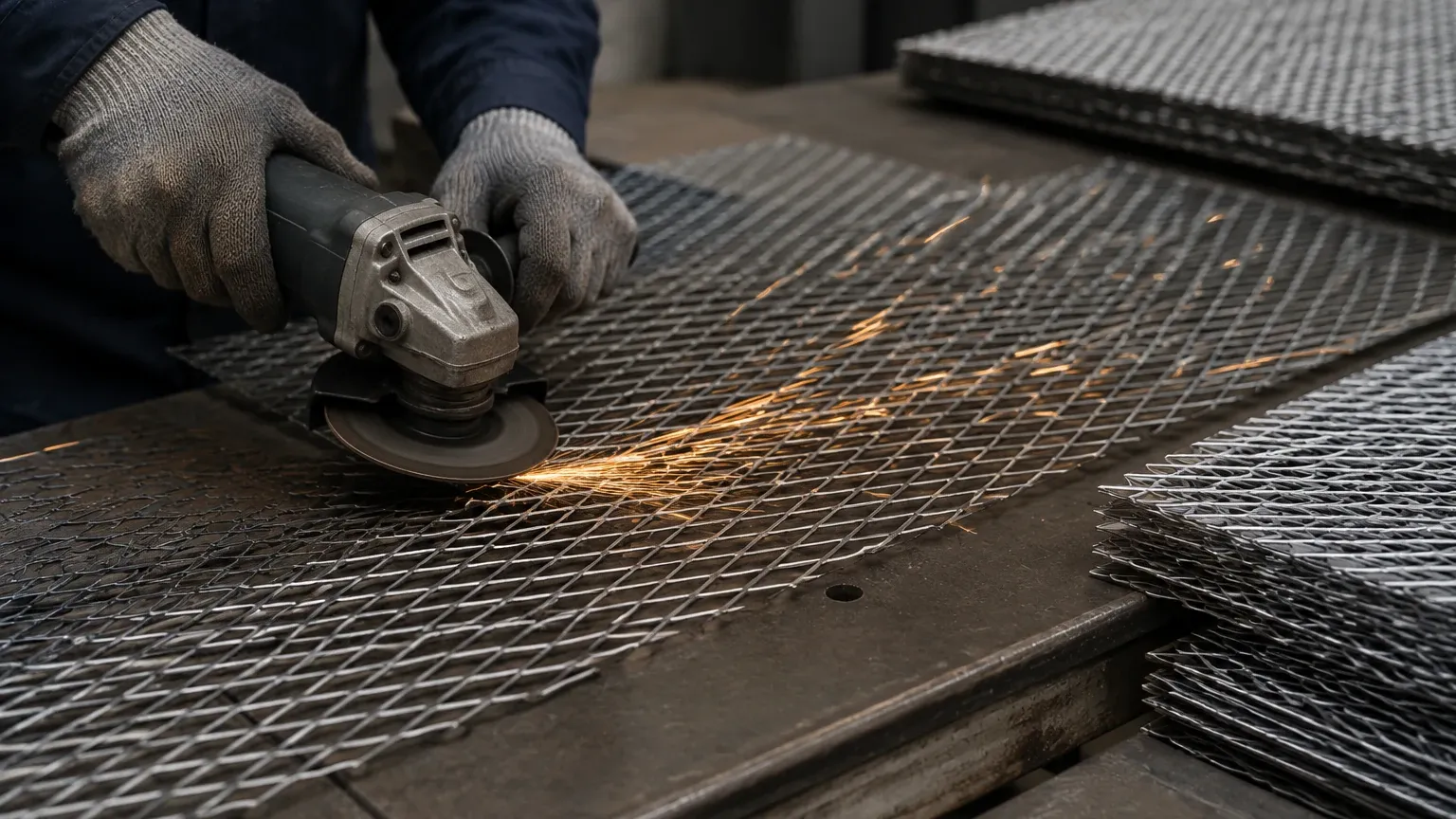
An angle grinder equipped with a thin (1mm or 1.6mm) abrasive cutoff wheel is perhaps the most common way to cut expanded metal in a B2B industrial setting.
* Technique: The operator should move the grinder steadily along the marked line, allowing the speed of the wheel to do the work rather than applying excessive pressure.
* Pros: Highly portable and capable of cutting through heavy-duty stainless steel expanded metal.
* Cons: Produces significant sparks and leaves a burred edge that requires post-processing.
Circular Saws with Metal-Cutting Blades
For long, straight cuts in large sheets of Perforated & Expanded Metal, a circular saw fitted with a carbide-tipped metal-cutting blade is highly efficient. Unlike abrasive wheels, these blades produce "cold cuts" with minimal heat-affected zones (HAZ). This is particularly important for stainless steel filtration components where excessive heat can compromise the material’s corrosion resistance.
Industrial Machinery and High-Precision Cutting
In a professional manufacturing environment like Kaifil’s, high-precision machinery is used to ensure that filtration components meet exact tolerances. These methods are preferred for OEM production where consistency is paramount.
Shearing (Guillotine Shears)
Industrial shears are the fastest way to cut expanded metal into rectangular or square blanks. However, shearing expanded metal presents a unique challenge: the "edge condition."
* Random Shearing: The cut falls wherever the blade lands, often leaving sharp, partial diamonds (points) along the edge.
* Bond Shearing: The cut is aligned specifically with the bonds of the diamonds. This results in a cleaner, safer edge but requires precise alignment and may result in non-standard overall dimensions.
Plasma and Laser Cutting
For complex shapes or precision filter discs, CNC plasma or laser cutting is required.
* Laser Cutting: Offers the highest precision and a very narrow kerf. It is ideal for thin to medium-gauge stainless steel expanded metal used in pharmaceutical or food-grade filtration.
* Plasma Cutting: Better suited for thicker, heavy-duty expanded metal. While faster on thick sections, it produces a larger heat-affected zone than laser cutting.
Waterjet Cutting
Waterjet cutting is the gold standard for expanded metal when material properties must remain completely unchanged. Since there is no heat involved, there is no risk of hardening the edges or altering the chemical composition of specialized alloys. This is often the preferred method for high-performance aerospace or chemical processing filters.
Step-by-Step Guide: How Do You Cut Expanded Metal Safely
To achieve a professional result, follow these engineering steps:
1. Measurement and Layout: Mark your cut lines using a high-visibility marker or layout dye. Because expanded metal is mostly open space, it is often helpful to lay the sheet over a solid template or use a chalk line that spans the gaps.
2. Securing the Material: Expanded metal is inherently flexible. To prevent the material from shifting or vibrating—which causes jagged edges and tool wear—clamp it firmly to a stable work surface. Use "sandwich" clamping (placing the mesh between two boards) for the cleanest results.
3. Selecting the Direction: Whenever possible, cut parallel to the long way of the design (LWD) or the short way of the design (SWD). Cutting diagonally across the diamonds is more difficult and results in more waste material.
4. Executing the Cut: Maintain a consistent speed. If using power tools, ensure the tool reaches full RPM before engaging the metal.
5. Edge Finishing (Deburring): All cut expanded metal will have sharp edges. Use a flap disc on an angle grinder, a bench grinder, or a specialized deburring tool to smooth the perimeter. For filtration applications, this step is critical to prevent metal fragments (shrapnel) from entering the fluid stream.
Engineering Considerations for Filter Design
When specifying Perforated & Expanded Metal for filtration solutions, engineers must consider how the cutting process impacts the final product’s performance.
Kerf Loss and Tolerances
The "kerf" is the width of the material removed by the cutting tool. While negligible with a laser, it can be significant with an abrasive saw. In precision filtration, even a 2mm variance can lead to bypass issues in a filter housing. Always account for tool kerf during the design phase.
Structural Integrity
Cutting expanded metal breaks the continuous path of the material. If a filter cartridge is subject to high differential pressure, the cut edges must be properly supported or welded into a frame to prevent the mesh from "unravelling" or collapsing under load.
Material Selection
The difficulty of cutting is directly proportional to the material's hardness. Stainless steel (304 or 316L), commonly used by Kaifil for its corrosion resistance, work-hardens quickly. This means that slow-moving tools or dull blades will struggle and may even damage the material. High-speed, sharp cutting edges are mandatory for stainless steel expanded metal.
Safety Protocols in Metal Processing
Processing expanded metal is inherently hazardous due to the numerous sharp points created during the expansion and cutting processes.
* PPE: Heavy-duty, cut-resistant gloves (Level 4 or 5) are mandatory. Eye protection is required to guard against metal chips and sparks.
* Material Handling: Never slide expanded metal sheets across one another, as the jagged edges can lock together or cause deep scratches on finished surfaces.
* Spark Containment: When using grinders or plasma cutters, ensure the work area is clear of flammable materials, as the open mesh allows sparks to travel further than they would with solid sheet metal.
Conclusion
Determining how do you cut expanded metal is a matter of matching the tool to the precision required by the application. For simple industrial guards, an angle grinder may suffice. However, for high-performance filtration components where accuracy, edge quality, and material integrity are non-negotiable, industrial CNC methods like laser or waterjet cutting are the preferred choice.
As a specialist in custom stainless steel filtration, Kaifil provides expertly processed Perforated & Expanded Metal tailored to specific industrial needs. By understanding the technical requirements of cutting and finishing, engineers can ensure their filtration systems operate efficiently and reliably in the most demanding environments.
