


How to Cut Perforated Metal Sheet
Perforated metal is a versatile material used extensively in industrial filtration, architectural design, and acoustic insulation. In the context of industrial filtration, Perforated & Expanded Metal serves as a critical support structure for fine wire meshes or as a standalone filter medium for coarse particles. However, achieving a precise, clean edge when modifying these sheets is essential to maintain the structural integrity and filtration efficiency of the final component.
Understanding how to cut perforated metal sheet requires an analysis of the material’s gauge, the hole pattern (staggered or straight), and the specific alloy—most commonly stainless steel 304 or 316 in B2B environments. This guide provides a technical overview of the methods, tools, and engineering considerations necessary for professional-grade results.
Factors Influencing the Cutting Process
Before selecting a cutting method, engineers must evaluate the physical characteristics of the perforated sheet. Unlike solid metal plates, perforated sheets have a reduced cross-sectional area, which affects how the material reacts to mechanical stress and heat.
Material Thickness and Gauge
The thickness of the sheet is the primary determinant of the tool required. Thin-gauge sheets (typically 26 to 20 gauge) can often be handled with manual or handheld power tools. Heavier plates (11 gauge and thicker) used in heavy-duty hydraulic or water treatment filters require industrial machinery like shears or plasma cutters.
Hole Pattern and Open Area
The "open area" percentage—the ratio of holes to solid metal—impacts the sheet's rigidity. A high open-area percentage makes the sheet more prone to deformation during cutting. Additionally, the cutting path should ideally follow the "land" (the solid metal between holes) to prevent jagged edges and maintain a consistent margin, which is vital for welding or fitting the sheet into a filter housing.
Alloy Composition
Stainless steel is the industry standard for corrosive environments, such as chemical processing or food and beverage applications. Because stainless steel work-hardens quickly, cutting tools must be sharp and operated at the correct speeds to prevent overheating and premature tool wear.
Manual and Handheld Power Tool Methods
For small-scale prototyping, field adjustments, or low-volume production, handheld tools are often the most practical choice. However, each tool has specific implications for the edge quality of the Perforated & Expanded Metal.
1. Aviation Snips and Tin Snips
Snips are suitable only for very thin-gauge perforated sheets (usually 22 gauge or thinner). While they are portable and require no power, they often cause the metal to curl or distort along the cut line. For filtration components where flatness is critical, snips are generally discouraged unless the edge will be hidden within a frame or flange.
2. Electric or Pneumatic Nibblers
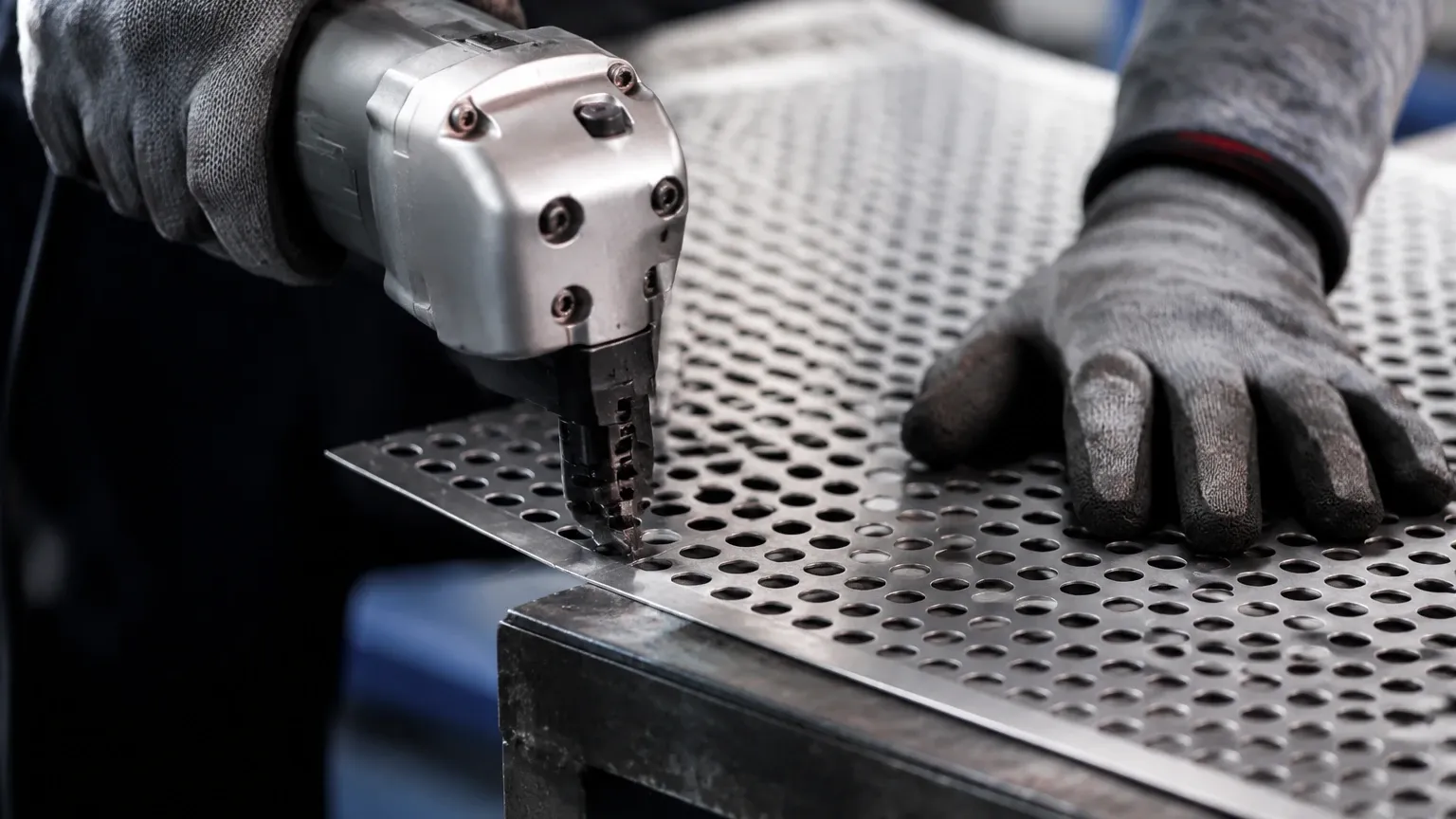
Nibblers are arguably the best handheld tool for cutting perforated metal. They work by rapidly punching out small bits of metal, allowing the tool to navigate through the holes without snagging.
* Advantages: They do not distort the material and can easily cut curves or complex shapes.
* Considerations: They create a "kerf" of small metal chips that must be carefully cleaned to avoid contamination in pharmaceutical or food-grade applications.
3. Angle Grinders with Thin Cut-Off Wheels
An angle grinder equipped with a 1mm or 1.6mm abrasive cut-off wheel is a common choice for thicker stainless steel sheets.
* Technical Tip: Use wheels specifically rated for stainless steel (Inox) to prevent carbon contamination, which can lead to localized corrosion (rusting) on the cut edge.
* Risk: Grinders generate significant heat, which can cause discoloration (heat-tint) and potentially affect the corrosion resistance of the alloy near the cut.
Industrial Cutting Technologies
When precision, repeatability, and high volume are required, industrial-grade machinery is necessary. These methods ensure that the perforated sheet maintains its dimensional tolerances for integration into complex filtration systems.
Shearing (Guillotine Shear)
Shearing is the most efficient method for making long, straight cuts. A heavy-duty blade descends on the sheet, providing a clean break.
* Engineering Note: When shearing perforated metal, there is a risk of "nibbling" the holes if the blade hits a row of perforations mid-diameter. To avoid this, operators should align the cut with the centers of the solid metal bars whenever possible.
Laser Cutting
Fiber laser cutting is the gold standard for custom filtration components. It offers unmatched precision and can handle complex geometries that would be impossible with mechanical tools.
* Precision: Laser cutting allows for extremely tight tolerances, which is essential when the perforated sheet must fit perfectly inside a filter cartridge.
* Edge Quality: The heat-affected zone (HAZ) is minimal, preserving the mechanical properties of the stainless steel.
Waterjet Cutting
Waterjet cutting uses a high-pressure stream of water mixed with abrasive garnet. It is a "cold" cutting process, meaning it introduces zero heat into the material.
* Applications: Ideal for very thick perforated plates or when the metallurgical properties of the stainless steel must remain completely unaltered. It is also the preferred method for cutting expanded metal where the 3D structure might be crushed by a laser or shear.
Step-by-Step Guide: How to Cut Perforated Metal Sheet Manually
If you are performing a manual cut in a workshop environment, follow these steps to ensure safety and accuracy.
Step 1: Layout and Marking
Measure your required dimensions and mark the cut line using a permanent marker or a scribe. When working with Perforated & Expanded Metal, try to align your cut line so it passes through the solid metal between the holes. This results in a stronger edge and reduces the risk of sharp, half-moon shapes remaining at the border.
Step 2: Securing the Workpiece
Clamp the sheet firmly to a stable work surface. Use sacrificial wood blocks or rubber pads under the clamps to avoid marring the surface of the stainless steel. If the sheet is very thin, sandwiching it between two pieces of plywood can prevent the metal from vibrating or bending during the cut.
Step 3: Executing the Cut
If using a power tool like a nibbler or circular saw with a metal-cutting blade, maintain a steady feed rate. Do not force the tool; let the blade or punch do the work. For stainless steel, keeping the cutting speed moderate helps manage heat buildup.
Step 4: Deburring and Finishing
Every cutting method (except perhaps high-end laser or waterjet) will leave a burr—a sharp ridge of metal—on the underside of the cut. For industrial filters, these burrs must be removed to prevent them from breaking off and entering the fluid stream. Use a deburring tool, a fine-grit flap disc, or a hand file to smooth the edges.
Engineering Considerations for Filtration Applications
When cutting perforated metal for use in industrial filtration, several technical factors must be prioritized over simple aesthetics.
1. Structural Integrity: If a perforated sheet is used as a support core for a pleated filter, the cut edge must be perfectly straight to ensure a uniform weld or epoxy bond. Any gaps caused by poor cutting can lead to "bypass," where unfiltered fluid escapes through the seam.
2. Compatibility: Ensure that the cutting fluid or abrasive used does not contain chlorine or sulfur if the filter is destined for the pharmaceutical or aerospace industries, as these can cause stress corrosion cracking in stainless steel.
3. The "Margin" Requirement: Many industrial designs require a "blank margin" (an unperforated border) around the edge of the sheet for welding. When cutting from a large master sheet, calculating the placement of these margins is critical to avoid cutting into the perforated pattern.
Why Professional Fabrication Matters
While knowing how to cut perforated metal sheet is useful for minor adjustments, sourcing pre-cut or custom-fabricated components from a specialist like Kaifil offers significant advantages. Professional manufacturing ensures:
* Burr-Free Edges: Advanced shearing and laser processes minimize the need for secondary finishing.
* Dimensional Accuracy: CNC-controlled cutting ensures every piece is identical, which is vital for high-volume OEM production.
* Material Optimization: Professional nesting software reduces waste, lowering the total cost of the Perforated & Expanded Metal components.
In demanding environments like chemical processing or hydraulic systems, the quality of the cut can be the difference between a filter that lasts for years and one that fails prematurely due to stress concentrations or poor fitment. By selecting the appropriate cutting technology and following rigorous post-processing standards, engineers can ensure their filtration solutions meet the highest performance expectations.
