


Images of Expanded Metal
In the specialized field of industrial filtration and structural engineering, visual documentation serves as a bridge between conceptual design and physical implementation. When procurement officers and engineers search for images of expanded metal, they are rarely looking for aesthetic inspiration; instead, they are seeking technical clarity on mesh geometry, material integrity, and manufacturing precision. Understanding how to interpret these visual data points is essential for selecting the correct Perforated & Expanded Metal for high-performance applications in chemical processing, hydraulic systems, and water treatment.
Expanded metal is a unique material produced through a process of simultaneous slitting and stretching. Unlike perforated metal, which involves punching holes and generating significant scrap material, expanded metal is formed from a single solid sheet. This results in a continuous, jointless structure that offers an exceptional strength-to-weight ratio. This article provides a comprehensive technical analysis of expanded metal, focusing on the dimensional variables, material choices, and quality indicators that professionals must verify during the specification process.
Technical Geometry: Decoding the Diamond Pattern
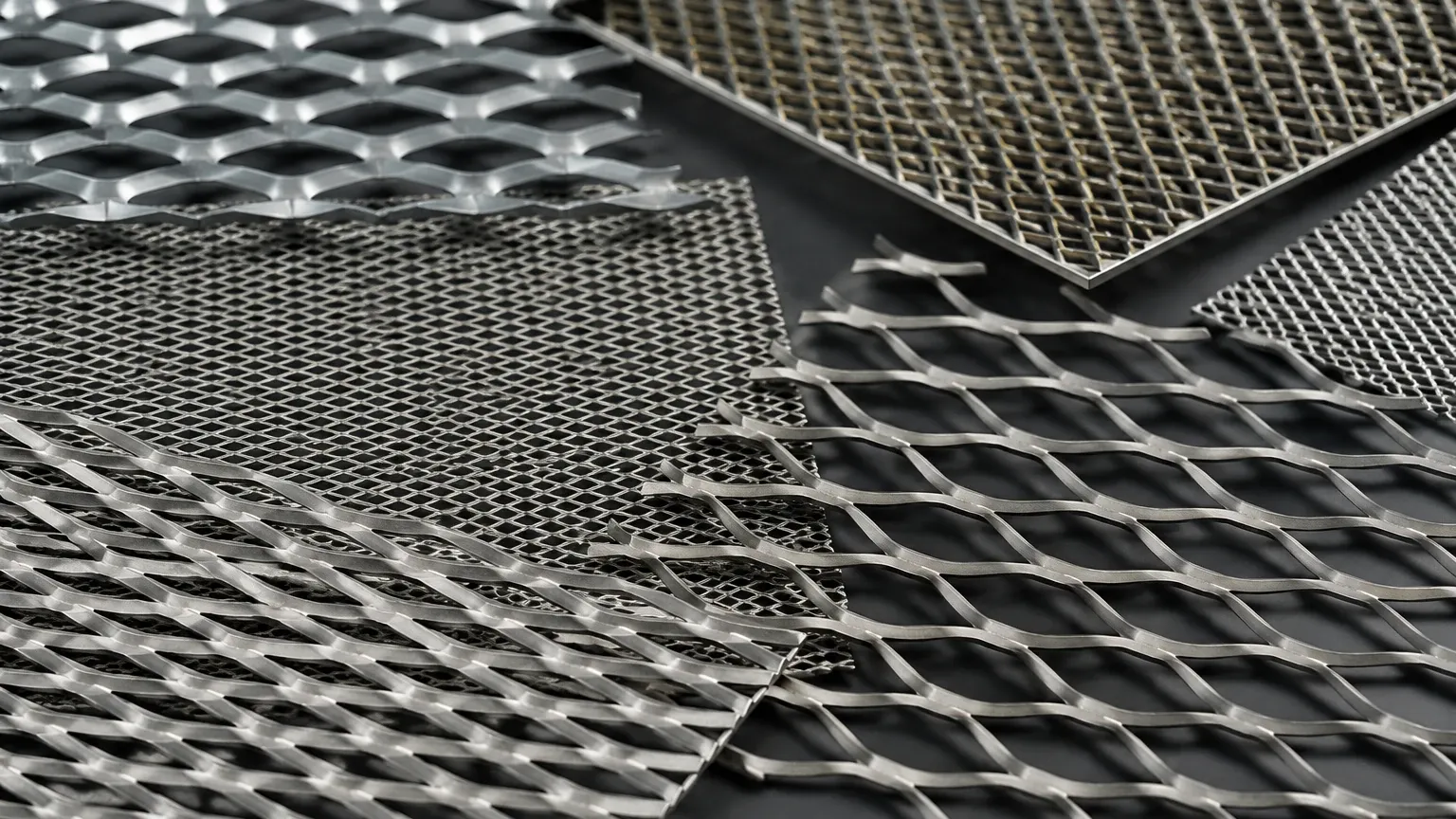
When reviewing technical images of expanded metal, the most prominent feature is the diamond-shaped opening. This geometry is not arbitrary; it is the result of precise engineering calculations that dictate the material's open area, flow rate, and structural rigidity. To properly evaluate these components, one must understand the four primary measurements that define the mesh.
SWD and LWD (Short and Long Way of Design)
The Short Way of Design (SWD) is the distance from a point on one bond to the corresponding point on the next bond, measured across the short diamond diagonal. Conversely, the Long Way of Design (LWD) measures across the long diagonal. These dimensions are critical for determining the filtration rating of the mesh. In images of expanded metal, the ratio between SWD and LWD indicates whether the mesh is "stretched" or "squat," which directly impacts the velocity of fluids passing through the filter.
Strand Width and Thickness
The strand width refers to the amount of metal between the diamond openings, while the strand thickness is the gauge of the original base material. In industrial filtration, a wider strand provides greater mechanical resistance against high-pressure surges, while a thinner strand maximizes the open area for higher flow rates. By examining high-resolution images, engineers can visually confirm the uniformity of these strands. Any variation in strand width across the sheet suggests an inconsistency in the manufacturing tension, which could lead to structural failure under operational stress.
Standard vs. Flattened: Visual and Functional Distinctions
One of the most critical decisions in the procurement process is choosing between standard (raised) and flattened expanded metal. Technical images clearly illustrate the physical differences between these two forms, each of which serves distinct industrial purposes.
Standard Expanded Metal
Standard expanded metal, often referred to as "raised" mesh, exits the expanding machine with the strands set at a sharp angle to the plane of the sheet. This creates a three-dimensional surface with significant depth. Visually, standard expanded metal has a textured, rugged appearance. From an engineering perspective, this 3D profile is advantageous for applications requiring high rigidity and grip. In filtration, the raised strands can act as turbulators, breaking up laminar flow and increasing the contact time between the fluid and the filter media, which can improve the capture of fine particulates.
Flattened Expanded Metal
Flattened expanded metal is produced by passing the standard raised sheet through a cold-roll reducing mill. This process flattens the strands and bonds into a single, smooth plane. When viewing images of expanded metal in its flattened state, the surface appears uniform and sleek. Flattened mesh is preferred when the filter must sit flush against a delicate membrane or fine wire mesh layer. The smooth surface prevents abrasion and ensures that pressure is distributed evenly across the entire filtration assembly. However, it is important to note that the flattening process slightly increases the LWD and decreases the overall thickness of the sheet, which must be accounted for in the final design specifications.
Material Selection: The Role of Stainless Steel in Filtration
For B2B applications, particularly in the pharmaceutical and chemical sectors, the material composition of the expanded metal is as important as its geometry. Kaifil specializes in manufacturing stainless steel filtration solutions, as this material provides the necessary durability for corrosive environments. When analyzing images of expanded metal for quality, the surface finish and material consistency are primary indicators of performance.
Grade 304 Stainless Steel
Grade 304 is the most common stainless steel used in expanded metal. It offers excellent corrosion resistance and is highly weldable, making it suitable for the outer support cages of industrial filter cartridges. In visual references, 304 stainless steel should exhibit a clean, bright finish without evidence of carbon contamination.
Grade 316L Stainless Steel
For more demanding environments, such as marine applications or chemical processing involving chlorides, Grade 316L is the industry standard. The addition of molybdenum provides superior resistance to pitting and crevice corrosion. When reviewing images of expanded metal intended for these sectors, engineers look for a high-quality electropolished or passivated finish, which further enhances the material's longevity. High-resolution images can often reveal the quality of the passivation, ensuring there are no surface impurities that could lead to premature oxidation.
Engineering Applications: Support Cores and Outer Cages
In the context of industrial filtration, Perforated & Expanded Metal serves two primary roles: as an internal support core or an external protective cage. Each application requires a different set of visual and physical characteristics.
Internal Support Cores
In a filter cartridge, the internal core must withstand the differential pressure as fluid flows from the outside in. Expanded metal used for cores is typically selected for its high collapse strength. Engineers often use images to verify the "bond"—the solid intersection where the strands meet. Because the bond is part of the original metal sheet, it is significantly stronger than a welded joint in a traditional wire mesh. This structural integrity ensures that the core does not buckle under the weight of accumulated contaminants.
External Protective Cages
The outer cage of a filter protects the inner pleats or fine mesh from mechanical damage during handling and operation. In these applications, standard (raised) expanded metal is often used because its 3D profile provides an extra layer of physical separation between the environment and the delicate filter media. Images of expanded metal cages show how the diamond pattern can be oriented to provide maximum protection while maintaining a high percentage of open area to prevent flow restriction.
Quality Assurance: What to Confirm Before Procurement
Before finalizing a B2B order, technical teams should use images of expanded metal to perform a preliminary quality audit. There are several "red flags" that can be identified through careful visual inspection of manufacturer samples or documentation.
1. Uniformity of the Open Area: The diamond openings must be perfectly consistent across the entire length and width of the sheet. Any "skewing" or distortion of the diamonds indicates a failure in the expansion process, which will result in uneven flow distribution and localized pressure drops.
2. Edge Shearing Quality: Expanded metal can be sheared in two ways: "random side shear" or "bond shear." Random shearing leaves sharp, pointed edges, while bond shearing cuts through the solid intersections to provide a safer, more stable edge. Images should clearly show the edge condition to ensure it meets the safety and assembly requirements of the final product.
3. Absence of Burrs and Micro-fractures: Because the metal is stretched to its limit during manufacturing, poor-quality tooling can cause micro-fractures at the apex of the diamond. High-resolution images can help identify these defects, which could lead to stress-corrosion cracking in high-pressure hydraulic applications.
4. Flatness and Camber: For large-scale industrial screens, the sheet must be perfectly flat. "Camber" refers to a slight bow in the metal sheet. While some camber is inherent in the expansion process, it must be within strict tolerances to ensure the mesh can be properly welded or framed into a filtration housing.
Customization and OEM Capabilities
In the B2B sector, one size rarely fits all. Kaifil provides customized filtration solutions that go beyond standard catalog specifications. When engineers review images of expanded metal, they often use them as a baseline to discuss custom modifications. These might include specific diamond sizes for unique particle retention needs, specialized coatings for high-temperature resistance, or custom-sheared dimensions for seamless integration into existing machinery.
Customization also extends to the "open area percentage." This is the ratio of the area of the openings to the total area of the sheet. For engineers, this is a critical calculation for determining the initial pressure drop (Delta P) of a filtration system. By adjusting the strand width and the degree of expansion, manufacturers can fine-tune the open area to meet specific flow requirements without compromising the structural integrity of the metal.
Conclusion: The Value of Precision Documentation
Images of expanded metal are more than just visual aids; they are a vital part of the technical dialogue between manufacturers and industrial engineers. By understanding the nuances of SWD, LWD, strand geometry, and material grades, procurement professionals can make more informed decisions that lead to longer service lives and lower total cost of ownership for their filtration systems.
Whether you are designing a high-pressure hydraulic filter or a large-scale water treatment screen, the choice of Perforated & Expanded Metal must be based on factual, verifiable data. By combining visual inspection with rigorous engineering standards, Kaifil ensures that every component delivered meets the exacting demands of the global industrial market. When evaluating your next project, prioritize clarity in visual documentation and precision in manufacturing to achieve optimal filtration performance.
