


Katalog Expanded Metal PDF
In the realm of industrial engineering and filtration, selecting the correct structural media is critical for ensuring system longevity and operational efficiency. Engineers and procurement specialists often search for a technical katalog expanded metal pdf to identify the precise specifications required for their specific applications. Expanded metal, a versatile material created by simultaneously slitting and stretching metal sheets, offers a unique combination of strength, ventilation, and cost-effectiveness.
As a specialized manufacturer, Kaifil provides high-performance Perforated & Expanded Metal solutions tailored for demanding industrial environments. Understanding the technical nuances of these materials—from diamond geometry to material metallurgy—is essential for optimizing filtration performance and mechanical stability.
Understanding Expanded Metal Geometry and Terminology
When reviewing a technical catalog, the first hurdle is often the specialized terminology used to describe the mesh dimensions. Unlike woven wire mesh, which is defined by mesh count and wire diameter, expanded metal is defined by the geometry of its openings and the dimensions of the remaining metal strands.
SWD and LWD (Short Way and Long Way of Design)
These are the most critical measurements found in any katalog expanded metal pdf.
- SWD (Short Way of Design): This refers to the distance from the center of one bond to the center of the next bond across the short axis of the diamond.
- LWD (Long Way of Design): This is the distance from the center of one bond to the center of the next bond across the long axis of the diamond.
- SWO (Short Way of Opening): The actual clear opening distance across the short axis.
- LWO (Long Way of Opening): The actual clear opening distance across the long axis.
Strand and Bond
The "strand" is the single metal strip that forms the side of the diamond opening. The "bond" is the point where two strands intersect. Engineers must specify the Strand Width (the amount of metal fed into the machine for each stroke) and the Strand Thickness (the original thickness of the base metal sheet). These parameters directly influence the weight per square foot and the percentage of open area, which are vital for calculating pressure drop in filtration systems.
Manufacturing Process: Efficiency and Structural Integrity
The manufacturing process of expanded metal is inherently sustainable and cost-efficient. Unlike perforated metal, which involves punching holes and generating scrap material (slugs), expanded metal is produced by a "slit and stretch" method. This means a single sheet of metal can be expanded into a mesh several times its original size without any material loss.
For industrial filtration, this process provides a significant advantage: the strands and bonds are oriented at an angle to the original plane of the sheet. This creates a three-dimensional structure that provides greater rigidity than a flat perforated sheet of the same weight. When used as a support layer for fine wire mesh or filter paper, expanded metal prevents the media from collapsing under high differential pressures.
Material Selection for Industrial Filtration
The choice of material is the primary factor in determining the filter's resistance to corrosion, temperature, and chemical degradation. While a katalog expanded metal pdf may list various alloys, stainless steel remains the gold standard for industrial B2B applications.
Stainless Steel 304 and 304L
Grade 304 is the most common stainless steel used in industrial settings. It offers excellent corrosion resistance in a wide range of atmospheric environments and many corrosive media. It is frequently used in food processing and general industrial filtration where extreme chemical resistance is not required.
Stainless Steel 316 and 316L
For more aggressive environments, such as chemical processing, marine applications, or pharmaceutical manufacturing, Grade 316 is preferred. The addition of molybdenum enhances its resistance to pitting and crevice corrosion, particularly in chloride-rich environments. The "L" (low carbon) versions are utilized when welding is required, as they minimize carbide precipitation that can lead to intergranular corrosion.
Specialized Alloys
In high-temperature or highly acidic environments, manufacturers like Kaifil can utilize specialized alloys such as Monel, Inconel, or Hastelloy. These materials ensure that the expanded metal structure maintains its mechanical properties even under extreme thermal cycling.
Flattened vs. Raised Expanded Metal
One of the most important decisions an engineer must make when consulting a product catalog is whether to specify "Raised" or "Flattened" expanded metal.
Raised (Standard) Expanded Metal
In its standard form, expanded metal comes off the machine with the strands and bonds set at an angle. This creates a textured surface and a thicker profile. In filtration, raised expanded metal is often used as a pre-filter or a protective cage because the angled strands can help deflect larger particles or create turbulence that aids in certain separation processes.
Flattened Expanded Metal
Flattened expanded metal is produced by passing the standard expanded sheet through a cold-roll reducing mill. This process flattens the strands and bonds into a single plane, resulting in a smooth, flat surface. Flattened mesh is generally 5% to 10% lighter than the original sheet and is ideal for applications where a low profile is required, such as in pleated filter cartridges where the support mesh must fit within tight tolerances between pleats.
Key Evaluation Criteria in a Katalog Expanded Metal PDF
When evaluating a technical catalog for procurement, engineers should look beyond simple dimensions. A comprehensive katalog expanded metal pdf should provide the following data points to ensure the material is fit for purpose:
1. Percentage of Open Area: This is critical for fluid dynamics. It determines the flow rate and the initial pressure drop across the filter element.
2. Weight per Square Foot: Essential for calculating the total weight of the filtration unit and for structural support requirements.
3. Load Tables: For expanded metal used as gratings or heavy-duty supports, load tables indicate the maximum weight the mesh can support over a specific span without permanent deformation.
4. Tolerances: Industrial applications require precision. The catalog should specify manufacturing tolerances for SWD, LWD, and overall sheet dimensions.
5. Shearing Options: Information on "Bond Shearing" vs. "Random Shearing" is important for safety and aesthetic considerations. Bond shearing leaves no sharp prongs at the edges, which is vital for manual handling during filter maintenance.
Integration into Filtration Systems
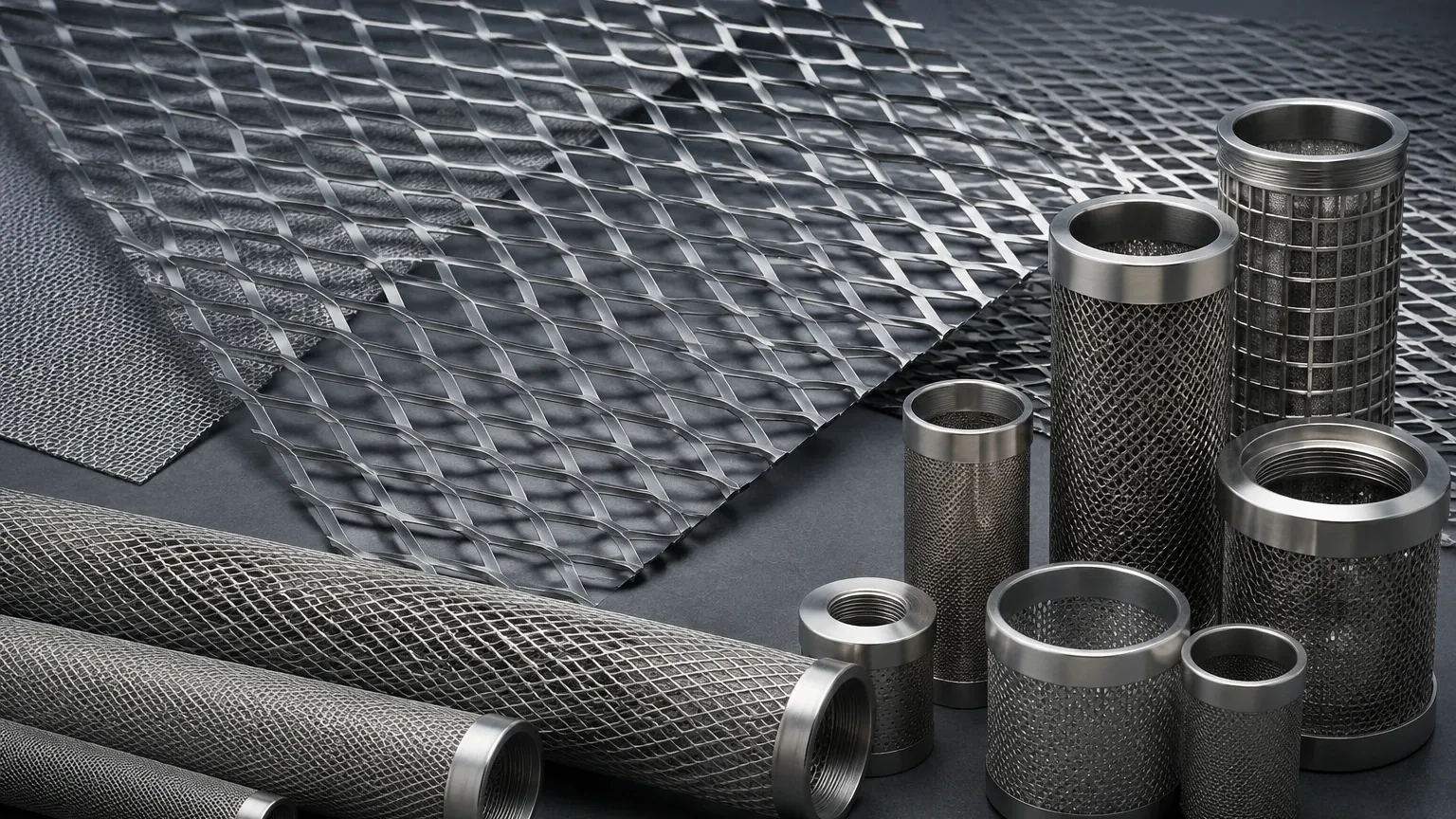
Perforated & Expanded Metal components rarely act alone in an industrial setting. They are typically integrated into complex filtration assemblies. Kaifil specializes in customizing these components to serve specific roles:
* Filter Cages: Expanded metal is rolled into cylinders to provide the outer protective cage for cartridge filters. This protects the delicate inner filter media from mechanical damage during installation and operation.
* Support Tubes: In high-pressure hydraulic filters, an expanded metal inner core provides the necessary hoop strength to prevent the filter media from collapsing inward.
* Pleat Support: In air and liquid filtration, expanded metal is used as a "spacer" or support layer to keep pleats open, ensuring that the entire surface area of the filter media is utilized.
Customization and OEM Capabilities
Standard catalog items may not always meet the unique requirements of a specialized industrial process. This is where OEM (Original Equipment Manufacturer) capabilities become essential. When a standard katalog expanded metal pdf does not offer the exact SWD/LWD or material grade required, Kaifil works with engineering teams to develop custom solutions.
Customization options include:
- Non-standard diamond sizes: Tailoring the opening to a specific particle size or flow requirement.
- Variable strand widths: Adjusting the strength-to-weight ratio for specific mechanical loads.
- Secondary Processing: This includes degreasing, pickling, passivating, or powder coating to enhance the chemical resistance or cleanliness of the final product.
- Precision Cutting and Forming: Providing expanded metal in circular discs, rectangular panels, or pre-rolled cylinders ready for immediate assembly.
Total Cost of Ownership and Replacement Cycles
From a B2B procurement perspective, the initial cost of the expanded metal component is only one part of the equation. The total cost of ownership (TCO) includes the lifespan of the material and the ease of maintenance.
Stainless steel expanded metal, while having a higher upfront cost than carbon steel, offers a significantly longer service life in corrosive environments. This reduces the frequency of replacement cycles and minimizes downtime. Furthermore, the robust nature of expanded metal allows for cleaning and reuse in many applications, such as in large-scale industrial strainers, where the mesh can be backwashed or ultrasonically cleaned to remove accumulated debris.
Conclusion: Selecting the Right Partner
Navigating a katalog expanded metal pdf is the first step in a successful engineering project. However, the complexity of industrial filtration demands more than just a part number. It requires a deep understanding of material science, fluid dynamics, and manufacturing precision.
Kaifil's expertise in Perforated & Expanded Metal ensures that engineers receive components that are not only dimensionally accurate but also optimized for their specific industrial environment. Whether you are designing a new chemical processing unit or optimizing a hydraulic system, choosing the right expanded metal specification is fundamental to achieving reliable, long-term performance. For technical support or to discuss custom filtration designs, reviewing product options and application support is the recommended next step for engineering and purchasing teams.
