


Kawat Expanded Metal
In the landscape of industrial filtration and structural support, kawat expanded metal represents a critical component engineered for durability and precision. Unlike woven wire mesh, which is created by interlacing individual wires, expanded metal is manufactured from a single solid sheet of metal that is simultaneously slit and stretched. This process results in a continuous, jointless mesh that offers unique mechanical properties, making it an essential material for engineers designing filtration systems, protective guards, and structural reinforcements in demanding environments.
For technical professionals and procurement teams, understanding the nuances of expanded metal—from its manufacturing geometry to its material performance—is vital for optimizing filtration efficiency and ensuring long-term equipment reliability. As a versatile solution within the broader category of Perforated & Expanded Metal, this material provides a high strength-to-weight ratio and a predictable open area that is crucial for fluid dynamics and mechanical support.
Understanding the Manufacturing Process of Expanded Metal
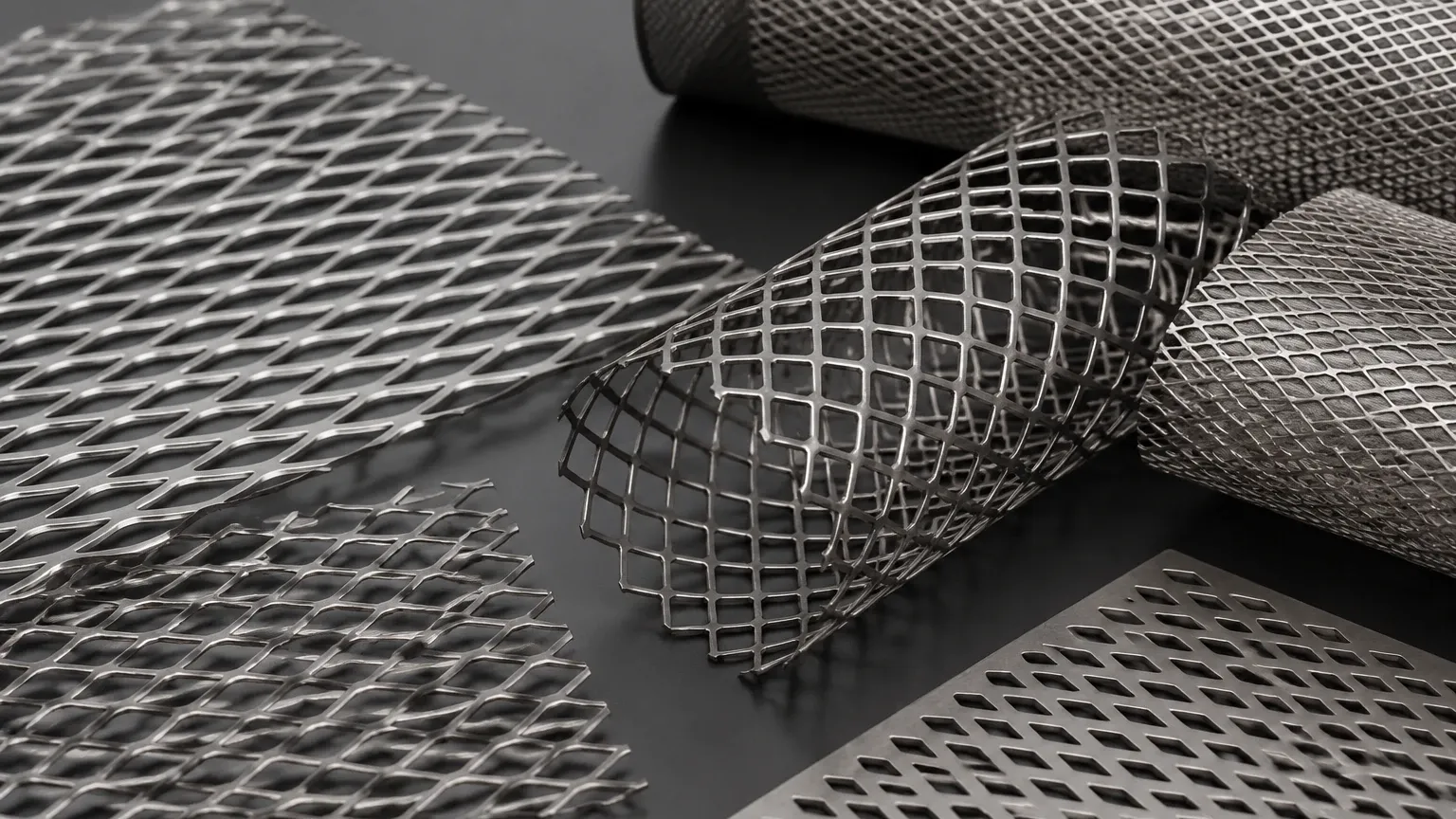
The production of kawat expanded metal is an efficient, no-waste process that distinguishes it from perforated metal. While perforated metal is created by punching holes and removing material (slugs), expanded metal is produced by a reciprocating knife that slits the metal sheet at regular intervals while the sheet is pulled forward. As the knife descends, it stretches the metal, creating diamond-shaped openings.
Because the material is stretched rather than cut out, the structural integrity of the original sheet is maintained. There are no welds to fail and no loose strands to fray, which is a significant advantage in high-vibration industrial applications. The points where the strands meet are known as "bonds." These bonds are part of the original metal sheet, providing inherent rigidity that allows the mesh to distribute loads evenly across its surface.
Raised vs. Flattened Expanded Metal
There are two primary forms of expanded metal used in industrial contexts:
1. Standard (Raised) Expanded Metal: This is the product as it comes directly from the expanding machine. The strands and bonds are set at a uniform angle to the plane of the sheet. This creates a three-dimensional surface that adds thickness and provides excellent grip or directional flow control. In filtration, raised expanded metal is often used as a pre-filter or a debris guard where turbulence might be beneficial or where mechanical grip is required.
2. Flattened Expanded Metal: This is produced by passing standard expanded metal through a cold-roll reducing mill. The process flattens the strands and bonds into the same plane as the sheet. Flattened kawat expanded metal is thinner, smoother, and slightly elongated. In the filtration industry, flattened mesh is frequently preferred as a support layer for finer filter media (such as wire cloth or membranes) because the smooth surface prevents abrasion or puncturing of the delicate inner layers.
Material Selection: Why Stainless Steel is the Standard for Industrial Filtration
While expanded metal can be produced from various materials, stainless steel is the gold standard for industrial filtration applications due to its mechanical strength and chemical resistance. At Kaifil, the focus on stainless steel ensures that the filtration components can withstand the rigorous cleaning cycles and corrosive environments found in chemical processing, food and beverage production, and pharmaceutical manufacturing.
Stainless Steel Grade 304
Grade 304 is the most common stainless steel used for expanded metal. It offers excellent corrosion resistance to a wide range of atmospheric environments and many corrosive media. It is highly formable and weldable, making it suitable for custom filter cartridges and frames.
Stainless Steel Grade 316 and 316L
For applications involving chlorides, acids, or high-salinity environments, Grade 316 is preferred. The addition of molybdenum enhances its resistance to pitting and crevice corrosion. Grade 316L (low carbon) is specifically used when welding is required, as it prevents carbide precipitation that can lead to intergranular corrosion in the heat-affected zones of the weld. This is particularly critical in pharmaceutical and food-grade filtration where hygienic standards are paramount.
Technical Specifications: SWD, LWD, and Strand Geometry
When specifying kawat expanded metal for an engineering project, several geometric variables must be defined to ensure the material meets the application's flow and strength requirements. The most common measurements include:
* SWD (Short Way of Design): The distance from the center of one bond to the center of the next bond across the short diamond diagonal.
* LWD (Long Way of Design): The distance from the center of one bond to the center of the next bond across the long diamond diagonal.
* SWO (Short Way of Opening): The actual width of the opening, measured from the inside of the bonds.
* LWO (Long Way of Opening): The actual length of the opening, measured from the inside of the bonds.
* Strand Width: The amount of metal fed into the machine between slits.
* Strand Thickness: The thickness of the original base metal sheet.
These dimensions directly influence the Open Area Percentage, which is a critical calculation for engineers. The open area determines the pressure drop across the filter and the flow velocity of the fluid. A higher open area reduces resistance but may compromise the structural support of the mesh. Balancing these factors is key to efficient filtration design.
The Role of Perforated & Expanded Metal in Filtration Systems
In industrial filtration, Perforated & Expanded Metal often serves as the backbone of a filter element. While it may not provide the final micron-rated filtration, its role is indispensable for the following reasons:
1. Structural Support and Pleat Spacing
In pleated filter cartridges, expanded metal is often used as an outer cage or an inner core. It prevents the pleats of the finer filter media from collapsing under high differential pressure. The diamond pattern of the expanded metal ensures that the fluid can reach the entire surface area of the filter media, preventing "blind spots" and extending the filter's service life.
2. Pre-Filtration and Coarse Separation
In water treatment and hydraulic systems, kawat expanded metal acts as a primary barrier against large debris, such as stones, wood chips, or metal shavings. By capturing these large particles, the expanded metal protects downstream fine filters and sensitive pumps from damage.
3. Flow Diffusion and Turbulence Induction
In certain chemical reactors or gas filtration systems, the angled strands of raised expanded metal are used to diffuse flow or induce controlled turbulence. This can improve the mixing of fluids or ensure that a gas stream is evenly distributed across a catalyst bed.
Comparing Expanded Metal with Perforated Metal and Woven Mesh
Engineers must often choose between expanded metal, perforated metal, and woven wire mesh. Each has specific advantages depending on the application context.
* Strength-to-Weight: Expanded metal typically wins in this category. Because the material is stretched, it covers more area with less weight compared to a solid sheet of the same thickness, while the bond structure provides high rigidity.
* Cost Efficiency: Expanded metal is often more cost-effective than perforated metal because there is zero material waste during manufacturing. In perforated metal, the "slugs" (the holes punched out) represent wasted material and energy.
* Filtration Precision: Woven wire mesh offers much finer filtration (down to single-digit microns), whereas expanded metal is generally limited to coarser filtration or support roles. However, expanded metal is far more rigid and durable than woven mesh of a similar open area.
* Surface Consistency: Perforated metal offers perfectly uniform hole sizes and shapes, which is critical for some high-precision screening applications. Expanded metal openings are diamond-shaped and can have slight variations depending on the stretching process, though modern CNC expanding machines have significantly tightened these tolerances.
Engineering Considerations for Selection and Customization
When purchasing kawat expanded metal for industrial use, engineers should evaluate several performance-based criteria:
Load-Bearing Requirements
Will the mesh be subjected to high-pressure pulses? If so, the strand width and thickness must be calculated to withstand the mechanical stress without deformation. In hydraulic applications, the mesh must resist the crushing force of the fluid as it passes through the filter media.
Chemical Compatibility
The filtration environment dictates the material. In food processing, stainless steel 304 or 316 is required for sanitation. In oil and gas, more exotic alloys may be necessary, though stainless steel remains the most versatile and cost-effective choice for most industrial filters.
Customization and OEM Integration
Industrial filters are rarely "off-the-shelf." Customization in terms of sheet size, diamond dimensions, and edge finishing is often required. Kaifil specializes in providing OEM solutions where the expanded metal is integrated into specific filter cartridge designs, including custom-welded cylinders or framed panels.
Total Cost of Ownership (TCO)
While the initial purchase price is important, the TCO includes the lifespan of the filter and the frequency of replacement. Stainless steel expanded metal, though more expensive than carbon steel or plastic, offers a much longer service life due to its resistance to corrosion and mechanical wear, ultimately reducing the cost per gallon filtered.
Maintenance and Durability in Demanding Environments
One of the primary benefits of using stainless steel kawat expanded metal is its ease of maintenance. In many industrial processes, filters must be cleaned and reused (backwashing or ultrasonic cleaning). The rigid, jointless structure of expanded metal allows it to withstand high-pressure cleaning without losing its shape or integrity.
Furthermore, because there are no overlapping wires (as in woven mesh), there are fewer crevices where bacteria or contaminants can hide. This makes expanded metal an excellent choice for "clean-in-place" (CIP) systems used in the dairy, beverage, and pharmaceutical industries.
Procurement and Quality Assurance for Industrial Applications
For purchasing teams, confirming the quality of expanded metal involves checking dimensional tolerances and material certifications. Reliable manufacturers provide Mill Test Reports (MTRs) that verify the chemical composition of the stainless steel used. This ensures that the "316L" specified in the engineering drawings is exactly what is delivered, preventing premature failure due to corrosion.
When evaluating a supplier for Perforated & Expanded Metal, it is important to confirm their ability to handle custom specifications. This includes the ability to provide specific SWD/LWD ratios that match your existing filtration housings and the capability to provide secondary operations like flattening, shearing to exact sizes, or forming into cylindrical shapes.
In conclusion, kawat expanded metal is a foundational material in the industrial filtration sector. Its unique manufacturing process provides a blend of strength, economy, and versatility that is difficult to match with other mesh types. By carefully selecting the material grade, diamond geometry, and finish, engineers can develop filtration solutions that are both high-performing and durable, meeting the rigorous demands of modern industrial processing.
