


Laser Cut Perforated Metal Panels
In industrial manufacturing and filtration, the precision of component design often dictates the efficiency of the entire system. Laser cut perforated metal panels represent a high-precision alternative to traditional mechanical punching, offering engineers the ability to create complex geometries, maintain structural integrity in thick materials, and achieve tighter tolerances. As a specialized manufacturer of stainless steel filtration solutions, Kaifil utilizes advanced fabrication techniques to provide Perforated & Expanded Metal components that meet the rigorous demands of chemical processing, water treatment, and hydraulic applications.
Understanding the technical nuances of laser cutting—from the heat-affected zone (HAZ) to the calculation of open area percentages—is essential for procurement teams and engineers tasked with selecting the right filtration support or protective screening. This guide examines the engineering principles, material considerations, and industrial applications of laser cut perforated metal panels.
The Technical Distinction: Laser Cutting vs. Mechanical Punching
While mechanical punching is the standard for high-volume production of simple hole patterns in thin gauges, laser cutting provides distinct advantages for specialized industrial requirements. The choice between these methods depends on material thickness, pattern complexity, and the required edge quality.
Precision and Complexity
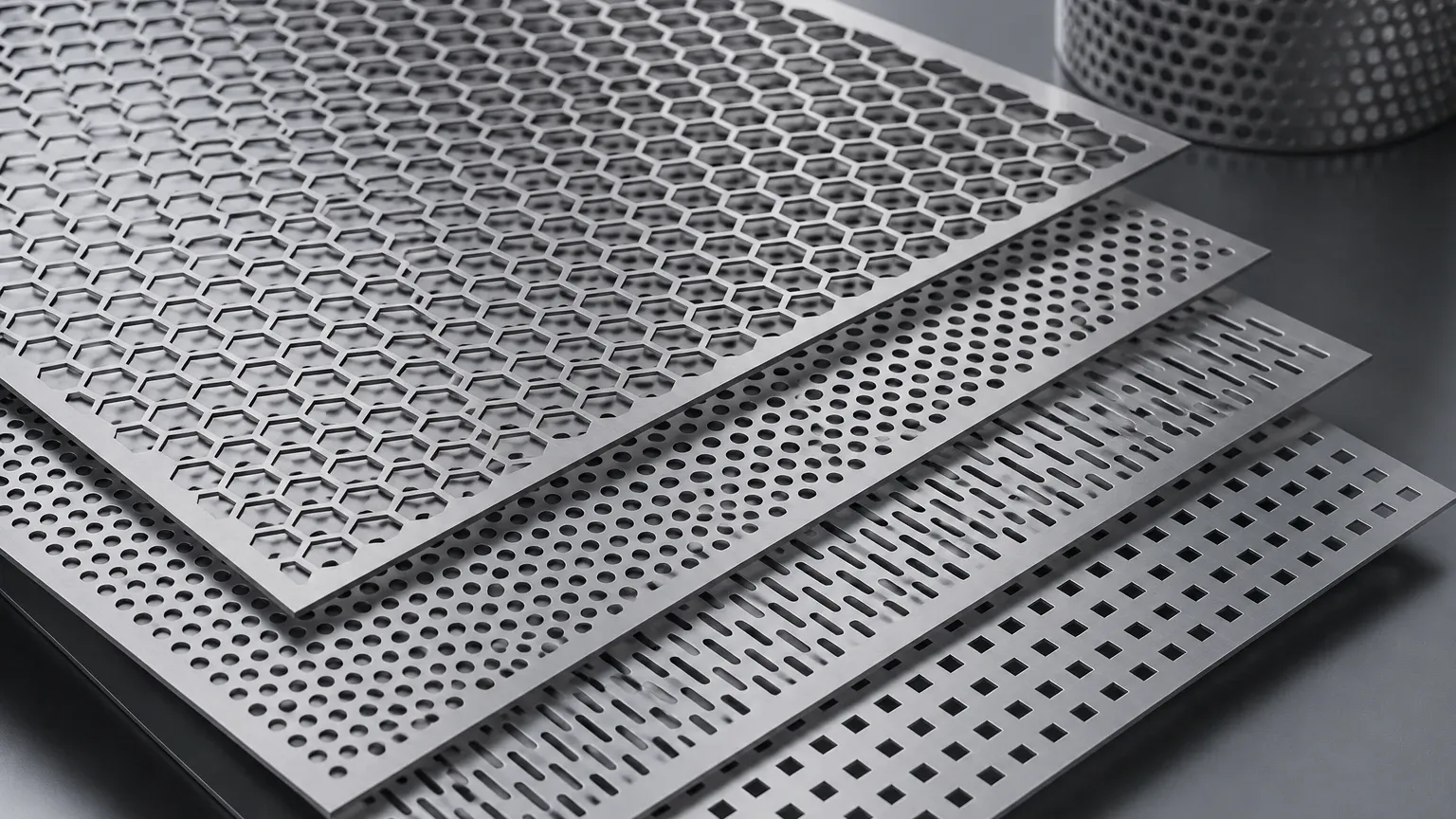
Mechanical punching is limited by the physical dimensions of the die and the strike force of the press. In contrast, laser cut perforated metal panels are fabricated using CNC-guided thermal energy. This allows for non-standard hole shapes, varying hole sizes on a single panel, and intricate patterns that would be impossible or cost-prohibitive to achieve with custom tooling. For filtration components requiring specific flow dynamics, laser cutting allows for the precise placement of apertures to optimize fluid distribution.
Material Thickness and Tooling Wear
Punching thick stainless steel plates (above 5mm) puts significant stress on mechanical tools, leading to burrs and dimensional drift as the die wears. Laser cutting is a non-contact process. Whether processing a 1mm sheet or a 10mm plate, the laser maintains consistent accuracy without the risk of tool degradation. This makes it the preferred method for heavy-duty support cylinders and high-pressure filter housings.
Edge Quality and the Heat-Affected Zone (HAZ)
One critical engineering consideration in laser cutting is the Heat-Affected Zone. Because laser cutting relies on concentrated heat to melt and vaporize the metal, a small area around the cut undergoes thermal cycling. In stainless steel, this can slightly alter the grain structure. However, modern fiber laser technology minimizes this zone, resulting in a clean, square edge that often requires no secondary deburring—a significant advantage over the "shear and break" edge produced by mechanical punching.
Material Selection for Industrial Environments
The performance of laser cut perforated metal panels is heavily dependent on the alloy selected. In industrial filtration and processing, stainless steel is the gold standard due to its mechanical strength and chemical resistance.
* Grade 304 Stainless Steel: The most common choice for general industrial use. It offers excellent formability and weldability, making it ideal for perforated panels used in food and beverage processing or general machinery guards.
* Grade 316/316L Stainless Steel: For applications involving marine environments, high chloride concentrations, or aggressive chemical solvents, 316L is preferred. The addition of molybdenum enhances pitting corrosion resistance, ensuring the longevity of the perforated panel in harsh conditions.
* Specialty Alloys: In high-temperature or highly corrosive environments, such as petrochemical refining, materials like Duplex stainless steel or Nickel alloys may be specified. Laser cutting is particularly effective for these harder alloys that are difficult to process with traditional mechanical tools.
Engineering Parameters: Open Area and Structural Integrity
When specifying laser cut perforated metal panels for filtration or airflow applications, the "Open Area" percentage is the most vital metric. It determines the flow rate, pressure drop, and the size of particles that can pass through the media.
Calculating Open Area
The open area is the ratio of the total area of the holes to the total area of the panel. For a standard 60-degree staggered round hole pattern, the formula is:
Open Area % = (D² × 90.69) / P²
*(Where D = Hole Diameter and P = Pitch/Center-to-Center distance)*
In laser cutting, engineers can fine-tune the pitch and diameter to achieve an exact open area required for a specific pressure drop profile. This is crucial in hydraulic systems where maintaining a specific flow velocity is necessary to prevent cavitation or system overheating.
The Relationship Between Hole Size and Plate Thickness
A general rule of thumb in mechanical punching is that the hole diameter should not be smaller than the material thickness (1:1 ratio). Laser cutting breaks this limitation. It is possible to cut holes significantly smaller than the plate thickness, allowing for the creation of robust, thick-walled filter strainers with fine filtration capabilities. This structural rigidity is essential for panels that must withstand high differential pressures without deforming.
Industrial Applications in Filtration and Beyond
Laser cut perforated metal panels serve as the backbone for many industrial systems. Their versatility allows them to function as both primary filtration media and structural support for finer meshes.
1. Filter Element Support Cores
In high-pressure hydraulic or chemical filtration, fine wire mesh is often wrapped around a perforated metal core. The laser-cut core provides the necessary collapse strength to withstand pressure surges, while the precision-cut holes ensure that the core does not restrict the flow of the filtered fluid.
2. Coarse Strainers and Intake Screens
For water treatment and power plant cooling systems, large-scale perforated panels act as the first line of defense against debris. Laser cutting allows for the fabrication of large-format panels with custom mounting holes and reinforced margins, simplifying the installation process into existing infrastructure.
3. Centrifuge Baskets
In pharmaceutical and chemical processing, centrifuge baskets require precise perforation patterns to ensure balanced rotation and efficient drainage. The CNC accuracy of laser cutting ensures that the weight distribution of the panel remains uniform, which is critical for high-speed rotating equipment.
4. Architectural and Protective Barriers
Beyond filtration, laser cut perforated metal panels are used in industrial facilities for acoustic dampening, ventilation grilles, and safety machinery guards. The ability to cut custom patterns allows these panels to meet specific safety standards regarding finger-reach or debris containment while maintaining necessary airflow for equipment cooling.
Quality Evaluation and Procurement Criteria
When sourcing laser cut perforated metal panels, engineers and purchasing teams must evaluate several quality markers to ensure the product is fit for purpose. Unlike standard commodity sheets, custom-cut panels require rigorous inspection.
* Dimensional Tolerance: Specify the allowable variance in hole diameter and center-to-center distance. For precision filtration, tolerances of ±0.1mm are often required.
* Flatness Requirements: The thermal nature of laser cutting can sometimes induce internal stresses that cause the sheet to bow. High-quality manufacturers use leveling processes to ensure the final panel meets flatness specifications for easy integration into filter housings.
* Surface Finish and Burrs: While laser cutting is generally cleaner than punching, the "exit side" of the cut should be inspected for dross (solidified molten metal). For food-grade or pharmaceutical applications, panels may require electropolishing or pickling to ensure a completely smooth, passive surface.
* Margin Specifications: Engineers must define the "margins" or the unperforated areas around the edges of the panel. These margins are essential for welding the panel into a cylinder or bolting it into a frame. Laser cutting allows for highly customized margins that can follow irregular perimeters.
Customization and OEM Capabilities
At Kaifil, we recognize that off-the-shelf solutions rarely meet the specific needs of complex industrial systems. Our expertise lies in the development of customized filtration components, including Perforated & Expanded Metal products tailored to unique application requirements.
By providing detailed CAD files or technical specifications, customers can receive laser cut perforated metal panels that are ready for immediate assembly. Our manufacturing process includes material verification, precision cutting, and secondary operations such as rolling, welding, and surface treatment. This end-to-end capability ensures that the final component performs reliably in demanding environments, from high-temperature chemical reactors to precision hydraulic circuits.
Conclusion: Selecting the Right Solution
Laser cut perforated metal panels offer a level of design freedom and structural integrity that traditional methods cannot match. By allowing for thicker materials, smaller hole-to-thickness ratios, and complex geometries, laser cutting enables engineers to optimize filtration performance and equipment durability.
When selecting a partner for these components, it is essential to prioritize technical expertise and quality assurance. Factors such as material grade, open area calculation, and edge finish are not just aesthetic concerns—they are functional requirements that impact the total cost of ownership and the operational lifespan of industrial equipment. For engineers seeking reliable, high-performance filtration supports and screens, laser-cut solutions provide the precision necessary for modern industrial excellence.
