


Lightweight Expanded Metal
In the landscape of industrial filtration and structural support, lightweight expanded metal represents a versatile and cost-effective solution. Unlike traditional perforated materials, expanded metal is manufactured through a process of simultaneous slitting and stretching, which creates a continuous mesh without the material waste associated with punching. For engineers and procurement specialists, understanding the technical nuances of this material is essential for optimizing filtration efficiency and ensuring the structural integrity of industrial components.
At its core, lightweight expanded metal is defined by its high strength-to-weight ratio. By utilizing thinner gauges of stainless steel or other alloys, manufacturers can produce a rigid mesh that provides significant open area for fluid or gas flow while maintaining the mechanical stability required for demanding industrial environments. This article examines the technical specifications, manufacturing considerations, and application-specific benefits of integrating lightweight expanded metal into industrial systems.
The Engineering Fundamentals of Lightweight Expanded Metal
Lightweight expanded metal is characterized by its unique three-dimensional structure. When a metal sheet is expanded, the resulting strands and bonds (the intersections of the strands) are set at an angle to the original plane of the sheet. This geometry is not merely aesthetic; it provides inherent directional strength and influences the flow dynamics of any medium passing through the mesh.
In filtration applications, the "lightweight" designation typically refers to materials with a thickness ranging from 0.010 inches to 0.050 inches, though this can vary based on the specific alloy and mesh configuration. The primary advantage of using a lightweight variant is the reduction in overall component weight without a proportional sacrifice in rigidity. This is particularly critical in aerospace, portable hydraulic systems, and large-scale chemical processing units where weight management impacts operational costs and installation complexity.
For those evaluating different mesh types, Perforated & Expanded Metal options offer a spectrum of performance characteristics. While perforated metal provides a flat surface with precise hole geometries, expanded metal offers a more complex, textured surface that can act as a pre-filter or a high-friction support layer for finer filter media.
Manufacturing Precision: Slitting and Stretching vs. Punching
The production of lightweight expanded metal is a resource-efficient process. The machinery uses a series of knives to slit the base metal sheet while simultaneously pulling it apart. This stretching action creates the diamond-shaped openings characteristic of the material. Because no metal is removed during this process, the yield is significantly higher than that of perforated metal, where the "slugs" or punched-out circles represent wasted material and energy.
There are two primary forms of expanded metal produced through this method:
1. Standard (Raised) Expanded Metal: This is the material as it comes off the expansion press. The strands and bonds are angled, creating a three-dimensional profile. This version provides maximum rigidity and is excellent for applications requiring high turbulence or mechanical grip.
2. Flattened Expanded Metal: After the expansion process, the sheet is passed through a cold-rolling reducing mill. This flattens the strands and bonds back into a single plane. Flattened lightweight expanded metal is often preferred when a smooth surface is required to prevent abrasion of adjacent filter layers or to facilitate easier cleaning.
From an engineering perspective, the choice between raised and flattened profiles depends on the pressure drop requirements and the mechanical interface with other components in the filter assembly.
Technical Specifications: SWD, LWD, and Open Area Calculations
To accurately specify lightweight expanded metal, engineers must use standardized terminology. The dimensions of the diamond openings are defined by two primary measurements:
* SWD (Short Way of Design): The distance from the center of one bond to the center of the next bond measured across the short diamond diagonal.
* LWD (Long Way of Design): The distance from the center of one bond to the center of the next bond measured across the long diamond diagonal.
* SWO (Short Way of Opening): The actual width of the opening, excluding the strand width.
* LWO (Long Way of Opening): The actual length of the opening, excluding the strand width.
In addition to these dimensions, the Strand Width (the amount of metal between openings) and Strand Thickness (the gauge of the original base metal) determine the overall weight and strength.
The Percentage of Open Area is perhaps the most critical metric for filtration. It is calculated based on the relationship between the opening sizes and the strand dimensions. A higher open area results in lower resistance to flow (lower pressure drop) but may reduce the material's ability to withstand high differential pressures. Lightweight expanded metal typically offers open areas ranging from 30% to over 80%, providing a wide window for customization based on the specific flow rate requirements of the application.
Material Performance: Stainless Steel in Corrosive Environments
While expanded metal can be produced from various materials, stainless steel is the industry standard for high-performance filtration. Kaifil specializes in stainless steel solutions because of the material's exceptional resistance to corrosion, oxidation, and mechanical wear.
* Grade 304: The most common grade, offering good corrosion resistance and excellent formability. It is suitable for food and beverage applications and general industrial filtration.
* Grade 316/316L: Contains molybdenum, which provides superior resistance to chlorides and pitting. This is the preferred choice for marine environments, pharmaceutical manufacturing, and aggressive chemical processing.
* High-Nickel Alloys: For extreme temperatures or highly acidic environments, specialized alloys can be expanded to meet the same lightweight specifications.
The durability of stainless steel ensures that the lightweight expanded metal maintains its structural integrity over repeated cleaning cycles. In many B2B industrial settings, the total cost of ownership is reduced by selecting a durable material that avoids the frequent replacement cycles associated with lower-quality plastics or carbon steels.
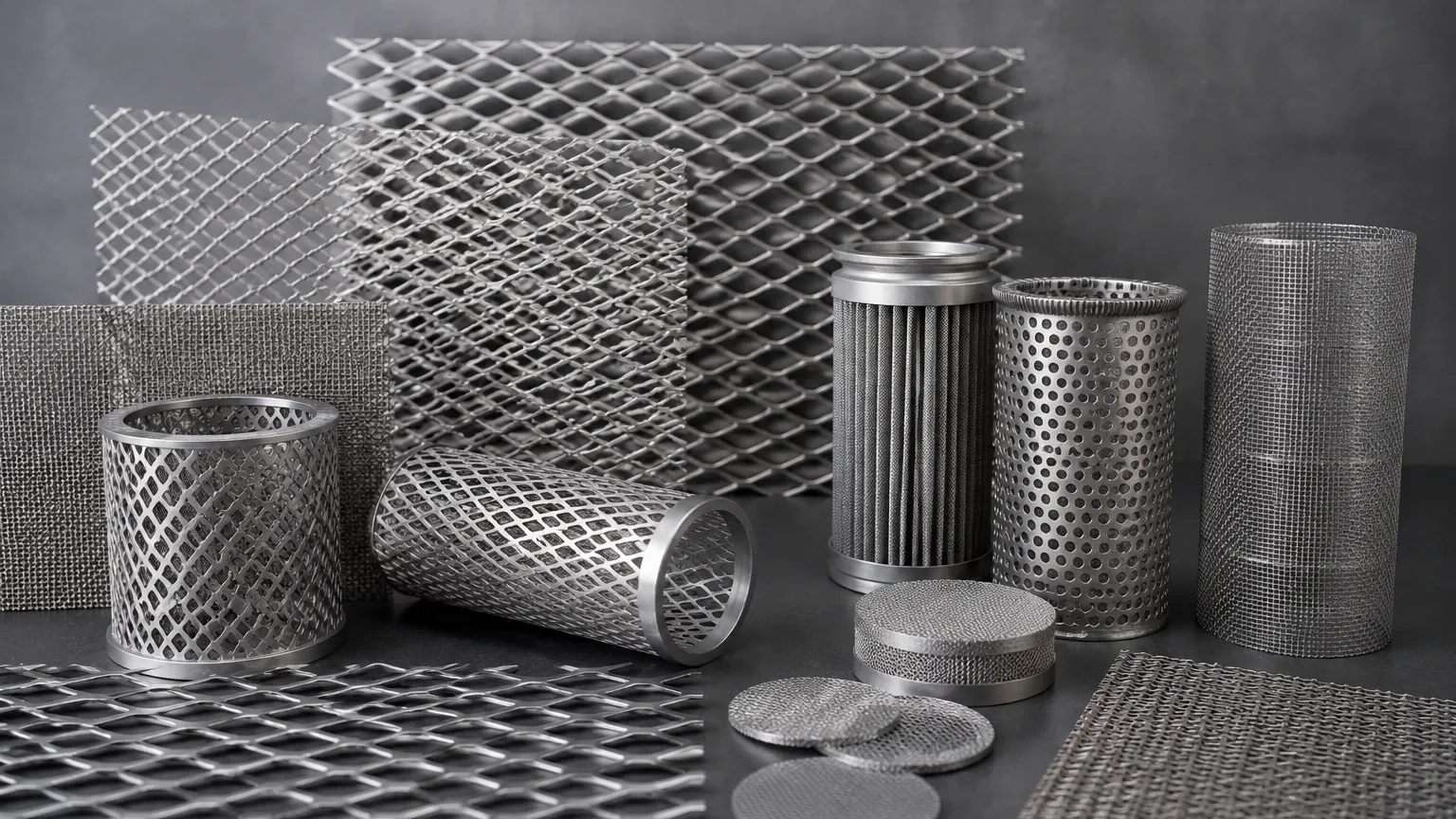
Comparing Perforated & Expanded Metal for Support Structures
When designing a filter cartridge or a precision metal component, engineers often debate between using perforated metal or expanded metal as the support core. Both have distinct advantages.
Perforated Metal offers highly predictable hole sizes and a perfectly flat surface. It is often used when the filtration accuracy depends on the hole size itself. However, the manufacturing process is more expensive due to material waste, and the resulting sheet is generally heavier than an expanded metal sheet of equivalent strength.
Lightweight Expanded Metal, by contrast, provides a much higher strength-to-weight ratio. The angled strands in the raised version act as structural trusses, providing significant resistance to collapse under external pressure. This makes it an ideal core for pleated filter elements, where it supports the delicate filter media against the force of the incoming fluid. Furthermore, the textured surface of expanded metal can help distribute flow more evenly across the surface of the primary filter media, preventing localized blinding and extending the filter's service life.
In many high-performance systems, the two materials are used in tandem. A heavy-duty perforated tube might provide the primary structural frame, while a layer of Perforated & Expanded Metal serves as the immediate support for a fine wire mesh, ensuring that the mesh does not migrate or deform under pressure.
Industrial Applications: From Chemical Processing to Hydraulics
The versatility of lightweight expanded metal allows it to function across a broad spectrum of industries. Its role is rarely singular; it often serves as a filter, a guard, and a structural component simultaneously.
Chemical and Petrochemical Processing
In these environments, filters must withstand aggressive solvents and high temperatures. Lightweight expanded metal made from 316L stainless steel is used in basket strainers and catalyst recovery systems. Its ability to be formed into complex cylindrical or conical shapes without losing structural integrity is a key benefit here.
Food and Beverage Industry
Hygiene and cleanability are paramount. Flattened expanded metal is frequently used in centrifugal sifting and juice extraction. The smooth surface of the flattened mesh prevents food particles from becoming trapped, while the stainless steel construction allows for high-temperature CIP (Clean-In-Place) sterilization.
Hydraulic and Lube Oil Systems
In hydraulic systems, maintaining low pressure drop is essential for pump efficiency. Lightweight expanded metal is used as a support wrap for micro-glass or metal fiber media. It ensures that the media remains pleated and functional even during cold starts when oil viscosity is high and differential pressure peaks.
Pharmaceutical Manufacturing
Precision and purity are the drivers in pharmaceutical filtration. Expanded metal components are used in fluid bed dryers and granulation equipment. The material's burr-free finish (achieved through specialized manufacturing and polishing) is critical to prevent batch contamination.
Selection Criteria for Custom Filtration Solutions
When sourcing lightweight expanded metal for a specific project, technical professionals should confirm several variables to ensure the final product meets the application's demands. A mismatch in specifications can lead to premature failure or system inefficiency.
1. Mechanical Load: What is the maximum differential pressure the mesh will encounter? This determines the required strand thickness and the choice between raised or flattened profiles.
2. Chemical Compatibility: Will the mesh be exposed to acids, bases, or high-chloride environments? This dictates the grade of stainless steel required.
3. Flow Characteristics: What is the target flow rate? The percentage of open area must be calculated to ensure that the mesh does not become a bottleneck in the system.
4. Forming Requirements: Does the material need to be rolled into a tight radius or welded to a flange? Lightweight gauges are easier to form but require precision welding techniques to avoid burn-through.
5. Surface Finish: Is a specific micron rating for smoothness required? Post-production treatments like electropolishing or passivation can improve both the corrosion resistance and the surface finish of the expanded metal.
By addressing these factors during the design phase, engineering teams can leverage the cost and performance benefits of expanded metal while ensuring long-term reliability. The transition from a standard perforated component to a customized lightweight expanded metal solution often results in a more efficient, lighter, and more durable end product.
In conclusion, lightweight expanded metal is a sophisticated engineering material that offers significant advantages in industrial filtration. Its unique manufacturing process eliminates waste, while its geometric structure provides a level of rigidity that traditional sheets cannot match. Whether used as a primary filter or a support structure for finer media, it remains a cornerstone of modern industrial design.
