


Metrix Group Perforated Metal
In the landscape of industrial filtration and structural engineering, perforated metal serves as a foundational component for fluid dynamics, particle separation, and mechanical protection. Whether utilized in architectural facades or high-pressure chemical processing, the precision of the perforation determines the efficiency of the entire system. Solutions like Metrix Group perforated metal have set industry benchmarks for precision and aesthetic versatility, particularly in architectural and specialized industrial applications. For engineers and procurement specialists, understanding the technical nuances of these materials is essential for optimizing performance and ensuring long-term durability in demanding environments.
Industrial filtration requires a balance between structural integrity and flow efficiency. When selecting Perforated & Expanded Metal for industrial use, technical professionals must evaluate hole geometry, pitch, open area percentages, and material compatibility to meet specific application requirements.
Understanding the Role of Perforated Metal in Industrial Filtration
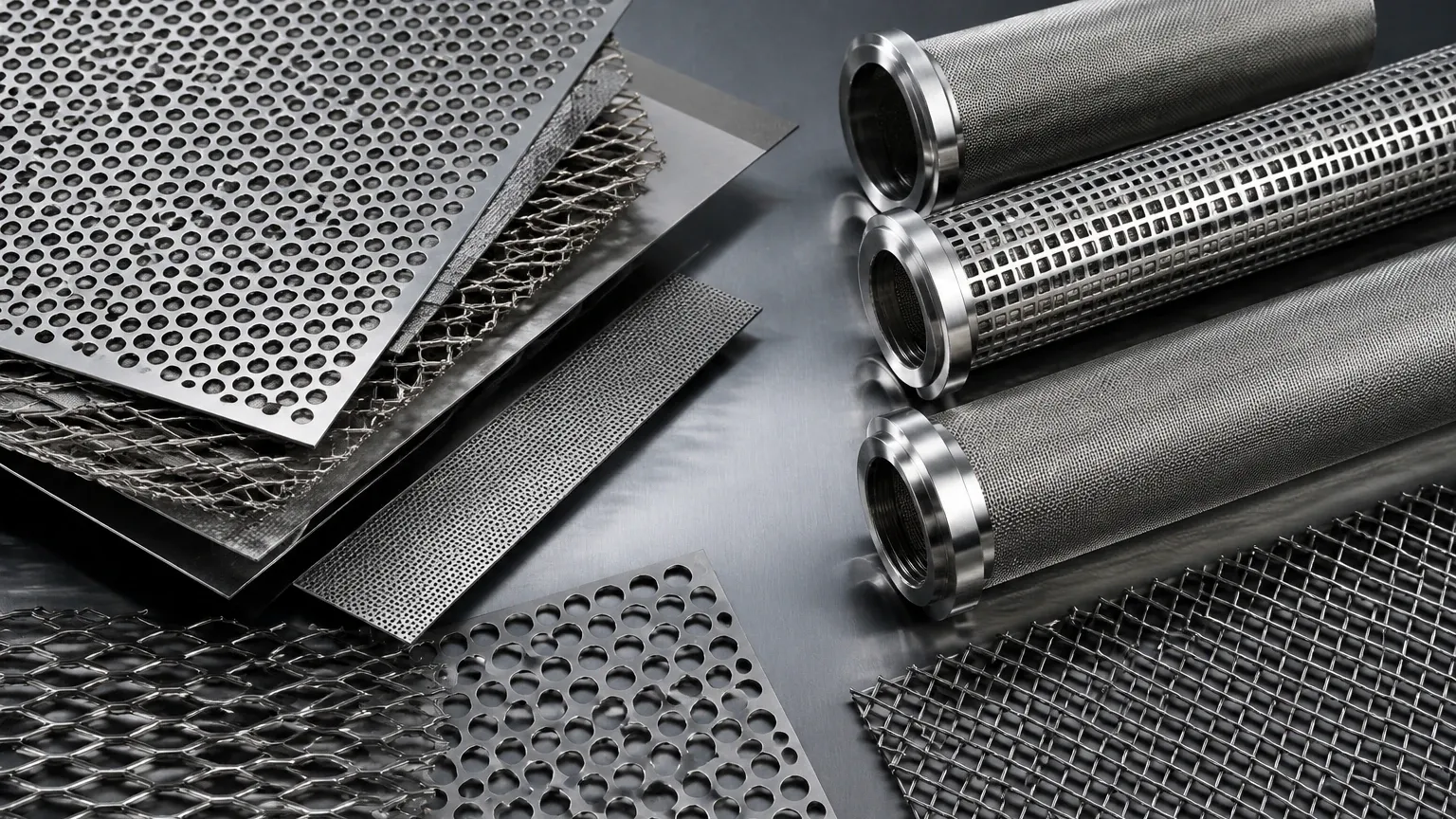
Perforated metal is produced by mechanically punching or laser-cutting a series of holes into a solid metal sheet. Unlike woven wire mesh, which relies on the intersection of wires to create openings, perforated metal is a monolithic structure. This inherent rigidity makes it an ideal choice for support structures in filter cartridges or as a primary filtration medium in high-viscosity or high-pressure applications.
In B2B industrial sectors, the choice of perforation pattern is rarely aesthetic. It is a functional decision based on the "Open Area" (OA) percentage. The OA determines the flow rate and pressure drop across the medium. For instance, a 40% open area provides a specific resistance to fluid flow that must be accounted for in pump sizing and system pressure calculations. When evaluating metrix group perforated metal or similar high-precision components, engineers prioritize the consistency of these openings to ensure uniform flow distribution, which prevents localized clogging and premature failure of the filter element.
Technical Specifications: Hole Patterns and Open Area Calculations
The geometry of the perforation significantly impacts the mechanical properties of the sheet. The most common configurations include:
* Round Holes (Staggered or Straight): Staggered patterns (typically at 60 degrees) are the industry standard due to their superior strength and uniform open area. They provide the highest structural integrity for a given OA percentage.
* Square Holes: These offer a higher open area than round holes but result in lower mechanical strength. They are often used in applications requiring high visibility or maximum airflow.
* Slotted Holes: Primarily used for sorting and grading applications, slotted perforations are effective for filtering elongated particles or in drainage systems where directional flow is required.
Calculating the open area is a critical step in the design phase. For a 60-degree staggered round hole pattern, the formula is:
OA = (R² × 90.69) / C²
Where *R* is the hole radius and *C* is the center-to-center distance (pitch). Precision in these calculations ensures that the perforated component does not become a bottleneck in the industrial process. High-quality manufacturing ensures that tolerances are kept within microns, preventing the variations that can lead to turbulent flow or bypass issues.
Material Selection: Stainless Steel vs. Alternative Alloys
The environment in which the perforated metal operates dictates the material selection. In the chemical, pharmaceutical, and food and beverage industries, stainless steel is the preferred choice due to its corrosion resistance and ease of sterilization.
1. Grade 304 Stainless Steel: Suitable for general industrial use, providing good corrosion resistance and excellent formability. It is commonly used in water treatment and food processing where exposure to mild acids or alkalis is expected.
2. Grade 316L Stainless Steel: The "L" denotes low carbon, which improves weldability and resistance to intergranular corrosion. 316L contains molybdenum, making it essential for marine environments, pharmaceutical manufacturing, and chemical processing where chlorides or high-salinity fluids are present.
3. Specialty Alloys: In high-temperature or highly corrosive environments, materials such as Monel, Inconel, or Hastelloy may be required. These alloys maintain their mechanical properties under extreme thermal stress, which is vital for aerospace and petrochemical applications.
When sourcing Perforated & Expanded Metal, confirming the material certification (MTR) is a non-negotiable step for quality assurance. This ensures that the chemical composition of the alloy meets the specific ASTM or ISO standards required for the project.
Comparing Perforated and Expanded Metal for Heavy-Duty Applications
While often discussed together, perforated and expanded metals are manufactured through different processes and offer distinct performance characteristics.
Perforated metal is created by removing material (the "slugs"). This allows for highly complex and precise hole shapes and patterns. It remains flat and is easily formed into cylindrical filter cartridges or custom shapes. The primary advantage is the ability to maintain "margins"—solid areas around the edges of the sheet that facilitate welding and structural mounting.
Expanded metal, on the other hand, is produced by simultaneously slitting and stretching the metal sheet. This process creates diamond-shaped openings and results in no material waste. Expanded metal is inherently stronger than the original sheet because the strands and bonds are angled, providing a truss-like structure. However, it is more difficult to achieve precise filtration ratings with expanded metal compared to perforated sheets.
In industrial filtration, expanded metal is frequently used as an outer protective cage for delicate pleated paper or fine wire mesh filters, providing impact resistance without significantly restricting flow. In contrast, metrix group perforated metal and similar precision-punched products are often used as the primary support core for high-pressure hydraulic filters, where the exact placement of holes is necessary to align with internal flow channels.
Engineering Considerations for Custom Perforated Metal Components
When designing custom filtration solutions, several engineering factors must be addressed beyond the hole size and material:
* Margins and Blank Areas: Standard perforated sheets often have "finished ends" or "unperforated margins." For B2B applications, specifying the exact width of these margins is crucial for assembly. A lack of margins can make seam welding difficult and compromise the structural integrity of a filter cartridge.
* Flatness and Leveling: The punching process introduces internal stresses into the metal, which can cause the sheet to curl or bow. Precision manufacturers utilize roller leveling to ensure the final product meets strict flatness tolerances, which is essential for components that must be integrated into automated assembly lines.
* Burr Removal and Surface Finish: In pharmaceutical and food-grade applications, the presence of burrs (small fragments of metal remaining after punching) is a significant contamination risk. Electropolishing or mechanical degreasing is often required to ensure a smooth, cleanable surface that meets sanitary standards.
* Hole-to-Bar Ratio: The "bar" is the metal remaining between the holes. If the bar is too thin relative to the sheet thickness, the material may deform during the punching process or fail under mechanical load. A general engineering rule is that the hole diameter should not be smaller than the material thickness.
Quality Control and Industrial Standards for Filtration Media
For purchasing teams, verifying the quality control processes of a manufacturer is as important as the technical specs. High-performance filtration components must adhere to specific industrial standards to ensure safety and reliability. This includes:
* Dimensional Accuracy: Using calibrated calipers and optical measurement systems to verify hole diameters and pitch.
* Material Traceability: Ensuring every batch of stainless steel can be traced back to the original heat number from the mill.
* Pressure Testing: For perforated components used in pressurized vessels, burst testing and collapse pressure analysis are performed to determine the maximum operating limits.
In the context of metrix group perforated metal, the focus on architectural precision often translates well into industrial sectors that require tight tolerances and high-quality surface finishes. However, for specialized filtration needs, working with a manufacturer that understands fluid dynamics and chemical compatibility is paramount.
Conclusion: Selecting the Right Filtration Solution
Choosing between perforated and expanded metal—and selecting the specific pattern and material—requires a deep understanding of the operational environment. Whether the goal is to protect a high-pressure pump from debris or to provide a sanitary screening surface for food processing, the technical details of the metal medium will dictate the system's success.
By focusing on engineering fundamentals such as open area calculations, material grades (like 316L), and secondary processing requirements, B2B buyers can ensure they receive components that offer the best total cost of ownership through reduced maintenance and extended service life. For those seeking specialized industrial components, reviewing the available options for Perforated & Expanded Metal is the first step toward a customized, high-performance filtration solution.
