


Micro Perforated Metal
In the landscape of industrial filtration and precision engineering, micro perforated metal represents a specialized category of materials designed to meet the rigorous demands of fine particle separation, controlled fluid flow, and structural durability. Unlike standard perforated sheets used for architectural or general-purpose screening, micro perforated metal is defined by aperture sizes that are significantly smaller, often reaching sub-millimeter dimensions that require advanced manufacturing techniques. For engineers and procurement professionals, understanding the technical nuances of these components is essential for optimizing the performance and longevity of industrial filtration systems.
At its core, micro perforated metal serves as a bridge between traditional wire mesh and standard perforated plates. It offers the precision and fine filtration capabilities often associated with woven mesh while retaining the mechanical rigidity, uniform surface, and ease of cleaning characteristic of solid metal sheets. This combination makes it an indispensable component in sectors ranging from chemical processing and pharmaceuticals to food and beverage production.
The Role of Micro Perforated Metal in Modern Industrial Filtration
Micro perforated metal is primarily utilized in applications where filtration accuracy must be paired with high mechanical strength. In many industrial environments, filters are subjected to high differential pressures, abrasive fluids, and frequent backwashing cycles. While wire mesh provides excellent open area, it can be prone to deformation or wire migration under extreme stress. Micro perforated metal, being a single, monolithic piece of material, eliminates the risk of fiber shedding and provides a stable geometry that maintains consistent filtration ratings over time.
In the context of Perforated & Expanded Metal solutions, the "micro" designation typically refers to hole diameters ranging from 0.05 mm to 1.0 mm. These small apertures allow for the effective removal of fine contaminants while the solid metal matrix provides the necessary support to resist bursting or collapsing. This is particularly critical in hydraulic systems and high-pressure liquid filtration where the integrity of the filter medium is paramount to protecting downstream equipment.
Technical Specifications: Engineering the Precision Aperture
When specifying micro perforated metal, engineers must evaluate several geometric and mechanical variables that directly impact filtration performance. These specifications go beyond simple hole size and encompass the entire topography of the metal sheet.
Hole Diameter and Shape
While round holes are the most common due to their uniform stress distribution and ease of manufacturing, micro perforation can also involve square, hexagonal, or slotted apertures. The choice of shape influences the "blinding" or clogging characteristics of the filter. For instance, slotted micro perforations are often preferred for processing fibrous materials, as they are less likely to trap elongated particles compared to round holes.
Pitch and Arrangement
The pitch refers to the center-to-center distance between adjacent holes. Micro perforated sheets usually employ a staggered (60-degree) pattern, which maximizes the number of holes per unit area and ensures uniform structural strength. A straight-row pattern may be used in specific applications where directional flow or alignment with other components is required, though it generally offers lower structural stability than a staggered layout.
Open Area Percentage
The open area is a critical calculation that determines the flow capacity and pressure drop across the filter. It is calculated based on the hole diameter and the pitch. In micro perforated metal, achieving a high open area while maintaining a small hole size requires a very tight pitch, which can challenge the structural limits of the metal "bridge" (the material remaining between the holes). Engineers must balance the need for high flow rates with the requirement for a robust filter that can withstand operational stresses.
Manufacturing Processes: From Mechanical Punching to Chemical Etching
The production of micro perforated metal requires specialized technology to achieve tolerances that standard perforating presses cannot reach. The manufacturing method chosen significantly affects the physical properties of the final product.
Mechanical Micro-Punching
Traditional punching uses high-speed presses and precision tooling. However, there is a physical limit known as the hole-to-thickness ratio. Typically, in mechanical punching, the hole diameter cannot be significantly smaller than the material thickness without risking tool breakage. For micro-scale applications, specialized micro-punching equipment can achieve smaller ratios, but this method may still introduce mechanical stress or slight burrs at the edges of the holes.
Photo-Chemical Etching (PCE)
Chemical etching is often the preferred method for producing the finest micro perforated metal. This process uses light-sensitive photoresists and chemical etchants to remove material at the molecular level. Because it is a non-mechanical and non-thermal process, it produces burr-free holes with no heat-affected zones. This ensures that the physical properties of the stainless steel or alloy remain unchanged. PCE allows for extremely complex patterns and hole diameters that are actually smaller than the material thickness, providing a level of precision unattainable by other means.
Laser Drilling
For thicker materials requiring very small holes, laser drilling offers a high-energy solution. While laser drilling can create precise apertures, it may leave a small amount of dross or a heat-affected zone around the hole. In high-purity applications, such as pharmaceutical or semiconductor processing, laser-drilled components may require secondary finishing like electropolishing to ensure a smooth, contaminant-free surface.
Material Selection for Corrosive and High-Temperature Environments
Material durability is a cornerstone of industrial filtration. Micro perforated metal is most commonly fabricated from stainless steel, though other high-performance alloys are used depending on the chemical and thermal demands of the application.
* Stainless Steel 304/304L: The standard choice for general industrial use, providing good corrosion resistance and mechanical strength at a cost-effective price point.
* Stainless Steel 316L: Containing molybdenum, 316L offers superior resistance to chlorides and acids, making it the preferred material for marine environments, chemical processing, and food production where rigorous cleaning agents are used.
* Specialty Alloys: For extreme environments, materials like Hastelloy, Inconel, or Monel may be used. These alloys are selected for their ability to maintain structural integrity at very high temperatures or in highly aggressive chemical baths where standard stainless steels would fail.
Surface finish is also a key consideration. Many micro perforated filters undergo electropolishing to create a microscopically smooth surface. This reduces the adhesion of particles, making the filter easier to clean (C.I.P. – Clean-In-Place) and improving its resistance to localized corrosion like pitting.
Performance Evaluation: Flow Dynamics and Filtration Efficiency
Selecting the right micro perforated metal requires a deep dive into the fluid dynamics of the specific application. Engineers must consider the relationship between the filtration rating and the total cost of ownership.
Filtration Rating
The filtration rating of micro perforated metal is absolute, meaning the hole size defines the maximum particle size that can pass through the medium. This is a distinct advantage over depth filters or some wire meshes where the pore size may be nominal or variable. When evaluating efficiency, it is important to confirm that the hole size is appropriately matched to the smallest particle that must be retained to protect downstream equipment.
Pressure Drop and Flow Rate
Because micro perforated metal often has a lower open area than thin wire mesh, the initial pressure drop ($ΔP$) may be higher. However, the rigidity of the metal allows for higher operating pressures without the risk of the media blinding or tearing. To optimize flow, designers often increase the total surface area of the filter by using pleated or cylindrical configurations, effectively compensating for the lower percentage of open area per square inch.
Common Industrial Risks and Quality Control Standards
Inconsistent quality in micro perforated metal can lead to catastrophic failures in industrial systems. Professionals should be aware of common risks associated with low-quality manufacturing:
1. Burrs and Sharp Edges: In mechanically punched metal, burrs can trap particles, making the filter impossible to clean effectively. In food and pharma applications, these burrs can also break off and contaminate the product stream.
2. Dimensional Variance: If the hole diameters are not uniform across the sheet, the filtration rating becomes unreliable. A single oversized hole can allow harmful contaminants to pass through.
3. Material Fatigue: Micro-perforations create stress concentrators. If the material is not high-quality or if the manufacturing process introduces internal stresses, the sheet may develop micro-cracks under cyclic loading or vibration.
To mitigate these risks, quality control should include microscopic inspection of hole geometry, material certification (MTRs), and pressure testing of finished filter components.
Integrating Micro Perforated Metal into Custom Filtration Systems
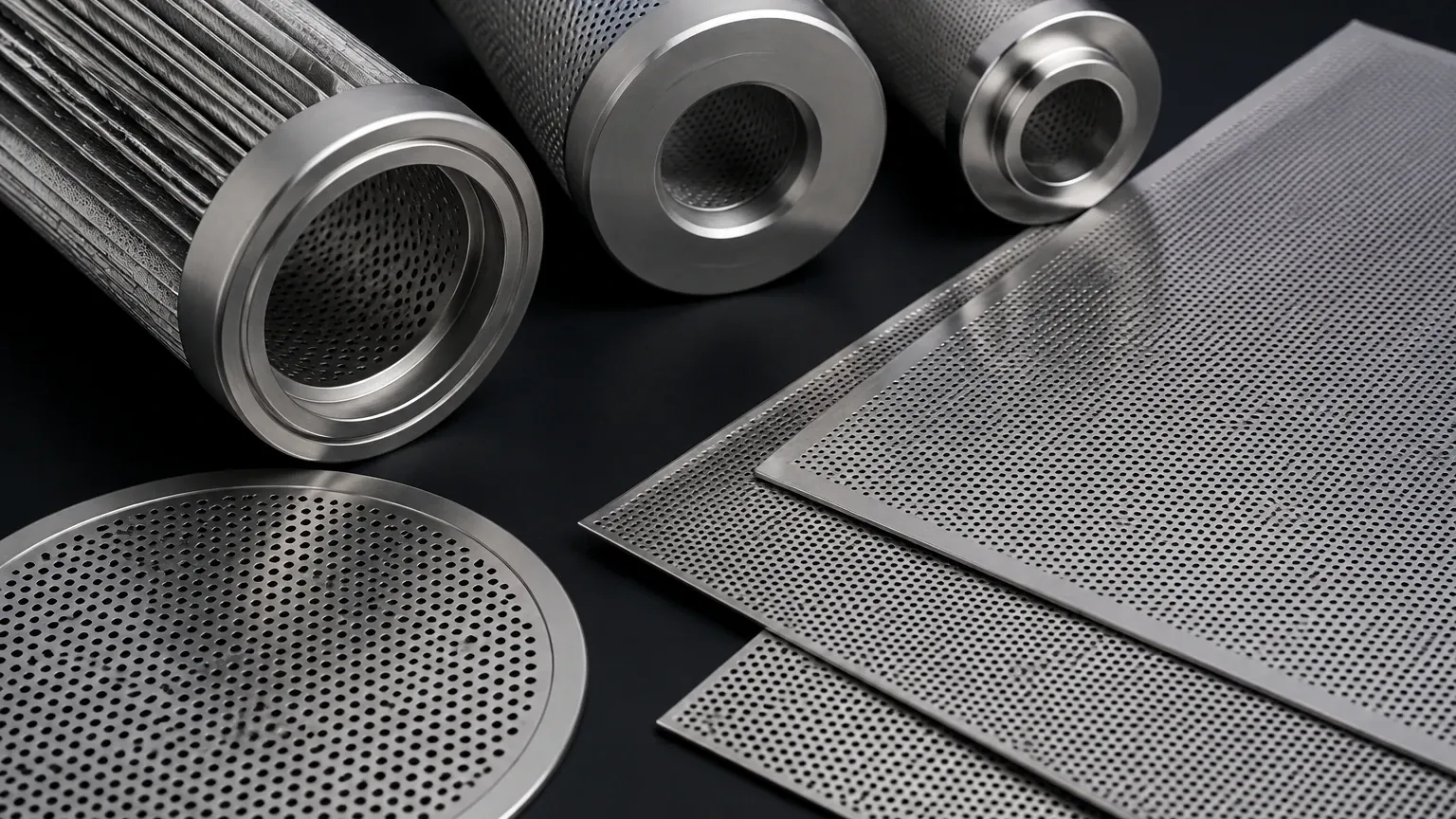
Micro perforated metal is rarely used as a standalone flat sheet in industrial settings. It is typically integrated into complex filter assemblies. For example, a micro perforated layer may be sintered or mechanically bonded to a coarser Perforated & Expanded Metal support core. This multi-layer approach allows the micro-scale layer to handle the precision filtration while the heavier perforated core provides the structural backbone necessary to withstand high-pressure differentials.
Customization is a key factor in successful implementation. OEM manufacturers like Kaifil work with engineers to design specific shapes, such as conical strainers, cylindrical cartridges, or custom-stamped discs. These components are often designed with reinforced margins (unperforated areas) to facilitate welding and mounting into filter housings without compromising the integrity of the micro-perforated zone.
Procurement Checklist: Technical Data for Custom Orders
Before initiating a purchase or a custom design project for micro perforated metal, technical teams should confirm the following data points to ensure the final product meets application requirements:
* Required Filtration Rating: What is the target particle size for retention?
* Operating Temperature and Pressure: What are the maximum and normal operating conditions?
* Chemical Compatibility: What fluids will the filter be exposed to, including cleaning chemicals?
* Flow Rate Requirements: What is the minimum allowable flow and maximum allowable pressure drop?
* Mechanical Interface: How will the filter be installed? (e.g., flange mounted, welded, or friction fit)
* Regulatory Compliance: Does the application require FDA, 3A, or USP Class VI compliance for food or medical safety?
By addressing these factors early in the design phase, engineers can select a micro perforated solution that balances precision, durability, and cost-effectiveness. Whether used in a simple strainer or a complex multi-stage chemical reactor, the right micro perforated metal component is fundamental to achieving reliable and efficient industrial filtration performance.
