


Metrix Perforated Metal
In the landscape of industrial filtration and structural engineering, precision is the primary determinant of performance. Metrix perforated metal refers to high-precision perforated sheets manufactured to exacting metric specifications, often utilized in environments where standard tolerances are insufficient. For engineers and procurement specialists, selecting the correct perforated or expanded metal component involves a deep understanding of material science, fluid dynamics, and mechanical integrity.
As industrial processes become more complex—particularly in the chemical, pharmaceutical, and food processing sectors—the demand for predictable, repeatable filtration results has elevated the importance of precise hole diameters, pitch configurations, and sheet thicknesses. This guide examines the technical nuances of metrix perforated metal, providing the factual foundation necessary for informed industrial selection.
The Role of Precision in Industrial Perforated Metal
Industrial filtration relies on the ability of a medium to allow specific substances to pass while retaining others based on size. Metrix perforated metal serves as the backbone for many of these systems, acting either as the primary filter medium or as a support structure for finer wire mesh. The term "metrix" underscores the shift toward metric-standardized precision, which is essential for global equipment compatibility and high-accuracy engineering calculations.
Precision in perforation affects more than just the size of the particles captured. It influences the structural rigidity of the filter cartridge, the flow rate of the medium, and the ease with which the system can be cleaned or backwashed. When dealing with high-pressure hydraulic systems or volatile chemical processing, even a minor deviation in hole spacing (pitch) can lead to uneven stress distribution, potentially resulting in mechanical failure or bypass leaks.
Technical Specifications: Metric Dimensions and Patterns
When specifying metrix perforated metal, engineers must define several critical parameters that dictate the functionality of the final product. Unlike general-purpose perforated sheets used in architectural applications, industrial-grade components require strict adherence to dimensional tolerances.
Hole Patterns and Pitch
The arrangement of holes is fundamental to both strength and filtration efficiency. The most common configurations include:
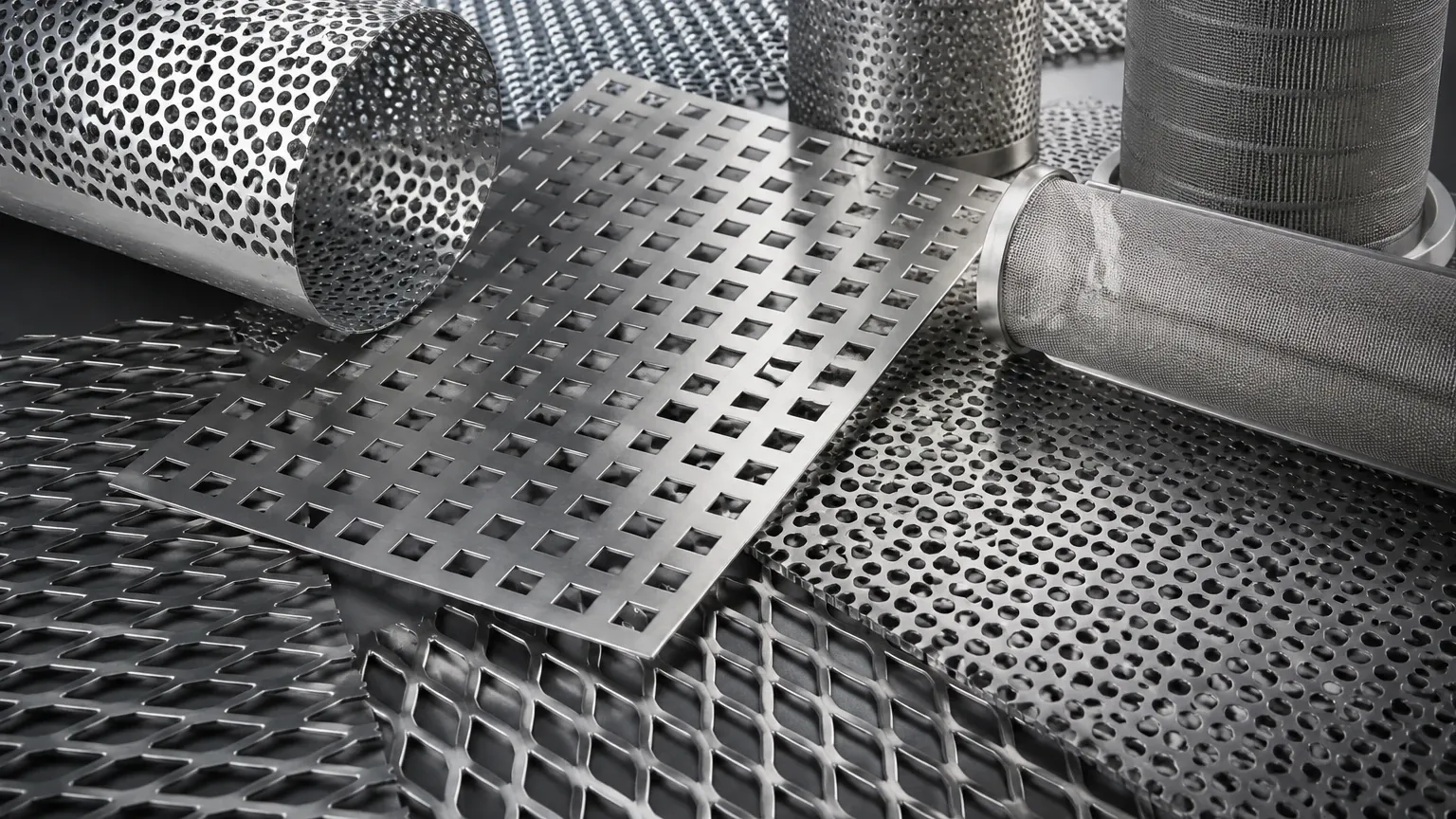
* 60-Degree Staggered: This is the industrial standard due to its inherent strength and high open area. It provides a uniform distribution of holes and is the most efficient pattern for filtration.
* Straight Line: Holes are aligned in both horizontal and vertical rows. While simpler to manufacture, this pattern generally offers lower structural integrity than staggered arrangements.
* 45-Degree Staggered: An alternative to the 60-degree pattern, often used for specific aesthetic or specialized flow requirements.
Dimensional Accuracy
In a metric-specified environment, hole diameters (D) and pitch (P—the distance from the center of one hole to the center of the next) are measured in millimeters. For high-precision applications, tolerances may be as tight as +/- 0.05mm. This level of accuracy ensures that the "open area" calculation remains consistent across the entire surface of the sheet, which is vital for maintaining a constant pressure drop across the filter.
Comparing Perforated & Expanded Metal for Industrial Use
While often discussed together, Perforated & Expanded Metal serve different roles based on their manufacturing processes and physical properties. Understanding these differences is key to optimizing filtration system design.
Perforated Metal Characteristics
Perforated metal is produced by punching holes into a solid sheet of material. This process allows for a high degree of customization regarding hole shape (round, square, hexagonal, or slotted) and precise control over the margins (the unperforated areas at the edges of the sheet). In filtration, perforated metal is preferred when a specific, consistent aperture size is required to ensure exact particle retention.
Expanded Metal Characteristics
Expanded metal is created by simultaneously slitting and stretching a sheet. This results in a diamond-shaped mesh that is formed from a single piece of metal without any joins or welds. Because no material is lost during the process, it is often more cost-effective for large-scale structural supports. However, expanded metal typically offers less precision in aperture size compared to metrix perforated metal, making it more suitable for secondary support layers or coarse filtration rather than fine precision tasks.
Material Selection for Demanding Environments
The longevity of a filtration component is largely determined by its material composition. In industrial settings, stainless steel is the preferred choice due to its mechanical strength and resistance to environmental degradation.
Stainless Steel Grades
* Grade 304: The most common stainless steel used in industrial perforation. It offers excellent corrosion resistance in most atmospheric conditions and is suitable for many food and beverage applications.
* Grade 316/316L: Contains molybdenum, which provides superior resistance to chlorides and acids. This is the standard for marine environments, chemical processing, and pharmaceutical manufacturing where rigorous cleaning protocols (such as CIP – Clean-In-Place) are used.
* Specialty Alloys: For extreme temperatures or highly corrosive chemical baths, alloys like Monel, Inconel, or Hastelloy may be perforated to meet specific metrix standards.
Surface Finishes and Treatments
Beyond the material itself, the surface finish of metrix perforated metal can impact performance. Electropolishing is often used in the pharmaceutical industry to remove microscopic burrs and create a smooth, passive surface that resists bacterial growth and facilitates easier cleaning. For abrasive applications, specialized coatings or heat treatments may be applied to increase surface hardness.
Engineering Considerations: Open Area and Pressure Drop
One of the most critical calculations for any engineer selecting metrix perforated metal is the percentage of open area. This figure represents the ratio of the total area of the holes to the total area of the sheet.
Calculating Open Area
For a standard 60-degree staggered round hole pattern, the formula for open area (OA) is:
$$OA = \frac{D^2 \times 90.69}{P^2}$$
Where:
* D = Hole Diameter
* P = Pitch
A higher open area allows for a higher flow rate and a lower initial pressure drop. However, as the open area increases, the structural strength of the sheet decreases. Engineers must find the "sweet spot" where the metal is open enough to allow efficient flow but strong enough to withstand the differential pressure (ΔP) that occurs as the filter begins to load with contaminants.
Pressure Drop and Flow Dynamics
As fluid or gas passes through the perforations, it experiences resistance. If the metrix perforated metal is used as a support for a fine mesh, the combined pressure drop must be calculated. If the perforated base has insufficient open area, it will become the bottleneck of the system, leading to increased energy consumption by pumps or compressors and shorter service intervals.
Customization and Fabrication for Filtration Systems
Standard off-the-shelf perforated sheets rarely meet the specific needs of advanced industrial filtration. Customization is often necessary to integrate the metal into a larger assembly, such as a basket strainer, a cylindrical filter cartridge, or a vibrating screen.
Fabrication Techniques
* Rolling and Welding: Perforated sheets are often rolled into cylinders. Precision in the metrix specifications ensures that the edges align perfectly for seam welding, maintaining the integrity of the filter's circumference.
* Margin Customization: Custom margins allow for easier welding to end caps or flanges without compromising the perforated pattern near the joints.
* Forming and Deep Drawing: Some applications require the metal to be formed into complex shapes. The ductility of the chosen stainless steel grade must be balanced against the perforation pattern to prevent tearing during the forming process.
OEM and Bespoke Solutions
For manufacturers of original equipment (OEMs), sourcing metrix perforated metal that fits exactly into a proprietary housing is essential. This reduces assembly time and eliminates the need for secondary trimming or adjustment on the production line. Reliability in the supply chain for these custom components is vital for maintaining production schedules.
Industry-Specific Requirements
Different sectors have unique benchmarks for what constitutes high-quality perforated metal.
Food and Beverage
In this industry, the primary concern is hygiene. Perforated metal must be free of "blind spots" where organic material can accumulate. Smooth perforations without burrs are mandatory to prevent contamination. Metrix standards allow for the precise sizing required in sorting and grading equipment for grains, fruits, and pulses.
Pharmaceutical and Biotech
These industries require the highest levels of material traceability and surface finish. Metrix perforated metal used here often undergoes rigorous validation to ensure it meets FDA or equivalent standards. The precision of the holes is critical for centrifugal separation and fluid bed drying processes.
Chemical and Petrochemical
Corrosion resistance and structural integrity under high temperatures are the priorities. Perforated metals in these sectors are often subjected to heavy vibration and high-velocity flow, requiring thicker gauges and robust material grades like 316L or Duplex stainless steels.
Procurement Guide: Evaluating Quality and Performance
When evaluating suppliers for metrix perforated metal, purchasing teams should look beyond the price per sheet. The total cost of ownership is influenced by the product's durability and its impact on system efficiency.
1. Verification of Tolerances: Does the supplier provide a certificate of conformance? Are the metric dimensions verified using calibrated measuring tools?
2. Edge Quality: Are the holes clean-cut, or is there significant burring? Burrs can catch fibers or particles, leading to premature clogging and difficult cleaning.
3. Flatness and Stress: The perforating process can introduce internal stresses into the metal, causing it to curl or buckle. High-quality metrix perforated metal should be leveled after the punching process to ensure it remains flat for subsequent fabrication.
4. Material Certification: Ensure that Mill Test Reports (MTRs) are available to verify the chemical composition of the stainless steel.
By focusing on these technical and quality-driven factors, engineers can ensure that their choice of metrix perforated metal contributes to a reliable, efficient, and long-lasting filtration solution. Whether used as a primary screen or a heavy-duty support, the precision of the perforation is the foundation of industrial performance.
For those seeking specific configurations or technical support regarding material selection and open area calculations, it is advisable to review product options and application support to ensure the chosen solution aligns with the mechanical and chemical demands of the intended environment.
