


Number 6 Expanded Metal
In industrial filtration and structural engineering, the selection of support materials is as critical as the selection of the primary filter media. Expanded metal, a versatile material created by simultaneously slitting and stretching metal sheets, offers a unique combination of structural integrity and open area. Among the various specifications available, number 6 expanded metal stands out as a heavy-duty solution frequently utilized in demanding industrial environments. This guide examines the technical specifications, engineering considerations, and application-specific benefits of utilizing number 6 expanded metal within the broader context of Perforated & Expanded Metal solutions.
Understanding the Technical Specifications of Number 6 Expanded Metal
The term "number 6" in the context of expanded metal typically refers to the gauge of the base metal sheet before the expansion process. In the industrial standard for heavy-duty expanded metal, particularly for gratings and heavy-duty meshes, this designation signifies a material thickness and strength profile suitable for load-bearing and high-pressure applications.
Key Dimensional Parameters
When specifying number 6 expanded metal, engineers must evaluate several critical dimensions that define its performance:
* SWD (Short Way of Design): This is the distance from the center of one bond to the center of the next bond measured across the short diamond diagonal. For a standard 1-1/2" #6 specification, the SWD typically measures approximately 1.33 inches.
* LWD (Long Way of Design): This is the distance measured across the long diamond diagonal. In the same 1-1/2" #6 specification, the LWD is usually around 3.0 inches.
* Strand Thickness: For number 6 expanded metal, the initial thickness of the metal is approximately 0.198 to 0.250 inches, depending on the specific alloy and manufacturer standards.
* Strand Width: This refers to the amount of metal fed into the precision dies to create the strand. For heavy-duty number 6 mesh, this width is substantial, contributing to the overall weight and rigidity of the sheet.
Standard vs. Flattened Expanded Metal
Number 6 expanded metal is available in two primary forms: standard (raised) and flattened.
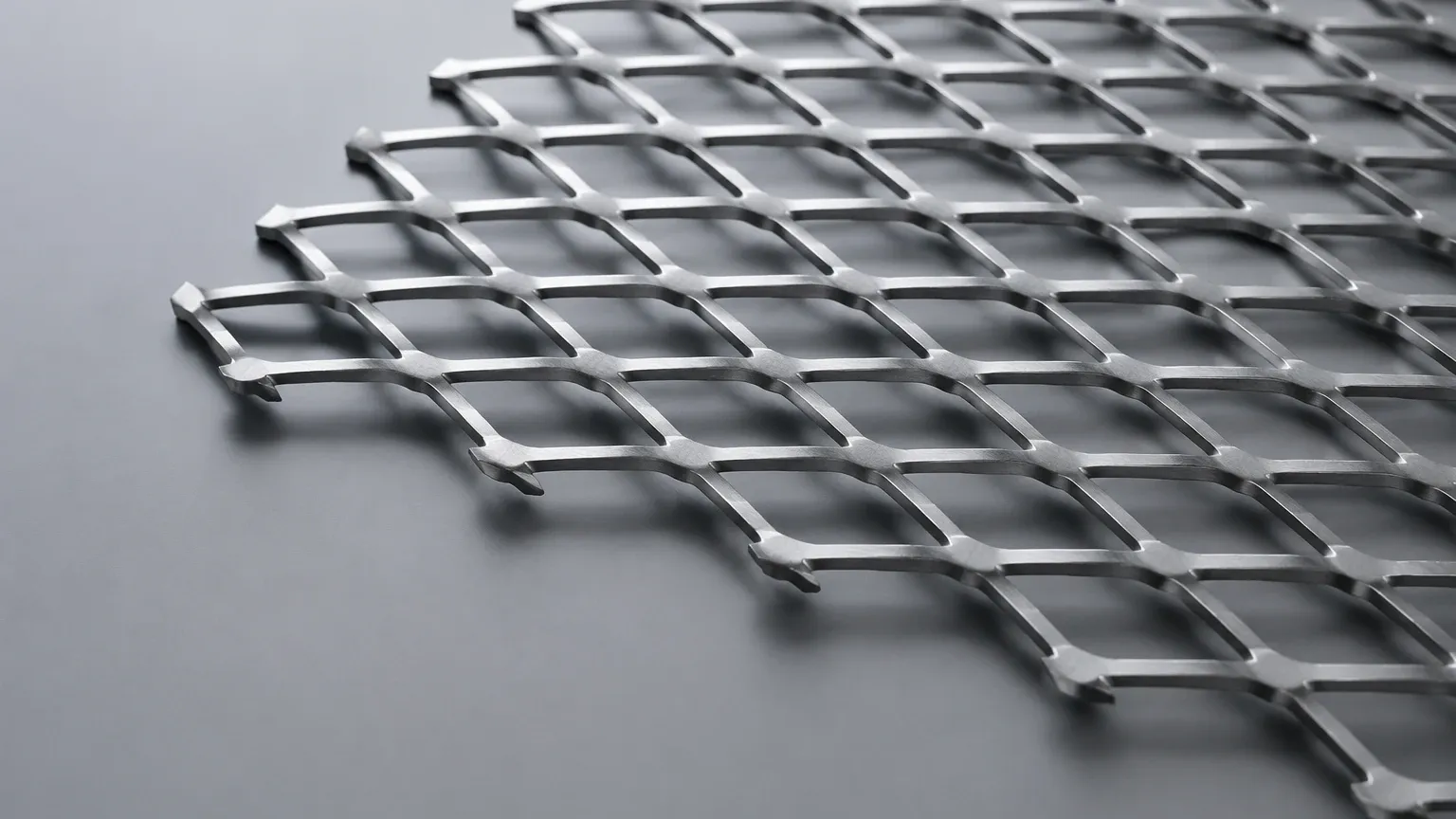
1. Standard Expanded Metal: In this form, the strands and bonds are set at a uniform angle to the plane of the sheet. This creates a three-dimensional surface that provides excellent grip and directional fluid flow characteristics. In filtration, the raised profile can act as a pre-filter for larger particulates or provide a high-friction surface for secondary media attachment.
2. Flattened Expanded Metal: This is produced by passing the standard expanded sheet through a cold-roll reducing mill. This process flattens the strands and bonds into a single plane, reducing the overall thickness and creating a smooth surface. Flattened number 6 expanded metal is often preferred when the mesh serves as an internal support for delicate filter cartridges, as it prevents the abrasion of the primary filter media.
Material Selection for Industrial Environments
The performance of number 6 expanded metal is heavily influenced by the alloy from which it is manufactured. In industrial filtration, where exposure to corrosive chemicals, high temperatures, and high pressures is common, material selection is paramount.
Stainless Steel (304 and 316L)
Stainless steel is the preferred material for most high-performance filtration applications.
* Grade 304: Offers excellent strength and basic corrosion resistance. It is suitable for many food and beverage applications and general industrial uses where chemical exposure is moderate.
* Grade 316L: Contains molybdenum, which significantly enhances resistance to pitting and crevice corrosion in chloride-rich environments. For pharmaceutical and chemical processing, 316L is the industry standard due to its superior durability and ease of sterilization.
Carbon Steel and Specialty Alloys
While carbon steel is a cost-effective option for structural supports in non-corrosive environments, it often requires secondary treatments such as galvanizing or powder coating to prevent oxidation. In specialized aerospace or high-temperature chemical applications, exotic alloys like Monel or Inconel may be specified for number 6 expanded metal to ensure structural integrity under extreme conditions.
Applications in Filtration and Industrial Support
Number 6 expanded metal is characterized by its high strength-to-weight ratio, making it an ideal component in complex filtration systems. Its primary roles include:
1. Support for Secondary Filter Media
In many liquid and gas filtration systems, the primary filtration is performed by a fine wire mesh or a synthetic membrane. These media lack the structural rigidity to withstand high differential pressures. Number 6 expanded metal serves as a robust support cage or core. Its rigid diamond structure prevents the finer media from collapsing or deforming under the force of the flow.
2. Coarse Pre-Filtration
In heavy industrial water treatment or raw chemical processing, number 6 expanded metal can function as a primary coarse filter. It is capable of capturing large debris, such as wood chips, stones, or large scale, protecting downstream pumps and finer filtration stages from mechanical damage.
3. Protective Guards and Enclosures
Beyond the internal components of a filter, this material is widely used for external guards on industrial machinery and filtration housings. Its ability to allow airflow and visibility while providing a physical barrier against impact makes it a staple in safety engineering.
Engineering Considerations for Selection
When integrating number 6 expanded metal into a project, engineers must move beyond basic dimensions and consider the mechanical and hydraulic implications of the material.
Load-Bearing Capacity and Structural Rigidity
The expansion process creates a continuous piece of metal without welds or joints. This inherent continuity allows for better stress distribution. For number 6 expanded metal, the load-bearing capacity is significant. Engineers must calculate the deflection rates based on the span of the mesh and the expected pressure or weight it will encounter. Because the strands are angled in the standard version, the material exhibits different structural properties depending on the orientation (long way vs. short way) relative to the support frame.
Open Area and Flow Dynamics
The percentage of open area determines the pressure drop across the mesh. Number 6 expanded metal typically offers an open area ranging from 40% to 60%, depending on the specific strand width. In filtration design, maximizing open area while maintaining structural support is a delicate balance. A higher open area reduces energy consumption by lowering the resistance to flow, but it may also reduce the rigidity of the support structure.
Directional Flow Characteristics
The angled strands of standard expanded metal can be used to direct fluid or gas flow. In certain reactor designs or large-scale filtration housings, the orientation of the number 6 mesh can be used to promote turbulence or, conversely, to help laminarize flow before it reaches a sensitive sensor or a fine filter stage.
Manufacturing and Customization Options
Standard off-the-shelf expanded metal often fails to meet the precise tolerances required for high-end industrial filtration. Customization is essential for ensuring a perfect fit within filter housings and optimal performance.
Precision Shearing and Forming
Number 6 expanded metal is difficult to cut without specialized industrial equipment due to its thickness and hardness. Precision shearing ensures that the edges are clean and the dimensions are accurate to within fractions of an inch. Furthermore, the material can be rolled into cylinders or formed into custom shapes to serve as the core or outer wrap of a filter cartridge.
OEM Capabilities and Engineering Support
Working with a manufacturer that understands the nuances of filtration is vital. Custom Perforated & Expanded Metal solutions allow for the adjustment of strand widths and opening sizes to meet specific filtration requirements. For instance, if a project requires a specific weight-per-square-foot to meet shipping or installation constraints, the expansion ratio can be adjusted during production.
Installation and Maintenance Best Practices
To ensure the longevity of number 6 expanded metal in an industrial setting, proper installation and maintenance protocols must be followed.
Welding and Fastening
When welding stainless steel number 6 expanded metal, it is critical to use the appropriate filler metal (e.g., 308L or 316L) to maintain the corrosion resistance of the joint. Because the material is relatively thick, TIG or MIG welding is typically used to ensure deep penetration and a strong bond to the surrounding frame. If mechanical fasteners are used, they must be compatible with the base metal to prevent galvanic corrosion.
Cleaning and Replacement Cycles
In filtration applications, expanded metal can accumulate "cake" or debris over time. While the diamond structure is relatively easy to clean via backwashing or ultrasonic cleaning, the intersections of the strands (the bonds) can trap small particles. Regular inspection is necessary to identify signs of erosion or chemical attack. In high-wear environments, number 6 expanded metal is often treated as a semi-permanent component with a replacement cycle dictated by the integrity of the support it provides to the primary media.
Total Cost of Ownership and Procurement
While the initial cost of number 6 expanded metal in stainless steel is higher than carbon steel or lighter gauges, the total cost of ownership is often lower due to its durability.
Factors Influencing Cost
* Material Volatility: The prices of nickel and chromium directly impact the cost of stainless steel alloys.
* Processing Complexity: Flattening and precision shearing add to the labor and machine time required.
* Volume: Large-scale industrial projects benefit from economies of scale in the expansion process.
Information to Confirm Before Ordering
Before finalizing a procurement order for number 6 expanded metal, purchasing teams and engineers should confirm the following:
1. Exact Alloy Grade: Ensure the grade matches the chemical environment (e.g., 316L for marine or pharmaceutical use).
2. Dimensional Tolerances: Specify the allowable variance in SWD, LWD, and overall sheet size.
3. Surface Finish: Determine if the material requires pickling, passivating, or electropolishing to meet hygiene or corrosion standards.
4. Orientation: For structural applications, specify whether the LWD should run parallel or perpendicular to the long dimension of the sheet.
By focusing on these technical details, industrial professionals can ensure that their selection of number 6 expanded metal provides the necessary support and performance for their specific filtration or structural application. For more detailed specifications and custom design support, engineers are encouraged to consult with specialists in the field of industrial metal components.
