


Open Area Calculator for Perforated Metal
In industrial filtration and structural engineering, the "open area" of a metal sheet is one of the most critical variables determining performance. Whether you are designing a high-pressure hydraulic filter, a chemical processing strainer, or an architectural screen, understanding the precise ratio of perforated space to solid material is essential for calculating flow rates, pressure drops, and mechanical strength.
An open area calculator for perforated metal allows engineers to determine the percentage of the sheet that is comprised of holes. This figure directly impacts the efficiency of the filtration system. At Kaifil, where we specialize in Perforated & Expanded Metal for demanding industrial environments, we recognize that a minor miscalculation in open area can lead to system failure, excessive energy consumption, or structural collapse under load.
The Technical Significance of Open Area
Open area is expressed as a percentage. For example, a sheet with a 40% open area means that 40% of the material has been removed by the perforation process, leaving 60% of the original solid metal. From an engineering perspective, this percentage dictates several key performance indicators:
1. Flow Capacity: In filtration applications, the open area determines how much fluid or gas can pass through the medium per unit of time.
2. Pressure Drop (Delta P): A lower open area increases resistance to flow, leading to a higher pressure drop across the filter. This requires more pumping power and can lead to premature clogging.
3. Structural Integrity: As the open area increases, the mechanical strength of the sheet decreases. Engineers must balance the need for high flow with the requirement for the metal to withstand the operating pressure and physical stress of the application.
4. Filtration Accuracy: While the open area tells you the total volume of flow, the individual hole size and pattern determine the size of particles that will be retained.
How to Use an Open Area Calculator for Perforated Metal
Calculating the open area manually requires specific geometric formulas based on the hole pattern. Most industrial applications utilize round, square, or hexagonal holes in either staggered or straight-row configurations. Below are the standard engineering formulas used in an open area calculator for perforated metal.
Round Holes, 60° Staggered Pattern
This is the most common and efficient pattern for industrial filtration because it provides the highest strength-to-open-area ratio. The holes are arranged so that the center of one hole forms an equilateral triangle with the centers of the adjacent holes.
Formula:
`Open Area % = (D² × 90.69) / P²`
*Where:*
* D = Hole Diameter
* P = Pitch (Center-to-center distance between holes)
Round Holes, Straight Line Pattern
In this configuration, holes are aligned in both vertical and horizontal rows. This pattern is less common in high-pressure filtration because it is structurally weaker than the staggered arrangement.
Formula:
`Open Area % = (D² × 78.54) / P²`
Square Holes, Straight Line Pattern
Square holes are often used for high-flow applications where maximum open area is required, though they are more prone to stress concentrations at the corners.
Formula:
`Open Area % = (S² × 100) / P²`
*Where:*
* S = Side length of the square hole
* P = Pitch
Hexagonal (Honeycomb) Pattern
Hexagonal perforations offer an extremely high open area (up to 80% or more) and are frequently used in ventilation and high-efficiency gas filtration.
Formula:
`Open Area % = (D² × 100) / P²` (Note: This varies slightly based on the specific bridge width between hexagons).
Engineering Considerations Beyond the Formula
While an open area calculator for perforated metal provides a theoretical percentage, real-world manufacturing introduces variables that engineers must account for during the specification phase.
1. Edge Margins and Unfinished Areas
Standard calculations assume the perforation pattern extends to the very edge of the sheet. However, most industrial filter components require "margins"—solid metal borders used for welding, forming, or seating the filter into a housing. If a sheet has wide margins, the *effective* open area of the total component will be lower than the calculated percentage of the perforated section alone.
2. Material Thickness and Hole Aspect Ratio
A common rule of thumb in the perforation industry is that the hole diameter should not be smaller than the material thickness. For example, if you are using 316L stainless steel that is 2mm thick, the holes should ideally be 2mm or larger. Attempting to perforate holes smaller than the thickness increases the risk of tool breakage and can result in irregular hole shapes, which affects the accuracy of the open area.
3. The Impact of Burrs and Surface Finishing
In precision filtration, the presence of internal burrs can reduce the effective open area and create turbulence. Kaifil utilizes advanced deburring and polishing processes to ensure that the calculated open area matches the actual flow performance. If the application involves high-viscosity fluids, surface roughness can also contribute to a higher-than-expected pressure drop.
Comparing Perforated & Expanded Metal for Filtration
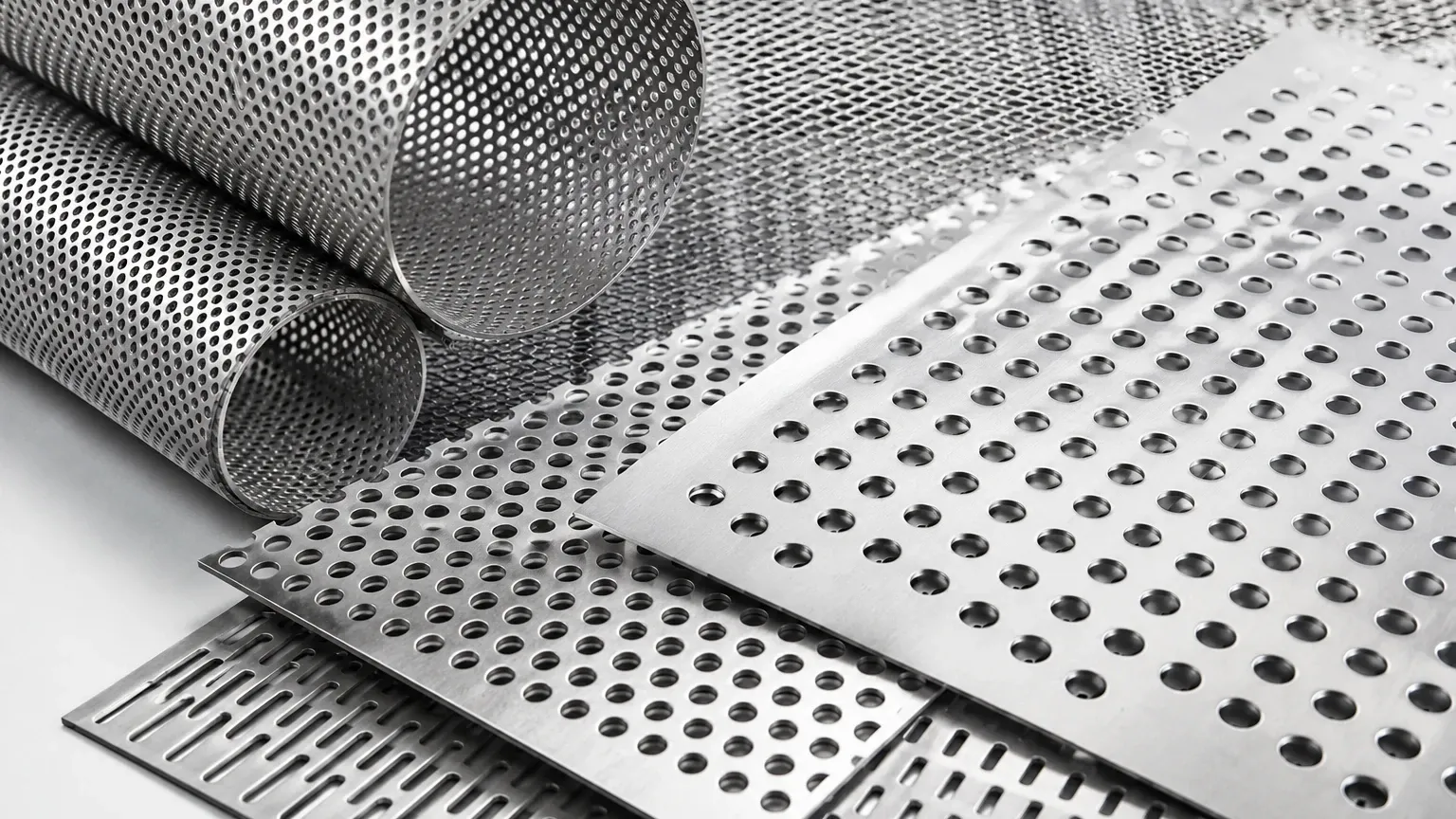
When selecting a filtration medium, engineers often compare Perforated & Expanded Metal. While both provide open area, their characteristics differ significantly.
* Perforated Metal: Offers precise control over hole size and placement. The open area is consistent and predictable, making it ideal for validated pharmaceutical or food-grade filtration where specific particle retention is required.
* Expanded Metal: Created by slitting and stretching a single sheet. This process creates diamond-shaped openings. While expanded metal is more cost-effective (as there is no material waste), calculating its open area is more complex because the "strands" are turned at an angle. Expanded metal is often used as a support layer for finer mesh filters rather than the primary filtration stage.
Common Risks in Open Area Selection
Selecting the wrong open area can lead to significant operational risks. If the open area is too low, the system may experience "blinding" or clogging much faster than anticipated. This increases maintenance frequency and reduces the lifespan of the filter cartridge. Conversely, if the open area is too high, the structural integrity of the stainless steel may be compromised, leading to deformation under hydraulic surges.
Another risk involves the "Bridge Width"—the amount of solid metal between the holes. If the bridge is too narrow, the metal may crack during the forming process (such as rolling the sheet into a cylinder for a filter cartridge). A reliable manufacturer like Kaifil evaluates the relationship between hole size, pitch, and material thickness to ensure the final product is both functional and durable.
Technical Checklist for Procurement and Design
Before finalizing a design based on an open area calculator for perforated metal, engineering and purchasing teams should confirm the following technical details with their supplier:
* Material Grade: Is the material compatible with the chemical environment? (e.g., 304 vs. 316L vs. Duplex stainless steel).
* Hole Direction: For staggered patterns, does the stagger run parallel or perpendicular to the length of the sheet? This affects the flow dynamics and the bending strength of the component.
* Tolerance Requirements: What is the allowable variance in hole diameter and pitch? In high-precision applications, even a 5% variance can significantly impact the total open area.
* Secondary Processing: Will the perforated sheet be rolled, welded, or pleated? These processes can slightly alter the hole geometry and the resulting open area.
* Total Cost of Ownership: While a high open area might reduce energy costs (lower pressure drop), it might increase the initial cost due to more complex tooling or slower production speeds.
Conclusion
Accurately determining the open area is the foundation of effective industrial filtration design. By using an open area calculator for perforated metal and accounting for mechanical constraints such as material thickness and margins, engineers can optimize their systems for both performance and longevity.
Kaifil provides comprehensive OEM and customized filtration solutions, leveraging advanced manufacturing to deliver precision metal components. Whether you require standard patterns or complex custom designs, our team supports global customers in achieving reliable, cost-effective filtration performance across the chemical, pharmaceutical, and water treatment sectors. Confirming your calculations with a technical partner ensures that your Perforated & Expanded Metal components meet the rigorous demands of your specific application.
