


Open Area of Expanded Metal
In industrial filtration and structural engineering, the open area of expanded metal is a fundamental metric that determines the performance, efficiency, and safety of a component. For engineers and procurement specialists sourcing materials for chemical processing, food and beverage production, or hydraulic systems, understanding how to calculate and optimize this percentage is critical. The open area refers to the ratio of the openings (the holes) to the total area of the sheet, expressed as a percentage. This value directly influences fluid dynamics, pressure drop, and the mechanical strength of the filter or support structure.
Selecting the correct Perforated & Expanded Metal specification requires a balance between high throughput and structural integrity. At Kaifil, we specialize in manufacturing custom stainless steel filtration solutions where the geometry of the expanded metal is engineered to meet specific industrial demands. This article provides a technical overview of the open area of expanded metal, the variables that govern it, and the engineering considerations necessary for effective application.
Understanding the Geometry of Expanded Metal
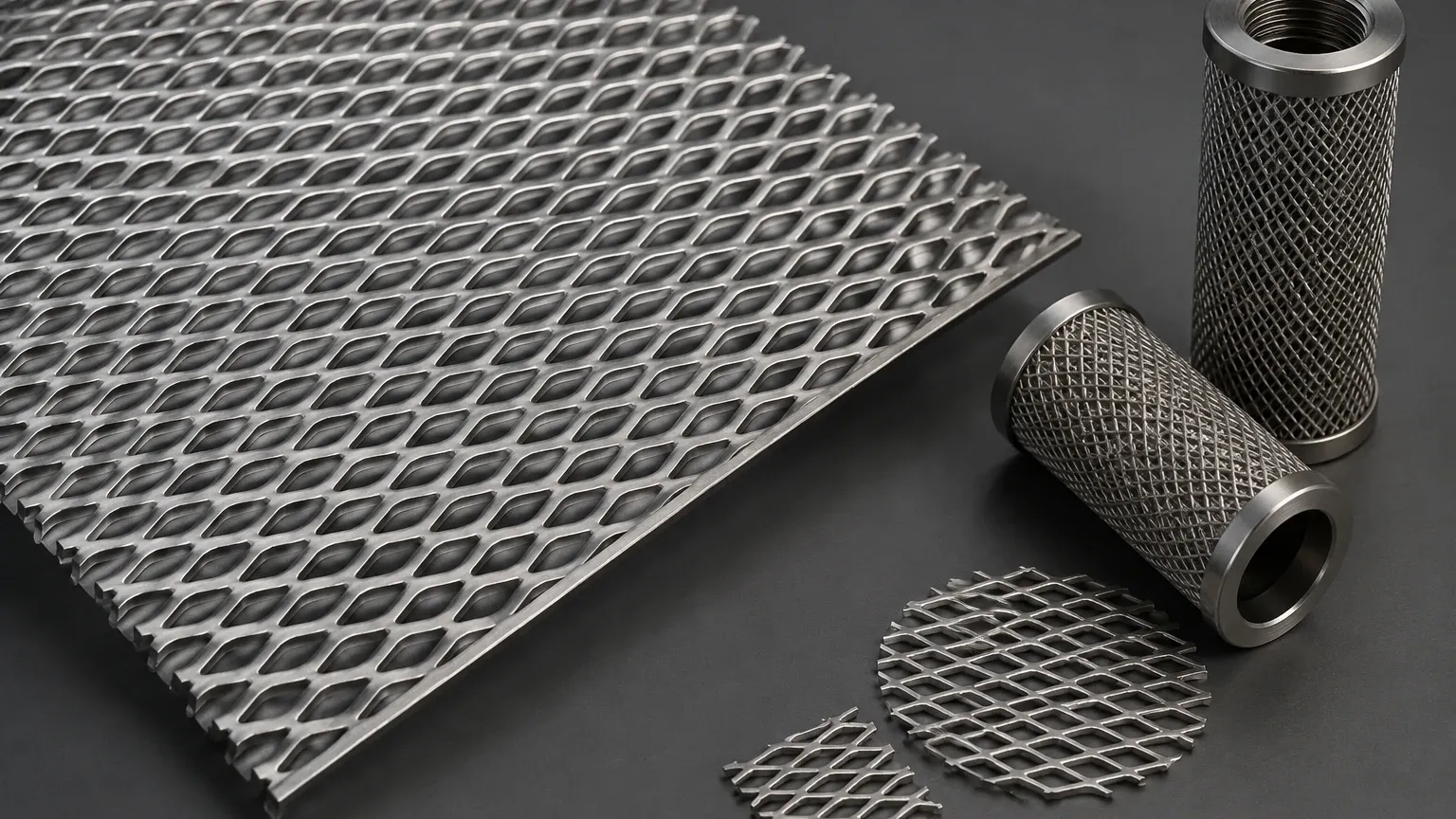
Unlike perforated metal, which is created by punching holes and removing material, expanded metal is produced by simultaneously slitting and stretching a solid metal sheet. This process creates a diamond-shaped pattern without any material waste. Because the metal is stretched, the resulting strands are set at an angle to the plane of the sheet. This unique geometry means that the "open area" is not as straightforward as it is in a flat perforated sheet.
To define the open area, one must first understand the standard terminology used in the industry:
* SWD (Short Way of Design): The distance from the center of one bond to the center of the next bond measured across the short diamond diagonal.
* LWD (Long Way of Design): The distance from the center of one bond to the center of the next bond measured across the long diamond diagonal.
* SWO (Short Way of Opening): The actual width of the opening measured from the inside of the bonds.
* LWO (Long Way of Opening): The actual length of the opening measured from the inside of the bonds.
* Strand Width: The amount of metal fed into the expanding machine for each stroke.
* Strand Thickness: The thickness of the original base metal.
When calculating the open area of expanded metal, engineers must distinguish between "Standard" (raised) and "Flattened" expanded metal. In standard expanded metal, the strands are tilted. The "apparent" open area changes depending on the angle at which fluid or light passes through the mesh. In flattened expanded metal, the sheet is passed through a cold-rolling mill, which levels the strands into the same plane as the sheet, providing a consistent two-dimensional open area.
Calculating the Open Area of Expanded Metal
For technical specifications, the open area is typically calculated based on the two-dimensional projection of the openings. The formula for determining the percentage of open area in expanded metal is generally derived from the relationship between the strand width and the short way of design (SWD).
A common engineering formula used to estimate the open area is:
Open Area % = (1 – (Strand Width × 2) / SWD) × 100
This formula assumes a standard diamond pattern. However, because the expanding process involves stretching the material, the actual dimensions can vary slightly based on the ductility of the metal and the precision of the tooling. For high-precision filtration applications, such as those used in pharmaceutical or chemical processing, it is essential to confirm these values through physical measurement or manufacturer-provided data sheets.
It is important to note that increasing the strand width will decrease the open area but increase the structural strength and weight of the mesh. Conversely, increasing the SWD while keeping the strand width constant will increase the open area and throughput but may reduce the mesh's ability to withstand high differential pressures.
Engineering Impact on Filtration Performance
In the context of industrial filtration, the open area of expanded metal is the primary variable affecting flow resistance and particle retention. When expanded metal is used as a primary filter or a support layer for finer wire mesh, its characteristics must be carefully aligned with the system's hydraulic requirements.
Pressure Drop and Flow Rate
A higher open area percentage correlates with a lower pressure drop across the filter element. In hydraulic systems and water treatment plants, minimizing pressure drop is essential to reduce energy consumption and prevent pump cavitation. If the open area is too restrictive, the velocity of the fluid through the openings increases, which can lead to turbulence and accelerated wear on the filter media.
Particle Retention and Pre-filtration
Expanded metal is often utilized as a pre-filter to capture large debris before the process fluid reaches more delicate, high-precision filter cartridges. The SWO and LWO dimensions define the maximum particle size that can pass through the mesh. Engineers must ensure that the open area of expanded metal is sufficient to prevent premature clogging (blinding) while still providing the necessary protection for downstream components.
Support for Fine Mesh
In many of Kaifil’s custom stainless steel filter cartridges, expanded metal serves as a rigid support cage for pleated or cylindrical wire mesh. In these designs, the open area must be maximized to ensure that the support structure does not block the active filtration surface of the finer mesh, while remaining strong enough to prevent the mesh from collapsing under high-pressure loads.
Structural Integrity vs. Open Area Trade-offs
One of the most challenging aspects of filter design is balancing the need for a high open area with the requirement for mechanical durability. Expanded metal is inherently strong because it is made from a single piece of metal; there are no welds or joints to fail. However, as the open area increases, the amount of metal (the "web") decreases, which affects several mechanical properties:
1. Load-Bearing Capacity: In applications where the filter is subject to heavy sludge loads or high-viscosity fluids, the expanded metal must resist deformation. A lower open area with wider strands provides greater stiffness.
2. Corrosion Allowance: In aggressive chemical environments, even stainless steel (304 or 316L) will experience some surface degradation over time. A design with very thin strands and a very high open area may have a shorter service life because there is less sacrificial material available before the structural integrity is compromised.
3. Vibration Resistance: In industrial machinery, filters are often subject to mechanical vibrations. A mesh with an optimized open area and robust strand thickness is less likely to suffer from fatigue cracking at the bonds.
Material Selection and Customization
The material used to manufacture expanded metal significantly influences its performance in industrial environments. At Kaifil, we primarily utilize stainless steel due to its exceptional corrosion resistance and thermal stability.
* Grade 304 Stainless Steel: Suitable for general industrial applications, food processing, and water treatment where moderate corrosion resistance is required.
* Grade 316L Stainless Steel: Preferred for pharmaceutical, marine, and highly acidic chemical environments due to its superior resistance to pitting and crevice corrosion.
* Specialty Alloys: For extreme temperatures or highly specialized chemical processes, materials like Monel or Inconel can be expanded, though these are typically reserved for specific OEM requirements.
Customization goes beyond material choice. Engineers can specify the degree of flattening, the orientation of the diamonds (parallel or perpendicular to the flow), and the edge configurations. For instance, in cylindrical filter cartridges, the expanded metal can be formed into a tube with a precision-welded seam, ensuring that the open area remains consistent across the entire circumference of the filter.
Evaluation Criteria for Purchasing Teams
When evaluating expanded metal components for a project, purchasing teams and engineers should confirm several key factors to ensure the product meets the intended performance specifications:
1. Verified Open Area Calculations: Request the manufacturer’s technical data sheet that specifies the calculated open area for the specific LWD/SWD and strand width combination.
2. Dimensional Tolerances: In precision filtration, even small variations in strand width can significantly impact the open area and flow characteristics. Ensure the supplier adheres to tight manufacturing tolerances.
3. Surface Finish: For food and beverage or pharmaceutical applications, the expanded metal must be free of burrs and sharp edges. Electropolishing or mechanical polishing may be required to ensure the component is cleanable and meets sanitary standards.
4. Flattened vs. Raised: Clearly define whether the application requires the three-dimensional profile of raised expanded metal (which can help with mechanical bonding in composite filters) or the smooth, flat profile of flattened expanded metal (which is easier to clean and provides a consistent thickness).
Conclusion
The open area of expanded metal is a critical design parameter that bridges the gap between filtration efficiency and mechanical strength. By carefully selecting the diamond dimensions and strand characteristics, engineers can optimize their systems for maximum throughput and durability. Whether used as a primary filtration media or a robust support structure within a complex filter assembly, expanded metal provides a versatile and cost-effective solution for demanding industrial environments.
Kaifil remains committed to providing high-performance, customized filtration components. By understanding the technical nuances of expanded metal geometry, we help our clients achieve reliable and efficient filtration performance across a wide range of industrial sectors. For those seeking specific configurations or technical advice on material selection, reviewing the available Perforated & Expanded Metal options is the first step toward a tailored filtration solution.
