


Perforated Metal 3d Model Free
In the realm of industrial engineering and filtration system design, the transition from conceptualization to physical manufacturing requires high-precision spatial planning. Engineers and designers often begin this process by seeking a perforated metal 3d model free of charge to serve as a placeholder or a baseline for their CAD (Computer-Aided Design) assemblies. While these digital assets are invaluable for visualizing layouts and checking clearances, the jump from a generic 3D model to a high-performance industrial component involves complex technical considerations that go beyond simple geometry.
For industries such as chemical processing, food and beverage, and pharmaceuticals, the choice between Perforated & Expanded Metal components is dictated by flow rates, pressure drops, and structural integrity. Understanding how to utilize 3D models effectively while accounting for real-world manufacturing constraints is essential for optimizing filtration performance and ensuring long-term durability.
The Role of 3D Modeling in Industrial Filtration Design
3D modeling has revolutionized how industrial filtration systems are developed. By using CAD software, engineers can simulate the integration of filter cartridges, support baskets, and screens within complex piping networks or processing vessels. A perforated metal 3d model free download from a public repository can provide a quick visual representation of hole patterns and sheet thickness, allowing designers to assess the aesthetic and basic spatial requirements of a project.
However, in B2B environments where filtration accuracy is measured in microns and structural failure can lead to significant downtime, the 3D model must be more than a visual aid. It must represent the physical properties of the material, including the open area percentage, which directly impacts the hydraulic performance of the system. Engineers use these models to perform Computational Fluid Dynamics (CFD) simulations, predicting how fluids will interact with the perforated surface. If the model does not accurately reflect the pitch, hole diameter, or bridge width of the actual manufactured product, the simulation results will be fundamentally flawed.
Understanding the Technical Differences: Perforated vs. Expanded Metal
When sourcing or modeling components, it is vital to distinguish between perforated and expanded metal, as their manufacturing processes and performance characteristics differ significantly.
Perforated Metal
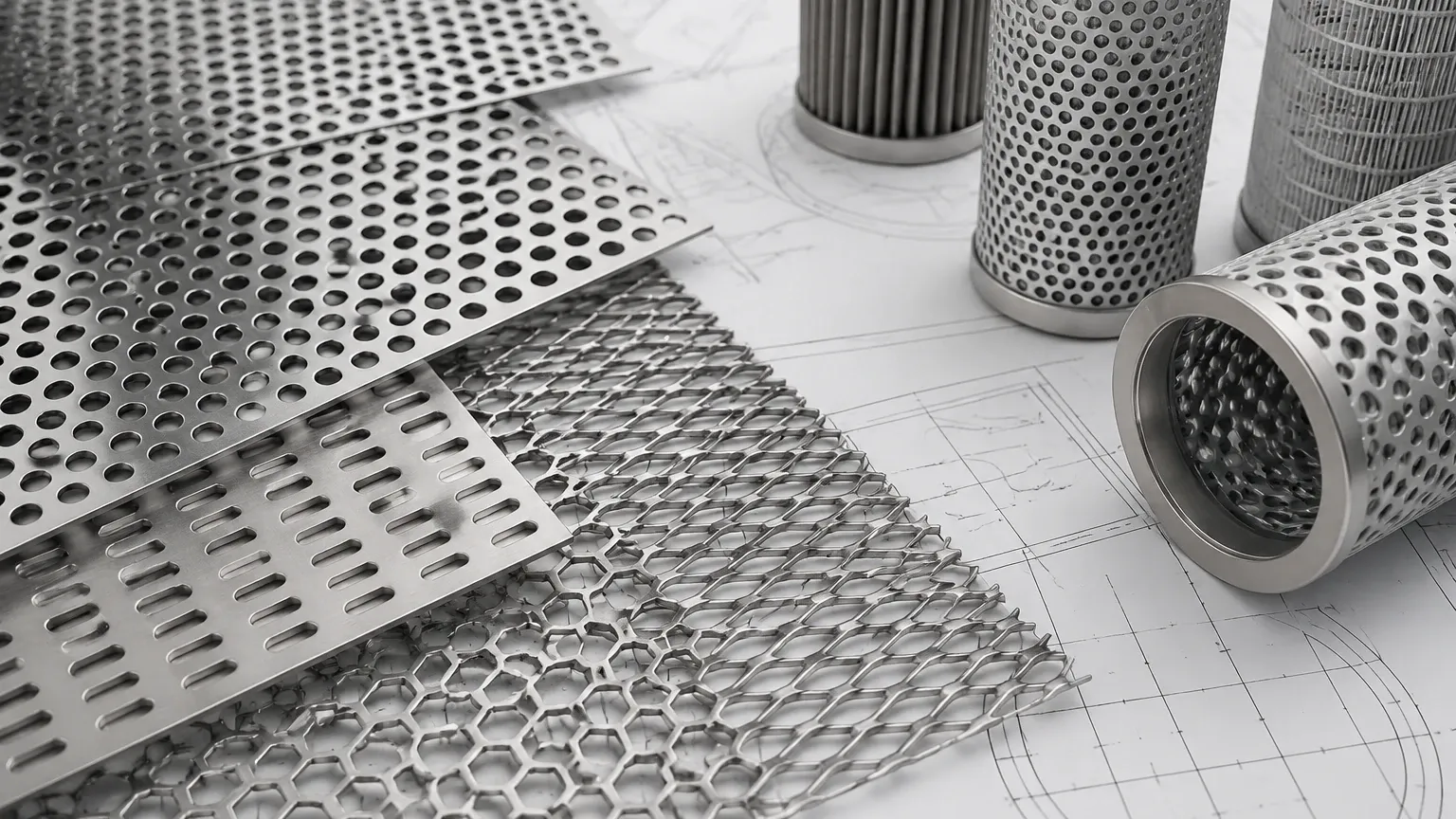
Perforated metal is created through a punching process where CNC machinery removes sections of a metal sheet to create a specific pattern of holes. This allows for extreme precision in terms of hole size, shape (round, square, slotted, or decorative), and spacing. In a 3D model, perforated metal is often represented as a solid sheet with a mapped texture or physical holes. For high-precision filtration, the physical hole geometry is preferred in the model to ensure accurate flow simulations.
Expanded Metal
Expanded metal is produced by simultaneously slitting and stretching a sheet of metal. This process creates diamond-shaped openings without any material waste. Unlike perforated metal, expanded metal has a three-dimensional profile where the strands are set at an angle to the plane of the sheet. This provides a high strength-to-weight ratio and excellent grip, making it ideal for support structures in filter cartridges. Modeling expanded metal is significantly more complex than perforated metal due to these angled strands, and a standard perforated metal 3d model free download will rarely capture the nuances of an expanded metal mesh.
Challenges with Generic "Perforated Metal 3d Model Free" Resources
While free 3D models are a useful starting point, professional engineers must be aware of several common pitfalls associated with generic digital assets found on the web:
1. Lack of Parametric Data: Many free models are static meshes (like STL files) rather than parametric CAD files (like STEP or SolidWorks files). This makes it difficult to adjust the hole size, pitch, or sheet thickness to match the specific requirements of a custom filtration project.
2. Inaccurate Open Area Calculations: The "open area" is the ratio of the area of the holes to the total area of the sheet. Generic models may not accurately calculate this, leading to errors in flow rate and pressure drop estimations.
3. Manufacturing Non-Viability: A digital model can easily depict a pattern that is physically impossible or prohibitively expensive to manufacture. For example, if the bridge width (the distance between holes) is too small relative to the material thickness, the metal may warp or tear during the punching process.
4. Material Properties: A free model rarely includes metadata regarding material grades, such as 304 or 316L stainless steel, which are critical for chemical compatibility and corrosion resistance in industrial environments.
Engineering Specifications for Accurate 3D Filtration Models
To move from a generic placeholder to a functional engineering tool, the model must incorporate specific technical data. When evaluating Perforated & Expanded Metal for a project, engineers should confirm the following specifications:
Hole Pattern and Pitch
The arrangement of holes—whether staggered (60-degree or 45-degree) or straight—affects both the strength of the sheet and the efficiency of the filtration. Staggered patterns are generally preferred for filtration because they provide a higher open area and more uniform flow distribution.
Open Area Percentage
This is a critical variable for any filtration system. A higher open area reduces the pressure drop across the filter but may decrease the structural rigidity of the component. Engineers must balance these two factors based on the operating pressure of the application.
Margins and Blank Areas
In real-world manufacturing, perforated sheets often require unperforated margins for welding or mounting. A standard perforated metal 3d model free often depicts a "full bleed" pattern, which may not be feasible if the component needs to be rolled into a cylinder or welded into a frame. Specifying margins in the design phase prevents assembly issues during the production stage.
Material Selection and Performance Expectations
The performance of a perforated or expanded metal component is heavily dependent on the material grade. In industrial filtration, stainless steel is the standard due to its durability and resistance to oxidation.
* Stainless Steel 304: Suitable for general-purpose applications, providing good corrosion resistance and formability. It is commonly used in food processing and water treatment.
* Stainless Steel 316L: Contains molybdenum, which provides superior resistance to chlorides and acids. This is the preferred choice for pharmaceutical and chemical processing environments where aggressive cleaning agents or corrosive fluids are present.
* Specialty Alloys: For high-temperature or extreme high-pressure environments, alloys like Monel or Hastelloy may be required.
When designing a 3D model, the thickness of the material (gauge) must be accurately represented. Thicker materials provide greater burst strength—essential for hydraulic applications—but require more force to perforate, which can limit the minimum hole size achievable.
From Digital Model to Industrial Reality: Customization Options
Once the initial design phase using a perforated metal 3d model free is complete, the next step is collaborating with a manufacturer to refine the design for production. Customization is often necessary to meet the unique demands of specialized industrial processes.
Kaifil specializes in bridging the gap between digital design and physical manufacturing. Customization options include:
* Precision Hole Sizing: Tailoring the perforation size to target specific particle retention levels.
* Custom Shapes and Forming: Beyond flat sheets, perforated metal can be rolled, folded, or stamped into complex geometries such as conical strainers or multi-layered filter cartridges.
* Surface Finishing: Options like electropolishing or passivating are critical for pharmaceutical and food-grade applications to ensure a smooth, burr-free surface that prevents bacterial growth and facilitates easy cleaning.
* Integration with Wire Mesh: Often, perforated metal serves as a high-strength support layer for finer wire mesh layers in a sintered or pleated filter construction.
Total Cost Considerations and Sourcing Strategies
When purchasing industrial filtration components, the "total cost of ownership" (TCO) should be prioritized over the initial purchase price. A low-cost, off-the-shelf perforated sheet may seem economical initially, but if it lacks the precision required for the application, it can lead to frequent clogging, higher energy consumption due to pressure drops, or premature failure.
Key factors influencing the TCO include:
* Replacement Cycles: High-quality stainless steel components manufactured to precise tolerances typically have longer service lives, reducing the frequency of maintenance shutdowns.
* Filtration Efficiency: Properly engineered open areas optimize flow rates, which can significantly reduce the energy requirements of pumps and processing equipment.
* Ease of Cleaning: Precision-manufactured perforated metal with consistent hole geometries is easier to backwash or chemically clean, extending the time between deep-cleaning cycles.
Engineers should work closely with manufacturers to ensure that the final product matches the intent of the original 3D model. Providing the manufacturer with detailed CAD files and performance requirements allows for a more accurate quote and ensures that the finished Perforated & Expanded Metal component performs as expected in the field.
Conclusion
While a perforated metal 3d model free is a convenient tool for the early stages of industrial design, it is only a small part of the engineering journey. Successful filtration solutions require a deep understanding of material science, fluid dynamics, and manufacturing capabilities. By focusing on accurate specifications—such as material grade, open area, and hole pattern—and partnering with an experienced manufacturer like Kaifil, engineering teams can ensure their designs translate into reliable, high-performance filtration components that meet the rigorous demands of modern industry.
