


Perforated Metal Adalah
In the industrial landscape, the term perforated metal adalah refers to a foundational material used extensively for filtration, separation, and structural support. Translated from Indonesian as "perforated metal is," the term encompasses sheet metal—typically stainless steel, aluminum, or carbon steel—that has been mechanically stamped or punched to create a specific pattern of holes, slots, or decorative shapes. For engineers and procurement specialists in the chemical, pharmaceutical, and food processing sectors, understanding the technical nuances of perforated and expanded metal is essential for optimizing filtration efficiency and equipment longevity.
At Kaifil, we specialize in the manufacturing of high-precision stainless steel filtration components. By integrating advanced manufacturing capabilities with deep engineering knowledge, we provide customized solutions that address the specific challenges of demanding industrial environments. This guide explores the technical specifications, application logic, and selection criteria for perforated metal within the context of industrial filtration.
Technical Definition and Manufacturing Process
To understand what perforated metal adalah in a technical sense, one must look at the precision manufacturing process. Unlike woven wire mesh, which is created by interlacing wires, perforated metal is a subtractive manufacturing product. The process involves feeding a metal coil or sheet through a machine equipped with a die and punch set. As the sheet moves, the punches descend to remove "slugs" of metal, leaving behind a precise pattern of openings.
Perforated vs. Expanded Metal
While often grouped together, perforated and expanded metals serve different structural and filtration roles.
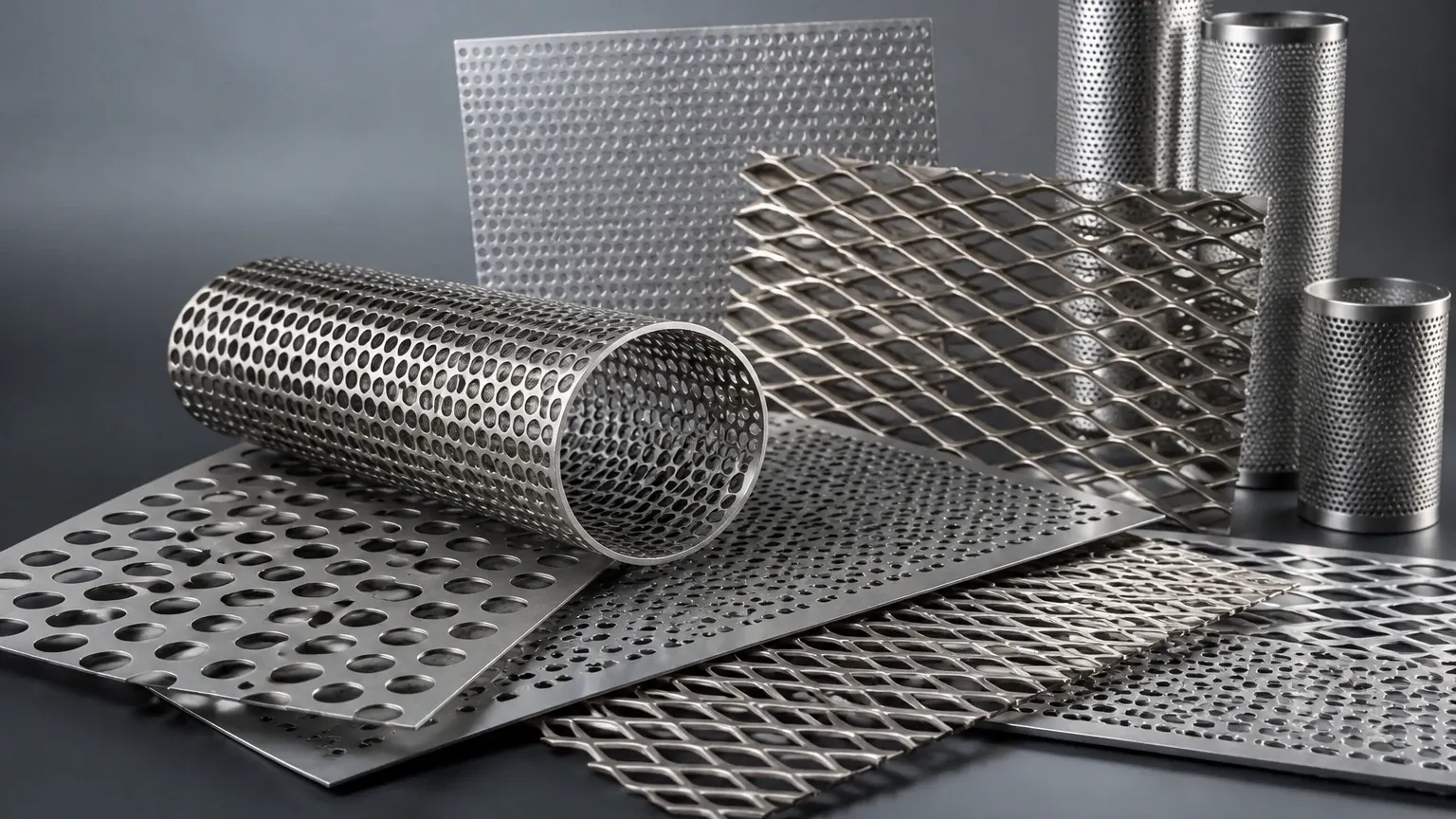
* Perforated Metal: Created by punching holes. This method allows for high precision in hole size and spacing (pitch), making it ideal for applications requiring specific flow rates or particle retention levels.
* Expanded Metal: Created by shearing and stretching the metal simultaneously. This results in diamond-shaped openings. Because no material is lost during production, it is often more cost-effective for structural support, though it offers less precision in filtration compared to perforated options.
For most high-performance filtration systems, Perforated & Expanded Metal components are chosen based on the required mechanical strength and the specific nature of the fluid or gas being processed.
Material Selection for Industrial Environments
In B2B industrial applications, material selection is the most critical factor in determining the service life of a filter component. Because perforated metal is often exposed to corrosive chemicals, high temperatures, and high-pressure differentials, stainless steel is the industry standard.
Stainless Steel 304
SS304 is the most common grade used for general industrial applications. It provides excellent corrosion resistance and durability for water treatment and standard food processing environments. However, it may be susceptible to chloride corrosion.
Stainless Steel 316 and 316L
For chemical processing and marine environments, SS316 is preferred due to the addition of molybdenum, which enhances resistance to pitting and crevice corrosion. In pharmaceutical and high-purity applications, SS316L (low carbon) is utilized to prevent carbide precipitation during welding, ensuring the structural integrity of the filter cartridge remains uncompromised.
Specialty Alloys
In extreme cases involving highly acidic or alkaline media, Kaifil provides custom perforated components using specialty alloys such as Monel or Hastelloy. These materials ensure that the filtration system does not fail prematurely due to chemical degradation.
Engineering Specifications: Holes, Pitch, and Open Area
When an engineer defines what perforated metal adalah for a specific project, they focus on three primary variables: hole shape, hole size, and the percentage of open area.
Hole Shapes and Patterns
* Round Holes: The most common and efficient pattern for filtration. Round holes offer the best balance between structural strength and open area. They are typically arranged in a 60-degree staggered pattern to maximize the number of holes per square inch.
* Square Holes: Often used when a higher open area is required, though they provide less structural rigidity than round holes.
* Slotted Holes: Ideal for the filtration of elongated particles or in applications where the direction of flow requires specific orientation.
Calculating Open Area
The "Open Area Percentage" is a vital metric for hydraulic and pneumatic engineers. It determines the flow capacity and the pressure drop across the filter. The formula for a staggered round hole pattern is:
Open Area % = (D² × 90.69) / P²
*(Where D = Hole Diameter and P = Pitch/Center-to-Center distance)*
A higher open area reduces resistance to flow but decreases the mechanical strength of the sheet. Finding the "sweet spot" is essential for ensuring the filter can withstand the operating pressure without deforming.
Applications in Industrial Filtration
Perforated metal is rarely a standalone component in fine filtration; rather, it serves as the backbone of complex filtration systems. Its primary roles include:
1. Filter Support Cages and Cores
In high-pressure hydraulic or chemical systems, fine wire mesh is too delicate to withstand the force of the fluid flow. Perforated metal cylinders act as internal or external support cores. By providing a rigid structure, the perforated metal prevents the fine mesh from collapsing or bursting under pressure.
2. Primary/Coarse Filtration
In water intake systems or large-scale chemical reactors, perforated metal acts as a primary strainer. It removes large debris and particulates before the fluid reaches more sensitive downstream components. This protects expensive pumps and valves from damage.
3. Diffusers and Flow Distributors
In gas filtration and steam applications, perforated metal is used to distribute flow evenly across the surface of a secondary filter medium. This prevents "channeling," where the fluid flows through a small portion of the filter, leading to uneven wear and premature clogging.
4. Centrifuge Baskets
In the pharmaceutical and food industries, perforated metal baskets are used in centrifuges to separate solids from liquids. The precision of the hole size ensures that the desired solid yield is achieved while maintaining the integrity of the batch.
Customization and OEM Capabilities
Every industrial process has unique requirements regarding flow velocity, particle size, and chemical compatibility. A standard off-the-shelf perforated sheet is rarely sufficient for specialized B2B applications. This is where Kaifil’s expertise in custom fabrication becomes a strategic advantage for our partners.
Our OEM services allow engineers to specify:
* Custom Hole Diameters: Ranging from sub-millimeter precision to large-scale openings.
* Variable Pitch: Adjusting the distance between holes to reinforce specific areas of the filter component.
* Complex Geometries: Beyond flat sheets, we provide custom-rolled cylinders, cones, and pleated perforated structures.
* Surface Treatments: Including electropolishing for pharmaceutical applications to ensure a smooth, burr-free surface that prevents bacterial growth.
By working closely with our clients during the design phase, we help optimize the total cost of ownership. A well-engineered perforated component reduces the frequency of replacement and minimizes energy costs associated with high pressure drops.
Selection Guide: Questions for Procurement Teams
When sourcing Perforated & Expanded Metal for industrial use, procurement teams should confirm the following technical details with their supplier:
1. What is the operating environment? (Temperature, chemical pH, and pressure levels).
2. What is the target particle retention size? (This determines the maximum hole diameter).
3. What is the required flow rate? (This dictates the minimum open area percentage).
4. Are there regulatory requirements? (e.g., FDA compliance for food contact or material traceability for pharmaceutical use).
5. What are the mechanical stresses? (Will the component be subject to vibration, back-pulsing, or high-pressure surges?).
Answering these questions ensures that the resulting product is not just a piece of metal with holes, but a precision-engineered tool designed for a specific industrial purpose.
Maintenance and Longevity
One of the primary benefits of using high-quality stainless steel perforated metal is its cleanability. Unlike disposable synthetic filters, metal components can be cleaned and reused multiple times. Common cleaning methods include:
* Backwashing: Reversing the flow to dislodge particles trapped on the surface.
* Ultrasonic Cleaning: Using high-frequency sound waves in a liquid bath to remove fine contaminants from the holes.
* Chemical Cleaning: Using specialized solvents to dissolve scale or organic buildup, provided the metal grade is compatible with the cleaning agent.
Proper maintenance cycles extend the life of the filter and ensure that the system operates at peak efficiency. Because perforated metal is structurally robust, it can withstand these cleaning processes without losing its shape or filtration accuracy.
Conclusion
Understanding perforated metal adalah more than just knowing its literal definition; it is about recognizing the critical role this material plays in industrial reliability. Whether used as a support structure for fine wire mesh or as a primary separation medium, the quality of the perforated metal directly impacts the efficiency of the entire filtration system.
Kaifil remains committed to providing the global industrial market with high-performance, customized filtration solutions. By focusing on material integrity, engineering precision, and a deep understanding of application-specific needs, we help our customers achieve superior filtration results. For engineers and purchasing teams looking to optimize their processes, selecting the right perforated or expanded metal component is a vital step toward operational excellence.
