


Perforated Metal Alpha Texture
In the realm of industrial design and mechanical engineering, the transition from a digital concept to a physical component requires precise technical documentation. One of the most critical tools for engineers working with filtration systems, acoustic panels, or protective guards is the perforated metal alpha texture. While often associated with 3D modeling and architectural visualization, the alpha texture serves as a functional bridge between aesthetic design and the rigorous specifications of manufacturing.
For technical professionals, understanding how a digital alpha map translates into a physical sheet of perforated or expanded metal is essential for ensuring that the final product meets the required flow rates, structural integrity, and filtration efficiency. This guide explores the technical nuances of perforated metal textures and the engineering considerations necessary when moving from a digital prototype to a manufactured solution.
The Role of Perforated Metal Alpha Texture in Industrial Design
A perforated metal alpha texture is essentially a grayscale image used in Computer-Aided Design (CAD) and rendering software to define transparency. In these digital maps, white areas typically represent the solid metal material, while black areas represent the holes or voids. This allows engineers to visualize complex patterns without the computational overhead of modeling thousands of individual holes as 3D geometry.
However, in a B2B manufacturing context, the alpha texture is more than just a visual aid. It represents the "Open Area Percentage," a critical metric in filtration and airflow management. When an engineer selects or creates a perforated metal alpha texture, they are effectively setting the parameters for:
* Filtration Accuracy: The size of the "black" pixels in the texture corresponds to the aperture size that will eventually block or allow particles to pass.
* Airflow and Pressure Drop: The ratio of black to white in the texture dictates the transparency, which in physical terms determines the resistance the material will offer to fluid or gas flow.
* Structural Mass: A texture with a high transparency (large open area) indicates a lighter, potentially less rigid physical component.
Technical Parameters of Perforated & Expanded Metal
When moving from a digital texture to a physical specification, engineers must define several geometric variables. Perforated & Expanded Metal products are manufactured through precise punching or stretching processes, and their performance is dictated by the following factors:
Hole Patterns and Geometry
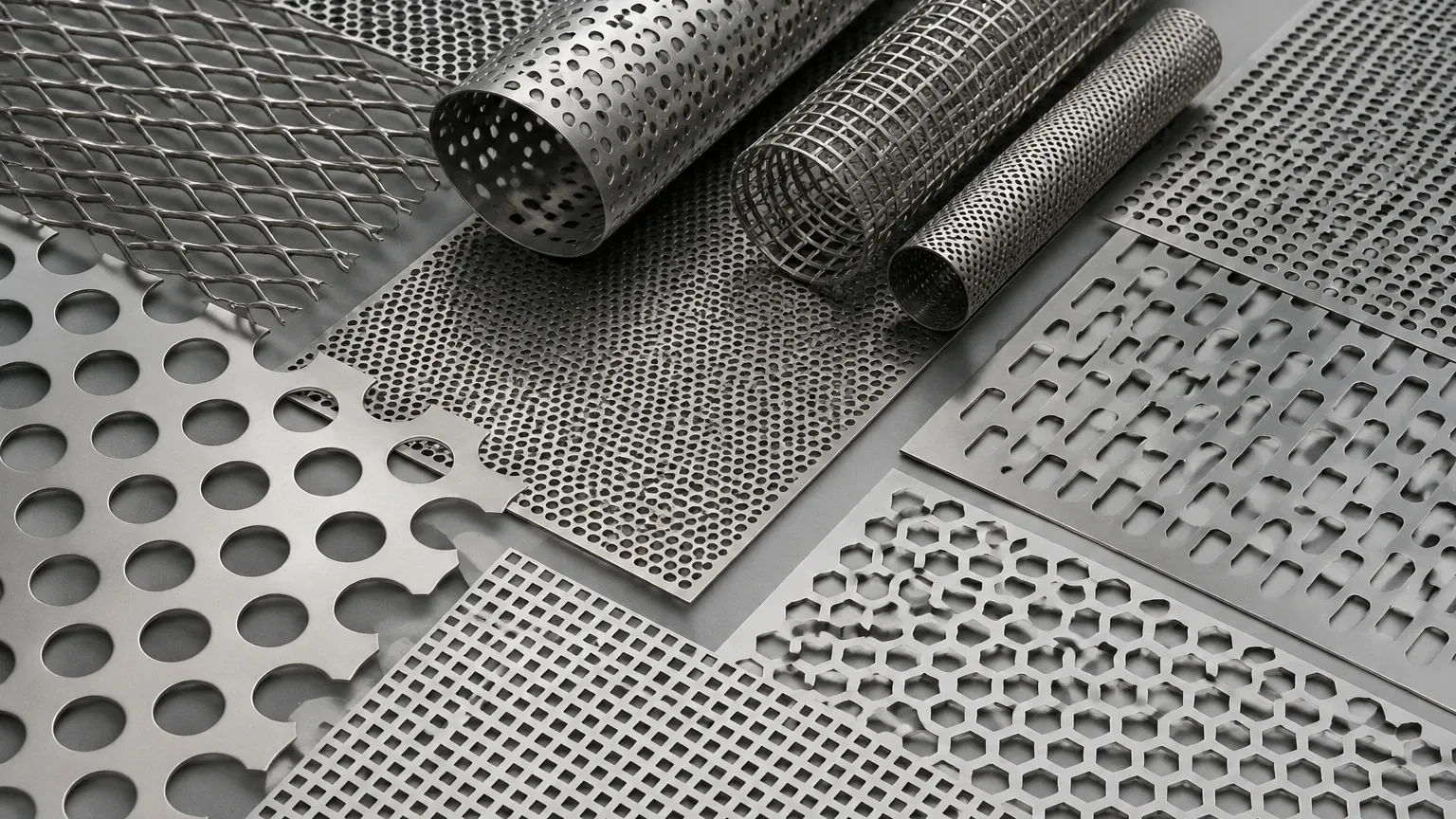
Digital textures can simulate any pattern, but manufacturing is often constrained by tooling. Common patterns include:
* Round Holes: The most common for filtration due to their structural stability and ease of cleaning. They are typically arranged in a 60-degree staggered pattern to maximize open area and strength.
* Square Holes: Often used for high-visibility applications or specific screening requirements where a larger open area is needed compared to round holes.
* Slotted Holes: Ideal for sorting and grading processes, particularly in the food and beverage or chemical processing industries.
Pitch and Bridge Width
The "pitch" is the distance from the center of one hole to the center of the adjacent hole. The "bridge" is the solid metal remaining between the holes. In a digital alpha map, the bridge width is represented by the thickness of the white lines between the black voids. In physical manufacturing, the bridge must be thick enough to maintain the structural integrity of the stainless steel sheet, especially under high-pressure hydraulic or industrial loads.
Calculating Open Area: The Bridge Between Texture and Function
The most significant technical overlap between a digital texture and a physical filter is the calculation of the open area. For an engineer, the "transparency" of the alpha map must match the calculated open area of the specified metal sheet.
For a standard 60-degree staggered round hole pattern, the formula is:
Open Area % = (D² × 90.69) / R²
*(Where D is the hole diameter and R is the center-to-center pitch)*
If the digital perforated metal alpha texture shows a 40% transparency, but the physical requirement for a hydraulic filter requires a 25% open area to maintain structural rigidity under 3000 PSI, the design must be reconciled. Kaifil specializes in assisting engineers to bridge this gap, ensuring that the visual prototype aligns perfectly with the mechanical performance requirements of the application.
Material Selection and Durability in Filtration
While an alpha texture is material-agnostic, the physical environment of the application dictates the choice of metal. For industrial filtration, stainless steel is the industry standard due to its corrosion resistance and thermal stability.
1. Stainless Steel 304: Suitable for general industrial use, offering excellent formability and resistance to oxidation.
2. Stainless Steel 316/316L: The preferred choice for chemical processing, pharmaceutical, and marine environments. It contains molybdenum, which provides superior resistance to chlorides and pitting corrosion.
3. Specialty Alloys: For extreme environments involving high temperatures or highly acidic media, alloys like Monel or Inconel may be required.
In the digital phase, the "texture" remains the same, but the engineering specification must account for the material's thickness (gauge). A common mistake in the design phase is choosing a hole diameter that is smaller than the material thickness. In physical manufacturing, the hole diameter should generally be equal to or greater than the material thickness to avoid excessive tool wear and potential structural failure of the sheet.
Manufacturing Considerations: Customization and OEM Capabilities
Standard off-the-shelf perforated sheets may not always meet the specific needs of a complex filtration system. This is where OEM (Original Equipment Manufacturer) capabilities become vital. When a project requires a specific perforated metal alpha texture to achieve a unique flow characteristic or aesthetic, custom manufacturing is necessary.
Kaifil provides comprehensive customization services, including:
* Custom Tooling: Creating unique hole shapes or sizes that are not found in standard catalogs.
* Varying Margins: Unlike a continuous digital texture, physical sheets often require "margins" (solid unperforated edges) for welding or mounting into filter cartridges.
* Secondary Processing: After the initial perforation, sheets can be rolled into cylinders, pleated, or welded into multi-layered filter elements to increase surface area.
Common Risks in Translating Design to Reality
When engineers rely solely on digital textures without consulting manufacturing standards, several risks can emerge:
* Scaling Errors: An alpha texture might look correct at a certain zoom level, but when scaled to the physical dimensions of a 48-inch filter housing, the hole size may become too large to capture the target particles.
* Moiré Patterns: In digital rendering, overlapping textures can create visual artifacts. In physical filtration, overlapping perforated layers (such as in a multi-stage filter) can cause "blind spots" that significantly reduce flow efficiency if not aligned correctly.
* Structural Weakness: High-transparency textures often ignore the "minimum bridge" rule. If the bridges are too thin, the metal will warp during the punching process or fail under the mechanical stress of the application.
Confirming Specifications Before Production
Before moving from a digital design involving a perforated metal alpha texture to a purchase order, purchasing teams and engineers should confirm the following technical details with their manufacturer:
1. Hole Size and Shape: Specify the exact diameter or dimensions in millimeters or inches.
2. Center-to-Center Pitch: Define the spacing to ensure the correct open area.
3. Material Grade and Thickness: Ensure the gauge is appropriate for the pressure and environmental conditions.
4. Sheet Dimensions and Margins: Provide a clear drawing showing where perforations should start and stop.
5. Surface Finish: Determine if the part requires degreasing, pickling, or polishing, especially for food-grade or pharmaceutical applications.
Conclusion
The use of a perforated metal alpha texture is a sophisticated way to integrate complex industrial components into modern design workflows. However, the transition from a grayscale map to a high-performance stainless steel filter requires a deep understanding of metallurgy, mechanical limits, and fluid dynamics.
By focusing on the factual boundaries of manufacturing—such as the relationship between hole size, pitch, and material thickness—engineers can ensure that their digital visions result in durable, efficient, and cost-effective physical solutions. Whether you are designing a high-precision hydraulic filter or a large-scale industrial screen, aligning your digital texture with physical manufacturing capabilities is the key to project success.
For those seeking to move from design to production, it is essential to work with a partner who understands both the engineering requirements and the manufacturing constraints of Perforated & Expanded Metal. This ensures that the final component performs exactly as the digital model intended, providing reliable service in even the most demanding industrial environments.
