


Perforated Metal Baskets
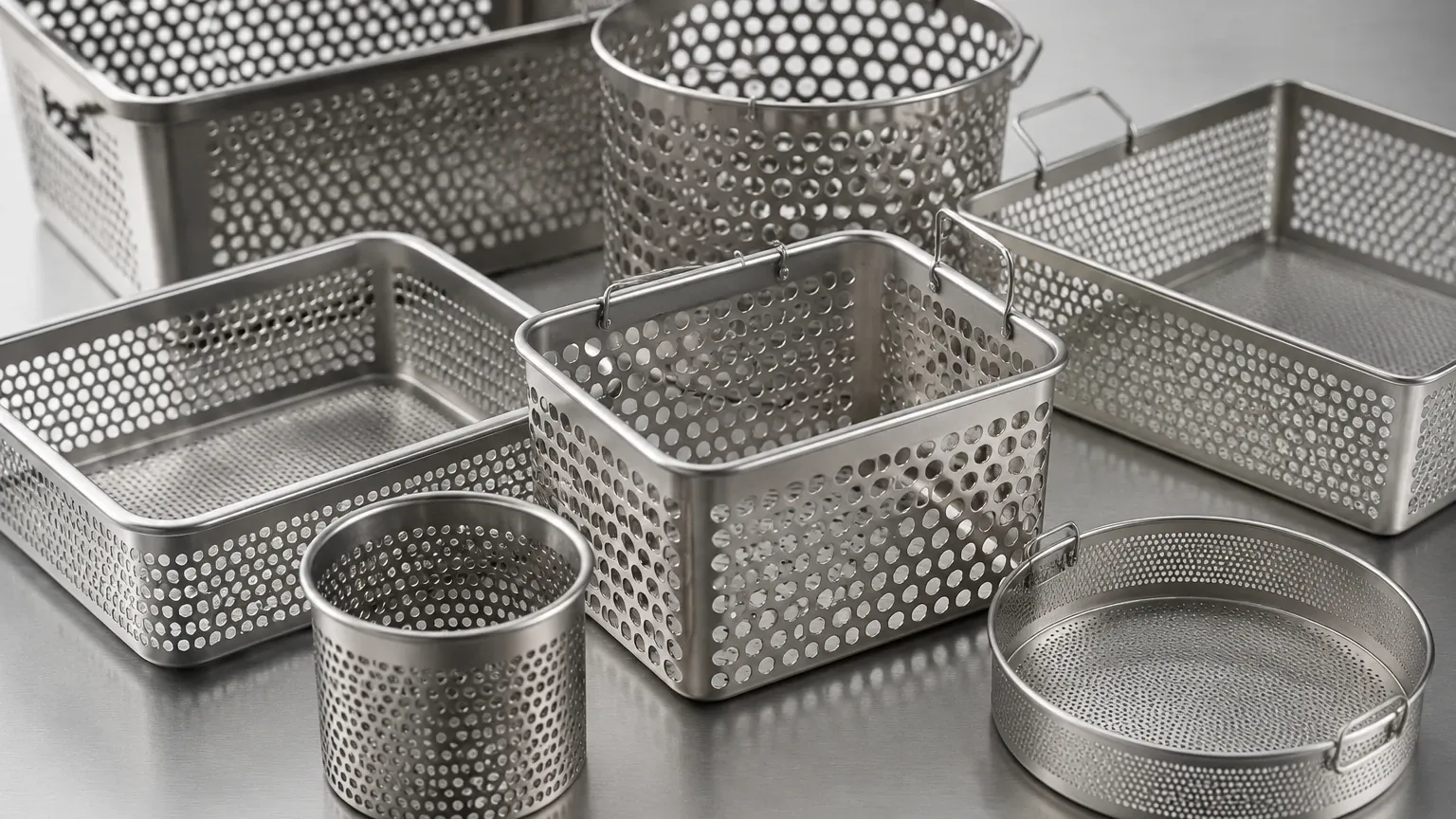
In industrial filtration and material handling, perforated metal baskets serve as critical components for straining, sorting, and protecting downstream equipment. Unlike woven wire mesh, which offers high flexibility and fine filtration, perforated metal provides superior structural rigidity and mechanical strength. These baskets are engineered from Perforated & Expanded Metal sheets, transformed through precise fabrication processes into cylindrical, conical, or rectangular containers designed to withstand high pressure and corrosive environments.
For engineers and procurement professionals, selecting the right perforated metal baskets involves more than choosing a size. It requires a deep understanding of material science, fluid dynamics, and fabrication tolerances to ensure the component performs reliably within a specific industrial system. Kaifil specializes in manufacturing these custom solutions, focusing on the technical nuances that differentiate a standard basket from a high-performance industrial filter component.
Structural Fundamentals of Perforated Metal Baskets
The primary advantage of using perforated metal for industrial baskets is its inherent structural integrity. Because the basket is fabricated from a single solid sheet of metal with punched holes, it maintains its shape under significant hydraulic loads. This makes perforated metal baskets ideal for use as "support baskets" or "strainer baskets" in high-pressure piping systems.
In many applications, a perforated basket acts as the primary strainer for coarse particles. However, in finer filtration stages, it often serves as the external support for a wire mesh liner or a filter bag. The rigidity of the perforated wall prevents the finer filter media from collapsing or bursting when the differential pressure increases due to contaminant loading.
Perforated vs. Expanded Metal in Basket Fabrication
While both materials are used in industrial settings, perforated metal is generally preferred for high-precision filtration. Perforated sheets offer exact hole diameters and consistent spacing, which allows for predictable flow rates and particle retention. Expanded metal, created by slitting and stretching the material, is often more cost-effective for general-purpose guards or secondary containment but lacks the precision and ease of cleaning required for critical process filtration.
Technical Specifications: Hole Patterns and Open Area
The performance of perforated metal baskets is largely dictated by the geometry of the perforations. Engineers must balance the need for high flow rates (high open area) with the requirement for mechanical strength (bridge width).
Hole Geometry
* Round Holes: The most common configuration due to its structural stability and ease of cleaning. Round holes provide the best balance between strength and open area.
* Square Holes: Often used when a higher open area is required, though they can be more prone to stress concentrations at the corners.
* Slotted Holes: Ideal for filtering elongated particles or for applications where the flow direction is specific.
Staggered vs. Straight Patterns
A 60-degree staggered pattern is the industry standard for perforated metal baskets. This configuration provides the highest open area while maintaining uniform strength across the sheet. Straight patterns, where holes align both horizontally and vertically, are typically weaker and are reserved for specific aesthetic or non-pressure applications.
Calculating Open Area
The percentage of open area determines the flow capacity and pressure drop across the basket. A higher open area reduces the initial pressure drop but may compromise the basket's ability to withstand high differential pressures. For a standard 60-degree staggered round hole pattern, the open area is calculated using the formula:
`Open Area % = (D² x 90.69) / C²`
*(Where D is the hole diameter and C is the center-to-center distance between holes)*.
Material Engineering for Challenging Environments
Material selection is the most critical factor in determining the lifespan and chemical compatibility of perforated metal baskets. Kaifil utilizes various grades of stainless steel to meet the demands of different industries.
Stainless Steel 304
This is the standard grade for general industrial use. It offers excellent corrosion resistance in most atmospheric conditions and is suitable for many food and beverage applications. However, it is susceptible to pitting in high-chloride environments.
Stainless Steel 316 and 316L
For chemical processing, pharmaceutical production, and marine environments, SS316 is the preferred choice. The addition of molybdenum enhances its resistance to chlorides and acids. SS316L (low carbon) is used when extensive welding is required, as it prevents carbide precipitation that can lead to intergranular corrosion in the heat-affected zones of the weld.
Specialized Alloys
In extreme cases involving highly aggressive chemicals or high temperatures, baskets may be fabricated from Duplex stainless steel, Monel, or Hastelloy. These materials are selected based on the specific chemical composition of the process fluid and the operating temperature range.
Manufacturing and Fabrication Precision
Converting a flat sheet of Perforated & Expanded Metal into a functional basket requires several precise manufacturing steps. The quality of these steps determines the basket's fit within the filter housing and its overall durability.
1. Forming: Sheets are rolled into cylinders or formed into specific shapes. Precision in the rolling process ensures that the basket maintains a perfect circular cross-section, which is vital for achieving a proper seal within the housing.
2. Welding: Industrial baskets typically utilize TIG (Tungsten Inert Gas) or plasma welding. The weld must be continuous and full-penetration to ensure the basket does not fail under pressure. For pharmaceutical and food-grade baskets, welds must be ground smooth to eliminate crevices where bacteria could grow.
3. Reinforcement: Large baskets or those subjected to high flow rates often require reinforcement rings, longitudinal ribs, or heavy-duty handles. These additions prevent deformation during handling and operation.
4. Surface Finishing:
* Pickling and Passivation: Removes surface contaminants and restores the protective oxide layer on stainless steel.
* Electropolishing: Provides a mirror-like finish, reducing surface roughness and making the basket easier to clean in sterile applications.
Performance Evaluation: Flow Dynamics and Pressure Drop
When integrating perforated metal baskets into a system, engineers must evaluate the "clean pressure drop." This is the resistance to flow caused by the basket before it begins to collect contaminants.
Several factors influence this performance:
* Viscosity of the Fluid: Higher viscosity fluids require larger hole diameters or a greater total surface area to maintain flow.
* Velocity: As the flow velocity increases, the pressure drop across the perforations increases exponentially.
* Solids Loading: The volume of solids the basket is expected to hold before cleaning is required. A basket with a larger volume or a deeper profile can operate longer between maintenance cycles.
In many liquid filtration systems, the goal is to keep the initial pressure drop below 2-3 PSI. Once the pressure drop reaches a predetermined limit (often 10-15 PSI), the basket must be removed and cleaned.
Industry-Specific Requirements for Perforated Metal Baskets
Different sectors have unique standards that dictate the design of perforated metal baskets:
Food and Beverage
Baskets used in food processing must comply with FDA and 3-A Sanitary Standards. This requires the use of SS304 or SS316L, smooth surface finishes (typically 32 Ra or better), and the absence of sharp edges or dead zones where food particles could stagnate.
Pharmaceutical and Biotech
These applications demand the highest level of surface finish, often requiring electropolishing. The baskets must be capable of withstanding SIP (Sterilization-in-Place) and CIP (Cleaning-in-Place) procedures without degrading.
Chemical and Petrochemical
Durability and chemical resistance are the priorities here. Baskets are often heavy-walled and may feature specialized coatings or high-alloy materials to survive exposure to caustic substances and high temperatures.
Hydraulic and Lubrication Systems
In these systems, perforated metal baskets are frequently used as suction strainers to protect pumps from large debris. They must be designed to prevent cavitation by ensuring the open area is significantly larger (often 3 to 5 times) than the cross-sectional area of the suction pipe.
Maintenance and Total Cost of Ownership
While the initial cost of a high-quality stainless steel perforated basket is higher than disposable alternatives, the total cost of ownership (TCO) is significantly lower. Perforated metal baskets are permanent components that can be cleaned and reused for years.
Cleaning Methods
* Backwashing: In some automated systems, flow is reversed to flush contaminants off the basket surface.
* Ultrasonic Cleaning: High-frequency sound waves are used to remove fine particles lodged in the perforations, which is particularly effective for baskets with small hole diameters.
* Manual Pressure Washing: Effective for coarse debris, provided the basket is constructed to withstand the force of the water jet.
Regular inspection of the basket for signs of erosion, weld cracking, or deformation is essential. Even minor damage can lead to bypass, where unfiltered fluid escapes around the basket, potentially damaging sensitive downstream equipment like pumps or spray nozzles.
Selection Guide: Information for Procurement
To ensure a manufacturer like Kaifil provides the most effective solution, engineers should confirm the following technical details before placing an order for perforated metal baskets:
* Dimensions: Accurate measurements of the outside diameter (OD), height, and flange thickness. If the basket must fit into an existing housing, provide the housing manufacturer's model number if available.
* Hole Specification: Specify the hole diameter and the center-to-center distance (pitch). If the exact hole size is unknown, specify the minimum particle size that must be retained.
* Material Grade: Confirm the specific alloy required based on the chemical compatibility of the process fluid.
* Flow Direction: Indicate whether the flow is from "inside-to-out" or "outside-to-in." This affects where the reinforcements and handles are placed.
* Operating Conditions: Provide the maximum operating pressure, temperature, and expected differential pressure at which the basket will be cleaned.
By focusing on these technical parameters, purchasing teams can ensure they receive a robust, high-performance component that minimizes downtime and protects the integrity of the entire industrial process. Whether the requirement is for a standard strainer or a highly customized OEM component, perforated metal baskets remain a cornerstone of reliable industrial filtration.
