


Perforated Metal Bunnings
In the procurement process for industrial components, engineers and purchasing managers often encounter a significant gap between retail availability and technical specifications. The search for "perforated metal bunnings" typically represents an initial inquiry into the availability of metal sheets for general-purpose applications. While retail outlets provide accessible solutions for DIY projects, architectural accents, or basic ventilation, industrial-scale filtration and chemical processing demand a level of precision, material certification, and customization that exceeds standard consumer offerings.
For professional applications—ranging from chemical processing to food and beverage production—the selection of Perforated & Expanded Metal must be guided by engineering data rather than mere convenience. Understanding the technical boundaries of these materials is essential for ensuring the longevity and efficiency of industrial filtration systems.
The Distinction Between Retail and Industrial Perforated Metal
When evaluating sources for metal components, it is critical to distinguish between "commodity" sheets and "engineered" components. Retail options found through searches for perforated metal bunnings are generally characterized by standardized dimensions, limited material grades (often galvanized steel or aluminum), and fixed hole patterns. These are suitable for non-critical applications where structural tolerances and chemical resistance are secondary concerns.
In contrast, industrial-grade perforated metal is manufactured to meet specific performance criteria. This includes precise hole diameters, specific center-to-center distances (pitch), and strict adherence to material standards such as ASTM or ISO. In industrial filtration, the consistency of the hole pattern directly impacts the flow rate and pressure drop across the filter media. A deviation of even a few micrometers can lead to uneven flow distribution, premature clogging, or the passage of oversized contaminants.
Engineering Specifications: Beyond Standard Off-the-Shelf Sheets
For engineers, the primary focus is on the functional performance of the metal. Several key variables must be defined before moving from a general search to a technical procurement order:
1. Open Area Calculation
The "open area" is the percentage of the sheet that is occupied by holes. This is perhaps the most critical metric for filtration efficiency. In a standard staggered round hole pattern, the open area is calculated using the formula:
Open Area % = (D² × 90.69) / C²
*(Where D is the hole diameter and C is the center-to-center distance)*
Retail sheets often provide a fixed open area that may not align with the flow requirements of a specific hydraulic or pneumatic system. Custom manufacturing allows for the optimization of this ratio to balance structural strength with filtration throughput.
2. Hole Geometry and Orientation
While round holes are the most common due to their structural stability and ease of manufacture, industrial applications may require square, slotted, or hexagonal patterns. Slotted holes, for instance, are frequently used in vibrating screens for the processing of elongated particles. The orientation of these patterns (straight line vs. staggered) also affects the mechanical properties of the sheet, such as its resistance to bending or tension.
3. Margins and Blank Areas
Unlike retail sheets that are often perforated edge-to-edge, industrial components often require specific "margins" or unperforated areas. These margins are necessary for welding, bolting, or fitting the sheet into a filter housing. Custom fabrication ensures that these blank areas are precisely located to facilitate seamless integration into the final assembly.
Perforated vs. Expanded Metal: Functional Differences in Filtration
Choosing between perforated and expanded metal is a fundamental engineering decision. Both materials offer unique advantages depending on the application environment.
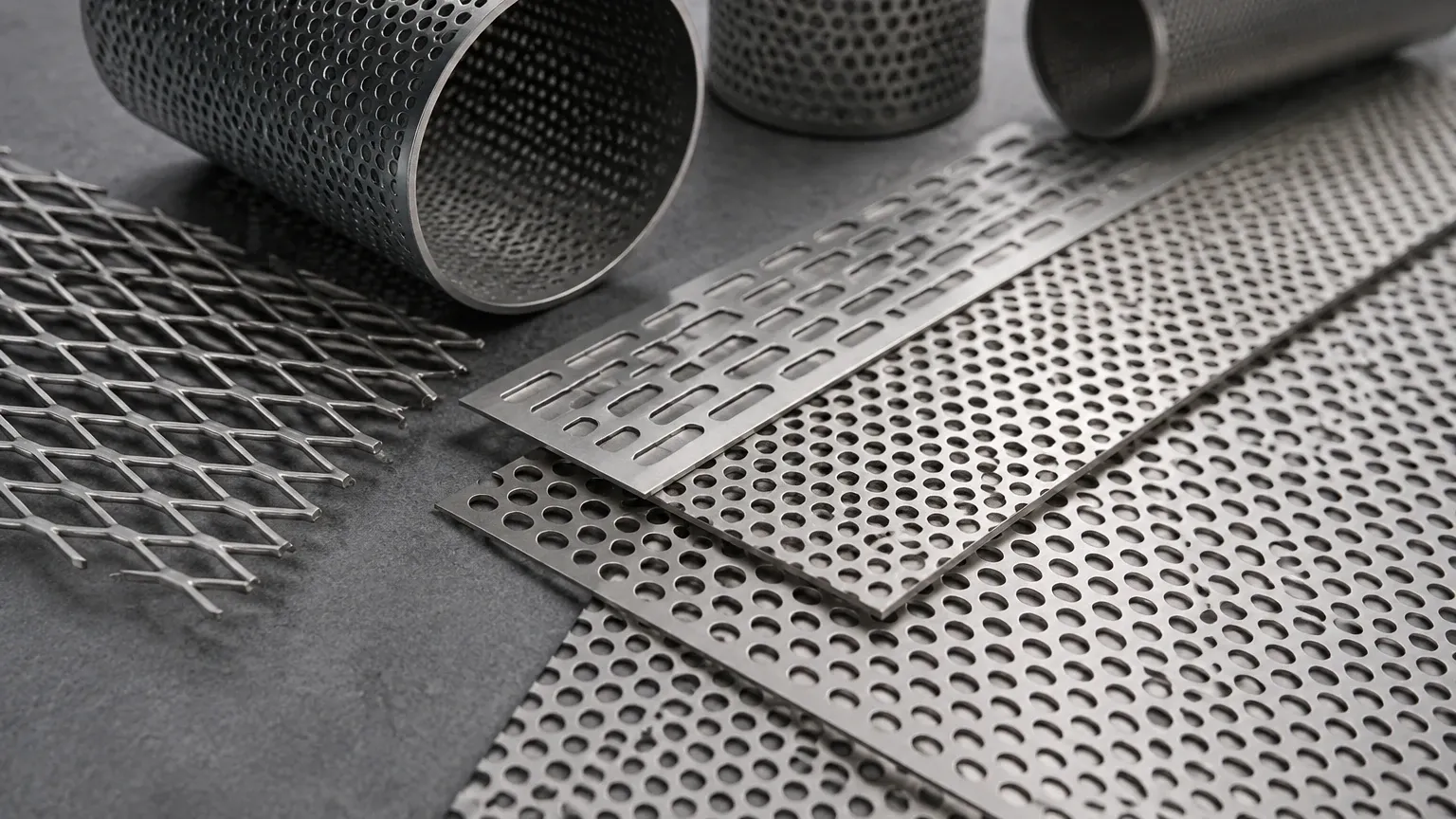
Perforated Metal is created by punching holes into a solid sheet. This process allows for extreme precision in hole size and placement. It is the preferred choice for fine filtration where specific particle retention is required. Because the base material remains flat, it is easier to roll into cylinders for filter cartridges or to weld into complex shapes.
Expanded Metal is produced by simultaneously slitting and stretching the metal sheet. This creates a diamond-shaped mesh. One of the primary benefits of expanded metal is that it is a "no-waste" product; the manufacturing process does not produce scrap. It offers an excellent strength-to-weight ratio and is often used as a support structure for finer wire mesh layers in multi-stage filtration systems. However, because the process deforms the metal, it lacks the precise aperture control found in perforated sheets.
Material Integrity and Chemical Compatibility
A common limitation of retail-sourced materials like those found via perforated metal bunnings searches is the lack of specialized alloys. In industrial environments, material selection is dictated by the chemical composition of the fluid being filtered and the operating temperature.
* Stainless Steel 304: The standard for general industrial use, offering good corrosion resistance and durability.
* Stainless Steel 316/316L: Contains molybdenum, which provides superior resistance to chlorides and pitting. This is essential for marine environments, pharmaceutical processing, and food production.
* High-Temperature Alloys: For applications involving exhaust filtration or high-heat chemical reactions, specialized alloys that maintain structural integrity at elevated temperatures are required.
Industrial manufacturers provide material mill certificates (MTRs) to verify the chemical makeup of the steel, ensuring that the component will not fail prematurely due to stress corrosion cracking or chemical erosion.
Custom Fabrication and OEM Integration
For original equipment manufacturers (OEMs), the ability to source components that fit perfectly into a proprietary design is paramount. Retail sheets require significant secondary processing—cutting, deburring, and forming—which increases labor costs and the risk of error.
By working with a specialized manufacturer, engineers can receive components that are already cut to size, rolled, and welded. This is particularly important for stainless steel filter cartridges, where the longitudinal seam must be perfectly executed to prevent bypass. Customization also extends to surface treatments, such as electropolishing for pharmaceutical applications to ensure a burr-free, hygienic surface, or powder coating for added chemical resistance.
Total Cost of Ownership in Industrial Filtration Systems
While the initial price point of a retail sheet might seem lower, the Total Cost of Ownership (TCO) often favors engineered solutions. TCO includes the purchase price, installation costs, maintenance requirements, and the cost of downtime.
In an industrial setting, using a sub-optimal perforated sheet can lead to:
1. Increased Pressure Drop: Resulting in higher energy consumption by pumps and compressors.
2. Frequent Replacement: Retail-grade materials may wear out or corrode faster, leading to more frequent maintenance shutdowns.
3. Downstream Damage: If a low-quality filter component fails, it can release contaminants into sensitive machinery, causing catastrophic failure and expensive repairs.
Investing in high-quality Perforated & Expanded Metal tailored to the specific demands of the application ensures a longer service life and more predictable performance.
Conclusion: Transitioning from General Supply to Engineered Solutions
For small-scale prototypes or non-critical structural work, searching for "perforated metal bunnings" is a logical starting point. However, as a project moves into the industrial phase, the requirements for precision, material traceability, and custom geometry become non-negotiable.
Engineers and procurement professionals must evaluate their filtration needs based on the technical realities of their specific industry. By focusing on variables such as open area, material grade, and fabrication tolerances, organizations can ensure they are selecting components that will perform reliably under pressure. Moving beyond the retail shelf to a specialized manufacturer like Kaifil allows for the development of filtration solutions that are not just available, but optimized for the task at hand.
