


Perforated Metal Grating
In industrial engineering and facility design, perforated metal grating serves as a critical component that bridges the gap between structural support and functional utility. Unlike standard perforated sheets used for decorative purposes, industrial-grade grating is engineered to withstand significant mechanical stress while providing essential features such as drainage, airflow, and slip resistance. For engineers and procurement specialists, selecting the correct grating involves a complex evaluation of material properties, hole geometries, and load-bearing requirements to ensure long-term performance in demanding environments.
As a specialized manufacturer, Kaifil provides precision-engineered Perforated & Expanded Metal solutions that meet the rigorous standards of the chemical, pharmaceutical, and food processing industries. Understanding the technical nuances of perforated metal grating is essential for optimizing both safety and operational efficiency.
Technical Specifications and Geometry
The performance of perforated metal grating is primarily dictated by its geometric configuration. This includes the hole shape, size, arrangement (pitch), and the resulting open area percentage. These factors influence not only the structural integrity of the grating but also its suitability for specific filtration or drainage tasks.
Hole Patterns and Pitch
Standard patterns include round, square, and slotted holes. Round holes are the most common due to their structural stability and ease of manufacturing. In grating applications, a staggered 60-degree pattern is often preferred over a straight-row arrangement because it provides higher strength-to-weight ratios and more uniform stress distribution. The pitch—the distance from the center of one hole to the center of the adjacent hole—must be calculated precisely to ensure the remaining metal (the "bridge") is wide enough to support the intended load.
Open Area Calculations
The open area is the percentage of the total sheet area that is occupied by the perforations. This is a vital metric for applications involving fluid dynamics or ventilation. A higher open area allows for greater flow rates but reduces the overall mechanical strength of the grating. Engineers must balance these competing requirements, often utilizing thicker gauges of metal to compensate for high open area percentages in load-bearing scenarios.
Material Selection for Industrial Environments
The choice of material is perhaps the most significant factor in determining the service life of perforated metal grating. Industrial applications often expose components to corrosive chemicals, extreme temperatures, and high-pressure cleaning cycles.
Stainless Steel (304, 316, and 316L)
Stainless steel is the industry standard for high-performance filtration and structural grating.
- Grade 304: Offers excellent corrosion resistance and is suitable for most general industrial environments, including food processing and architectural applications.
- Grade 316/316L: Contains molybdenum, which provides superior resistance to chlorides and pitting. This makes it the preferred choice for chemical processing plants, marine environments, and pharmaceutical facilities where aggressive cleaning agents are used.
Specialty Alloys and Carbon Steel
While stainless steel is prominent, carbon steel may be used in less corrosive environments where cost-effectiveness is a priority, often requiring galvanization or powder coating for protection. For specialized chemical applications, high-nickel alloys may be specified to handle specific corrosive media that would degrade standard stainless steel.
Structural Integrity and Load-Bearing Performance
When utilized as perforated metal grating for walkways, platforms, or heavy-duty filter supports, the material must be evaluated for its structural limits. Unlike solid plate, the perforations introduce stress concentrators that can affect the yield strength of the component.
Deflection and Yield Strength
Engineers must calculate the maximum allowable deflection based on the span between supports and the anticipated load (static or dynamic). For industrial safety, deflection is typically limited to 1/240th of the span. The thickness (gauge) of the metal is the primary variable here; increasing the gauge significantly enhances the moment of inertia, allowing the grating to span longer distances without compromising safety.
Slip Resistance and Safety Standards
In environments where liquids, oils, or greases are present, the grating must provide adequate traction. Perforated grating can be manufactured with embossed or raised edges around the holes to enhance slip resistance. This is particularly critical in the food and beverage industry, where wash-down procedures create frequent slip hazards on elevated platforms.
Manufacturing Processes and Customization
The production of high-quality perforated metal grating involves more than just punching holes in a sheet. Advanced manufacturing techniques ensure that the final product meets the precise tolerances required for OEM integration.
Precision Perforating
Modern CNC punching presses allow for high-speed, high-accuracy perforation. This precision is necessary to ensure that the margins (the unperforated areas at the edges of the sheet) are consistent, which is vital for subsequent welding or bolting into frames.
Secondary Operations
To transform a perforated sheet into a functional grating component, several secondary processes are often required:
- Leveling: The perforating process can introduce internal stresses that cause the metal to curl. Precision leveling restores flatness.
- Forming and Bending: Grating often requires "C-channel" or "L-shape" edges to provide additional structural rigidity and to facilitate installation.
- Surface Finishing: For stainless steel, processes such as pickling, passivation, or electropolishing are employed to remove surface contaminants and enhance the protective oxide layer, ensuring maximum corrosion resistance.
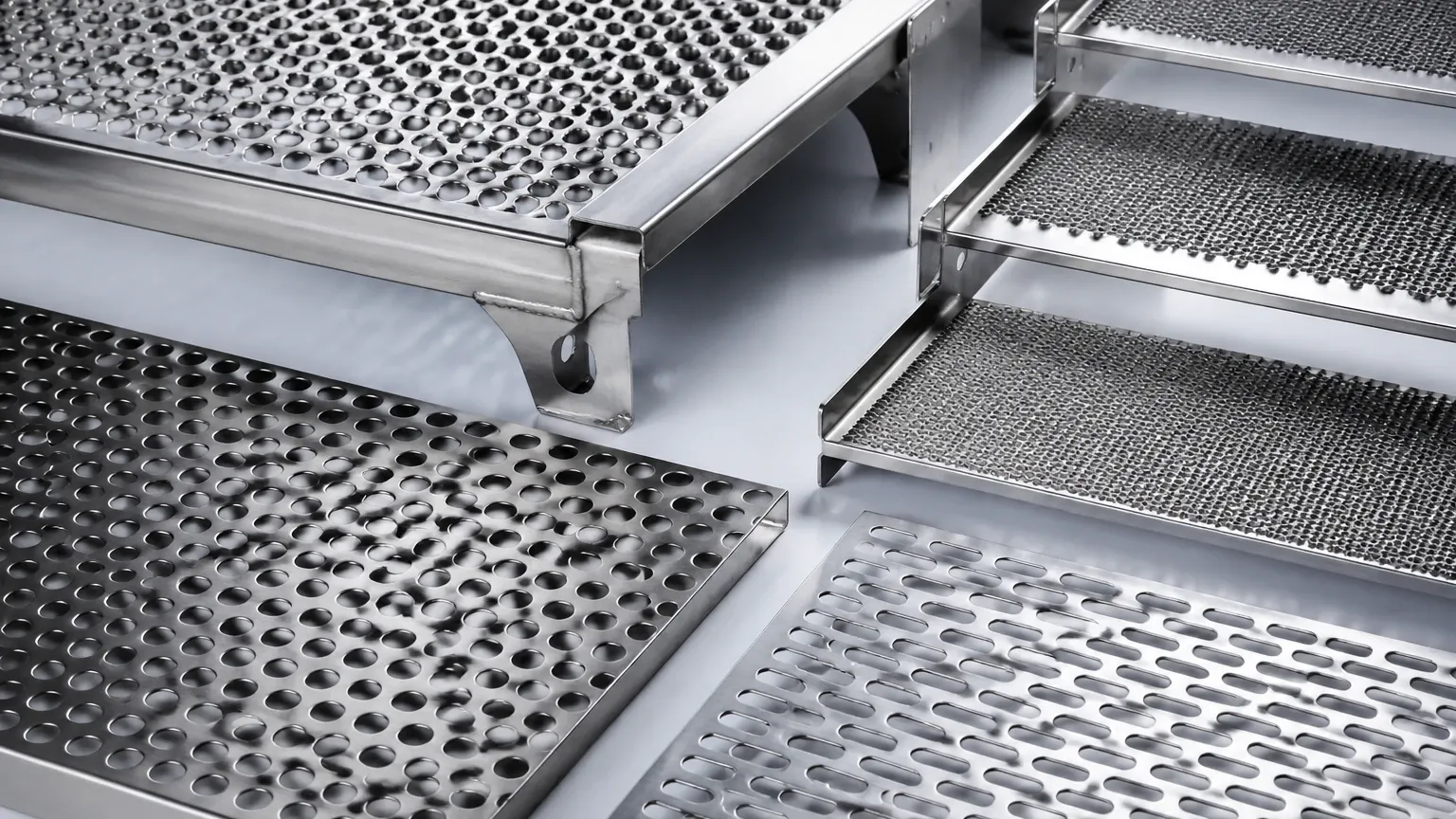
Applications in Industrial Filtration and Support
Beyond its role as a structural floor or walkway, perforated metal grating is a fundamental component in industrial filtration systems. It often serves as the robust skeleton that supports finer filtration media.
Filter Element Support Cores
In high-pressure hydraulic or chemical filtration, fine wire mesh lacks the structural strength to withstand the differential pressure across the filter. Perforated grating is rolled into cylinders to act as internal or external support cores. These cores prevent the mesh from collapsing or bursting under load while maintaining a high open area to minimize pressure drop.
Primary Coarse Strainers
In water treatment and intake systems, heavy-duty perforated grating acts as a primary strainer, removing large debris before the fluid reaches more sensitive downstream equipment. The durability of stainless steel ensures these strainers can withstand the mechanical impact of debris and the erosive force of high-velocity fluid flow.
Total Cost of Ownership and Maintenance
When specifying perforated metal grating, procurement teams should look beyond the initial purchase price and consider the total cost of ownership (TCO). A well-engineered solution reduces long-term costs through durability and ease of maintenance.
Cleaning and Hygiene
In the pharmaceutical and food industries, the ability to clean equipment thoroughly is paramount. Perforated grating with smooth, burr-free holes and passivated surfaces prevents the accumulation of bacteria and facilitates "Clean-in-Place" (CIP) procedures. This reduces downtime and the risk of product contamination.
Replacement Cycles
Lower-quality materials or improper gauge selection may lead to premature failure due to corrosion or fatigue. By selecting the appropriate grade of Perforated & Expanded Metal and ensuring the structural design accounts for the specific operating environment, facilities can significantly extend the interval between replacements.
Selection Checklist for Engineers
Before finalizing a specification for perforated metal grating, engineers should confirm the following technical details with their manufacturer:
1. Environment: What is the exact chemical composition of the fluid or atmosphere? (Determines material grade).
2. Load Requirements: What is the maximum weight the grating must support, and what is the distance between supports? (Determines gauge and hole pattern).
3. Flow Characteristics: What is the required flow rate or maximum allowable pressure drop? (Determines open area percentage).
4. Installation Method: Will the grating be welded, bolted, or held by friction clips? (Determines margin requirements and edge finishing).
5. Regulatory Compliance: Does the material need to meet specific standards, such as FDA for food contact or ASTM for structural integrity?
By addressing these factors during the design phase, technical professionals can ensure that the perforated metal grating they implement provides a reliable, safe, and efficient solution for their specific industrial application. Kaifil’s expertise in custom stainless steel fabrication allows for the development of tailored components that meet these exacting requirements, supporting the operational goals of global industrial partners.
