


Perforated Metal Guardrail
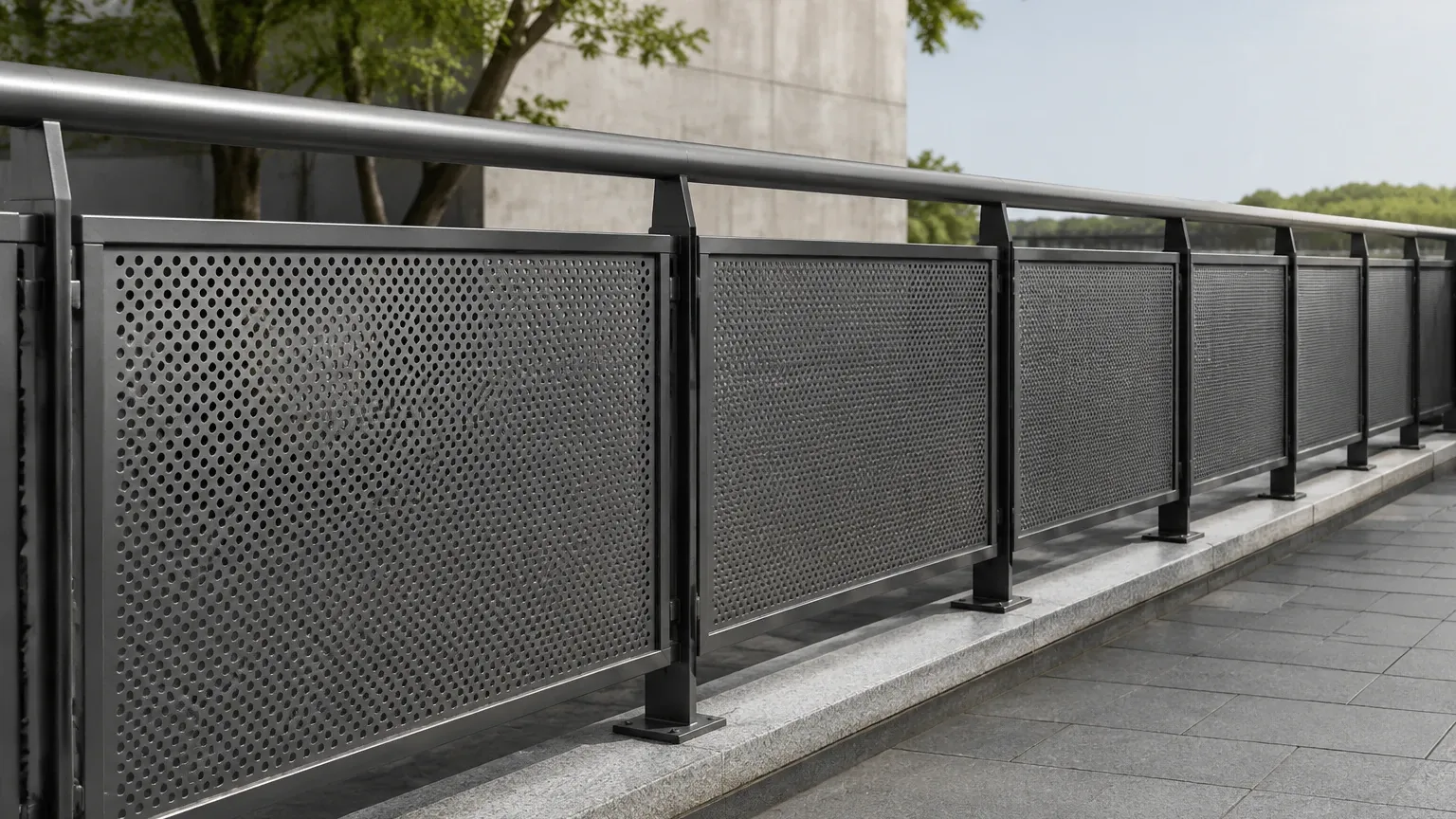
In industrial and architectural engineering, the selection of safety barriers requires a balance between structural integrity, visibility, and environmental resistance. A perforated metal guardrail serves as a specialized solution that addresses these needs by utilizing precision-engineered metal sheets. Unlike solid barriers, these components provide essential fall protection while allowing for the passage of light, air, and sound, which is critical in high-traffic industrial zones, chemical processing plants, and public infrastructure.
Selecting the appropriate Perforated & Expanded Metal for guardrail applications involves understanding the mechanical properties of the base material, the geometry of the perforations, and the specific safety standards required for the installation environment. This guide examines the technical considerations engineers must evaluate when specifying perforated metal for safety and containment systems.
Engineering Principles of Perforated Metal Guardrails
Perforated metal guardrails are more than aesthetic choices; they are functional engineering components designed to withstand specific loads. The primary function of a guardrail is to prevent falls and provide a physical boundary. When using perforated materials, the structural capacity is influenced by the "bridge" or the metal remaining between the holes.
Structural Integrity and Load Bearing
Engineers must calculate the concentrated load and uniform load requirements based on local building codes (such as OSHA in the US or Eurocodes in Europe). Because the perforation process removes material, the effective strength of the panel is lower than that of a solid sheet of the same thickness. To compensate, designers often specify higher-gauge (thicker) materials or reinforced framing systems. The choice of material—typically stainless steel, aluminum, or carbon steel—further dictates the panel's ability to resist deflection under pressure.
Visibility and Airflow
In many industrial settings, such as mezzanine levels or equipment platforms, visibility is a safety requirement. Perforated panels allow operators to see through the barrier to monitor machinery or personnel below. Furthermore, in environments where gas buildup or heat dissipation is a concern, the open area provided by a perforated metal guardrail ensures adequate ventilation without compromising the physical barrier.
Comparing Perforated & Expanded Metal for Safety Barriers
When specifying metal barriers, engineers often choose between perforated metal and expanded metal. While both fall under the broader category of Perforated & Expanded Metal, their manufacturing processes and mechanical behaviors differ significantly.
Perforated Metal Characteristics
Perforated metal is produced by punching a series of holes into a solid metal sheet. This process allows for extreme precision in hole size, shape, and spacing. For guardrails, perforated metal offers a smooth surface finish and highly predictable open area percentages. It is preferred when specific aesthetic patterns are required or when the guardrail must interface precisely with other machined components.
Expanded Metal Characteristics
Expanded metal is created by simultaneously slitting and stretching a metal sheet, resulting in a diamond-shaped mesh. This process involves no material waste, making it a cost-effective alternative. Expanded metal typically has a higher strength-to-weight ratio because the strands and bonds form a structural truss. However, the surface can be sharper or more textured than perforated metal, which may require additional finishing or framing to prevent injury in pedestrian-facing guardrails.
Material Selection and Corrosion Resistance
The longevity of a perforated metal guardrail is largely determined by the material's resistance to its operating environment. Kaifil specializes in high-performance alloys that provide durability in demanding industrial sectors.
1. Stainless Steel (304 and 316): This is the standard for chemical processing, pharmaceutical, and marine environments. Grade 316 stainless steel, containing molybdenum, offers superior resistance to chlorides and industrial solvents, preventing "tea staining" or pitting corrosion.
2. Aluminum: Preferred for its lightweight properties and natural oxide layer that resists corrosion. It is often used in architectural guardrails or transportation infrastructure where weight reduction is a priority.
3. Carbon Steel: While cost-effective, carbon steel requires secondary treatments such as hot-dip galvanizing or powder coating to prevent oxidation. It is suitable for indoor industrial warehouses where moisture levels are controlled.
For engineers, the choice often comes down to the Total Cost of Ownership (TCO). While stainless steel has a higher initial procurement cost, its minimal maintenance requirements and multi-decade service life often make it more economical than carbon steel systems that require frequent repainting or replacement.
Design Parameters: Hole Patterns and Open Area
The performance of a perforated metal guardrail is defined by its geometric configuration. The most common patterns include round, square, and slotted holes, each offering different advantages.
The Importance of Open Area
The "Open Area" is the percentage of the sheet that is occupied by holes. For guardrails, this typically ranges from 30% to 60%. A higher open area increases visibility and airflow but reduces the structural rigidity of the panel. Engineers use the following formula to determine the open area for round holes in a 60-degree staggered pattern:
* Open Area % = (D² × 90.69) / P²
*(Where D is the hole diameter and P is the center-to-center pitch)*
Safety Compliance (The "Finger Guard" Rule)
In many jurisdictions, guardrails must prevent the passage of specific objects. For example, a common requirement is that a sphere of a certain diameter (often 4 inches or 100mm in residential/commercial codes, or smaller in industrial "finger-safe" applications) cannot pass through any opening. When designing a perforated metal guardrail, the hole diameter must be selected to comply with these safety regulations while still meeting the project's aesthetic and ventilation goals.
Installation and Structural Integration
Proper installation is critical to ensure that the perforated panels function as a cohesive safety system. Unlike wire mesh, perforated sheets are rigid and can be bolted or welded directly to a support frame.
Framing Methods
Perforated panels are rarely used as stand-alone structural elements. They are typically inset into a frame made of angle iron, U-edging, or tube steel. The framing provides the necessary stiffness to prevent the panels from bowing under impact. For industrial applications, U-edging is a popular choice as it covers the sharp edges of the perforated sheet and provides a clean attachment point for welding to posts.
Attachment Points
Engineers must specify the type and frequency of fasteners. Bolted connections allow for easier replacement of individual panels if they become damaged, which is a common occurrence in heavy industrial environments where forklifts or machinery may impact the guardrail. Welded connections offer maximum security and vibration resistance but are more difficult to repair.
Procurement and Total Cost of Ownership
When purchasing perforated metal for guardrail projects, technical buyers should look beyond the price per square foot. Several factors influence the final project cost and performance:
* Customization vs. Standard Sizes: While standard sheets (e.g., 4'x8' or 4'x10') are more affordable, custom-cut panels from an OEM manufacturer like Kaifil can reduce on-site labor and material waste. Precision cutting ensures that hole patterns remain symmetrical relative to the panel edges, which is vital for both aesthetics and structural mounting.
* Finishing Processes: Post-perforation treatments such as degreasing, deburring, and passivation (for stainless steel) are essential. Deburring removes the sharp edges created by the punching process, which is a critical safety step for guardrails that may come into contact with skin or clothing.
* Lead Times and Logistics: In large-scale industrial projects, the synchronization of material delivery with the construction schedule is vital. Working with a manufacturer that understands the complexities of industrial filtration and precision metal components ensures that the material meets the exact tolerances required for seamless integration.
Conclusion for Technical Decision Makers
A perforated metal guardrail is a sophisticated engineering solution that provides safety without sacrificing environmental transparency. By carefully selecting the material grade, hole pattern, and framing method, engineers can create a barrier system that meets stringent safety codes while withstanding the rigors of industrial use.
When evaluating suppliers for Perforated & Expanded Metal, it is essential to confirm their ability to provide precise tolerances and high-quality finishes. Whether the application is a chemical plant mezzanine or a public walkway, the right perforated solution provides a balance of durability, safety, and functional design that solid barriers cannot match.
