


Perforated Metal Home Depot
For maintenance engineers, facility managers, and product designers, the search for "perforated metal home depot" often begins when an immediate, small-scale solution is required for a repair or a rapid prototype. While retail hardware stores serve a vital role in the consumer and light construction markets, industrial applications—particularly those involving precision filtration, chemical processing, or high-pressure hydraulic systems—demand a level of technical specification that off-the-shelf retail products cannot provide.
Understanding the distinction between retail-grade materials and industrial-grade Perforated & Expanded Metal is essential for ensuring the longevity, safety, and efficiency of industrial equipment. This guide examines the technical parameters of these materials, the limitations of retail procurement for B2B applications, and the engineering considerations necessary for selecting the right filtration components.
Defining Perforated and Expanded Metal in Industrial Contexts
Before comparing procurement sources, it is necessary to define the two primary types of metal structures used in industrial filtration and support.
Perforated Metal
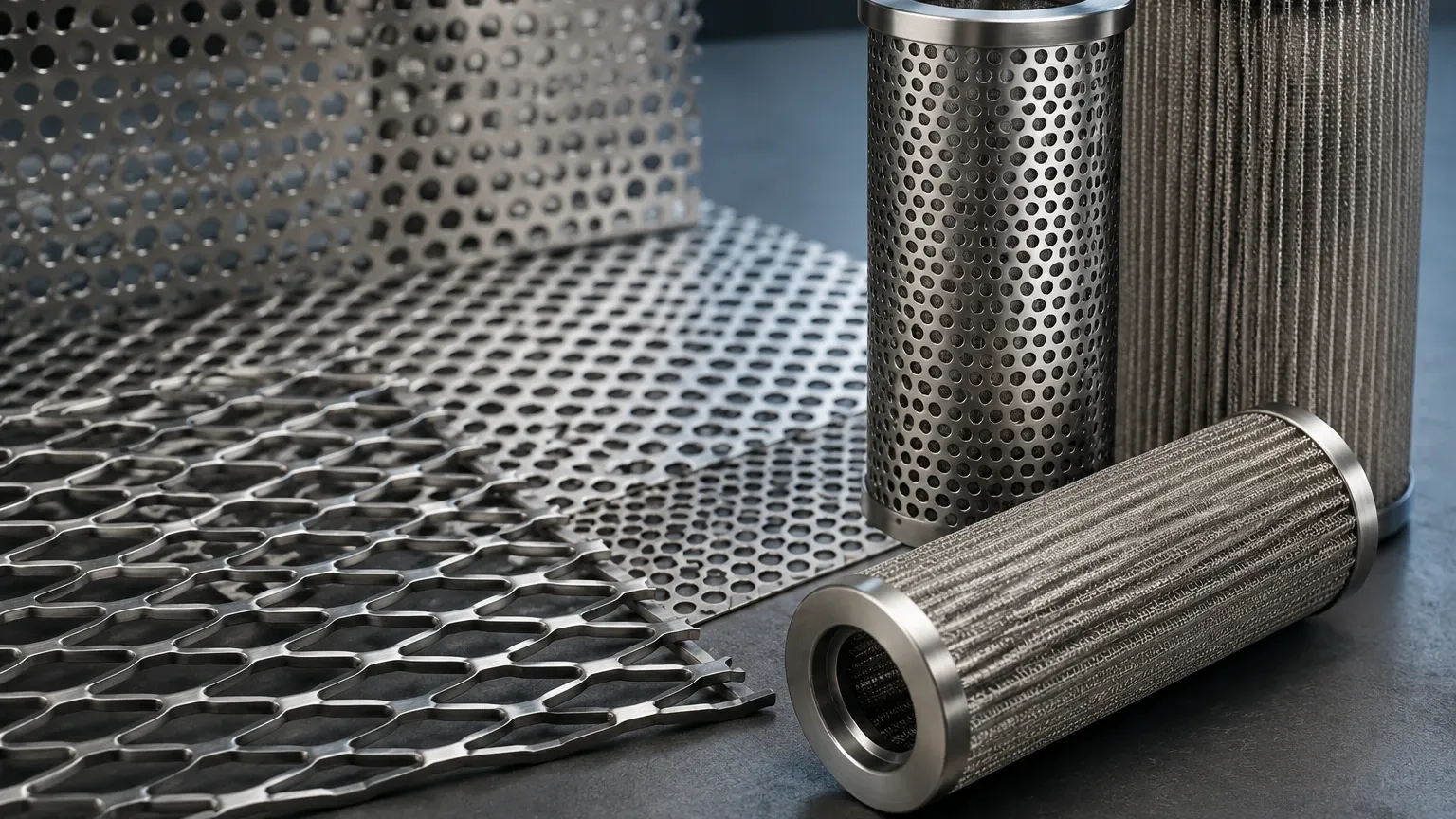
Perforated metal is produced by mechanically punching or stamping sheets of metal (typically stainless steel, carbon steel, or aluminum) to create a pattern of holes, slots, or decorative shapes. In industrial filtration, the precision of these holes is paramount. The punching process allows for exact control over the hole diameter, the distance between hole centers (pitch), and the resulting open area percentage. This precision ensures predictable flow rates and particle retention.
Expanded Metal
Expanded metal is manufactured by simultaneously slitting and stretching a solid sheet of metal. This process creates a diamond-shaped mesh pattern. Unlike perforated metal, expanded metal production generates no waste, making it a cost-effective alternative for structural support or coarse filtration. It is available in two forms: "standard" (raised), where the strands are at an angle to the plane of the sheet, and "flattened," where the sheet is passed through a cold-roll reducing mill to create a smooth, level surface.
Analyzing the Retail Search: When "Perforated Metal Home Depot" Works
Searching for perforated metal at a retail outlet like Home Depot is a common starting point for specific scenarios. Retailers typically stock small, pre-cut sheets (e.g., 12"x24" or 24"x36") in thin gauges, often intended for decorative radiator covers, cabinet inserts, or basic ventilation covers.
Retail procurement is generally suitable for:
* Non-critical prototyping: Creating a geometric mock-up where material grade and filtration accuracy are not yet a factor.
* General facility maintenance: Patching non-load-bearing partitions or creating simple safety guards for low-risk areas.
* Residential or light commercial aesthetics: Projects where visual appearance outweighs technical performance data.
However, for B2B buyers and engineers, the limitations of these products become apparent when subjected to industrial stress tests, corrosive environments, or strict regulatory requirements.
Technical Limitations of Off-the-Shelf Retail Metal
When evaluating "perforated metal home depot" options against industrial requirements, several critical gaps emerge:
1. Material Traceability and Grade Selection
Retailers often stock "galvanized steel" or "aluminum" without providing specific alloy designations or Material Test Reports (MTRs). In industrial filtration, there is a significant performance difference between Stainless Steel 304 and 316L. The latter contains molybdenum, which provides essential resistance to chlorides and pitting in chemical or marine environments. Industrial suppliers provide full traceability, ensuring the material meets ASTM or ISO standards.
2. Limited Gauge and Size Range
Industrial applications often require heavy-duty gauges to withstand high differential pressures in hydraulic or water treatment systems. Retail stock is typically limited to thin, light-duty sheets (often 20 gauge or thinner). Industrial manufacturing can accommodate thicknesses from foil-thin precision mesh to heavy plates exceeding 1/4 inch.
3. Lack of Custom Hole Patterns and Open Area Control
The "Open Area" is the percentage of the sheet that is occupied by holes. This is a critical calculation for engineers determining the pressure drop across a filter. Retail products offer a "one-size-fits-all" pattern. In contrast, custom industrial solutions allow for the adjustment of hole size and pitch to achieve a specific open area, balancing structural integrity with flow efficiency.
Engineering Specifications for Industrial Filtration
When moving beyond retail options, engineers must define several technical parameters to ensure the Perforated & Expanded Metal component performs as intended within a larger system.
Hole Patterns and Orientation
* Staggered (60-degree): The most popular pattern for perforated metal. It provides the highest open area and is the most efficient for fluid flow.
* Straight Row: Holes are aligned in both horizontal and vertical rows. This is often used for aesthetic purposes or specific structural requirements but generally offers lower open area than staggered patterns.
* Slotted: Ideal for filtering elongated particles or for use in vibrating screens.
Calculating Open Area
For a standard 60-degree staggered round hole pattern, the formula is:
Open Area % = (D² × 90.69) / P²
*Where D = Hole Diameter and P = Center-to-Center Pitch.*
Accurate calculation of this value is essential for pump sizing and preventing system cavitation. Retail products rarely provide these verified calculations, whereas industrial manufacturers provide them as part of the technical datasheet.
Margins and Edges
In industrial filtration cartridges, the "margin" (the unperforated area around the edges of the sheet) is critical for welding and assembly. Retail sheets are often "full-perf," meaning the holes run to the very edge. This makes it difficult to achieve a clean, strong longitudinal weld when forming a filter cylinder. Industrial custom-cut sheets can be produced with specific margins to facilitate seamless integration into filter housings.
Material Selection: Beyond Basic Galvanized Steel
While a retail search for perforated metal might yield galvanized or plain steel options, industrial environments usually demand higher-performance alloys.
* Stainless Steel 304/304L: The standard for food and beverage applications due to its corrosion resistance and ease of cleaning.
* Stainless Steel 316/316L: The preferred choice for pharmaceutical and chemical processing where exposure to corrosive agents is frequent.
* Monel & Inconel: Specialized nickel alloys used in extreme temperature or highly acidic environments, such as oil and gas refining.
* Titanium: Used where a high strength-to-weight ratio and extreme corrosion resistance are required, such as in aerospace or specialized medical filtration.
Customization and OEM Capabilities in Metal Fabrication
One of the primary reasons B2B buyers transition from retail searches to industrial partnerships is the need for OEM (Original Equipment Manufacturer) customization. A manufacturer like Kaifil provides services that a retail outlet cannot match:
1. Precision Forming: Rolling perforated sheets into perfectly round cylinders for filter cartridges.
2. Specialized Welding: Utilizing TIG, MIG, or plasma welding to ensure the structural integrity of the filter under high-pressure pulses.
3. Surface Finishing: Providing electropolishing, passivating, or specialized coatings to enhance corrosion resistance and reduce bacterial adhesion in sanitary applications.
4. Multi-Layer Integration: Combining perforated metal with fine wire mesh layers (sintered or pleated) to create complex, multi-stage filtration elements.
Procurement and Total Cost of Ownership for B2B Buyers
While the unit price of a single sheet of metal at a retail store may seem low, the Total Cost of Ownership (TCO) for an industrial project can be significantly higher if the material fails.
Factors that impact TCO include:
* Replacement Cycles: Retail-grade materials may corrode or deform quickly, leading to frequent downtime and replacement costs.
* System Efficiency: Incorrect open area calculations can lead to higher energy consumption by pumps and reduced throughput.
* Compliance Risks: In industries like food or pharma, using non-certified materials can lead to regulatory fines or product recalls.
By sourcing directly from a manufacturer, B2B buyers benefit from volume pricing, consistent quality across large batches, and engineering support that optimizes the component for its specific environment.
Conclusion
While searching for "perforated metal home depot" is a practical step for simple, non-industrial tasks, it rarely meets the rigorous demands of professional engineering and large-scale manufacturing. For applications where filtration accuracy, material durability, and structural integrity are non-negotiable, a specialized industrial approach is required.
Selecting the right Perforated & Expanded Metal involves more than just picking a pattern off a shelf; it requires a deep understanding of metallurgy, fluid dynamics, and fabrication techniques. For those looking to move from retail-grade limitations to industrial-grade performance, the next step is to consult with a manufacturer capable of delivering customized, high-precision filtration solutions.
To explore technical specifications and custom fabrication options for your next project, Review product options and application support to ensure your filtration components meet the highest industrial standards.
