


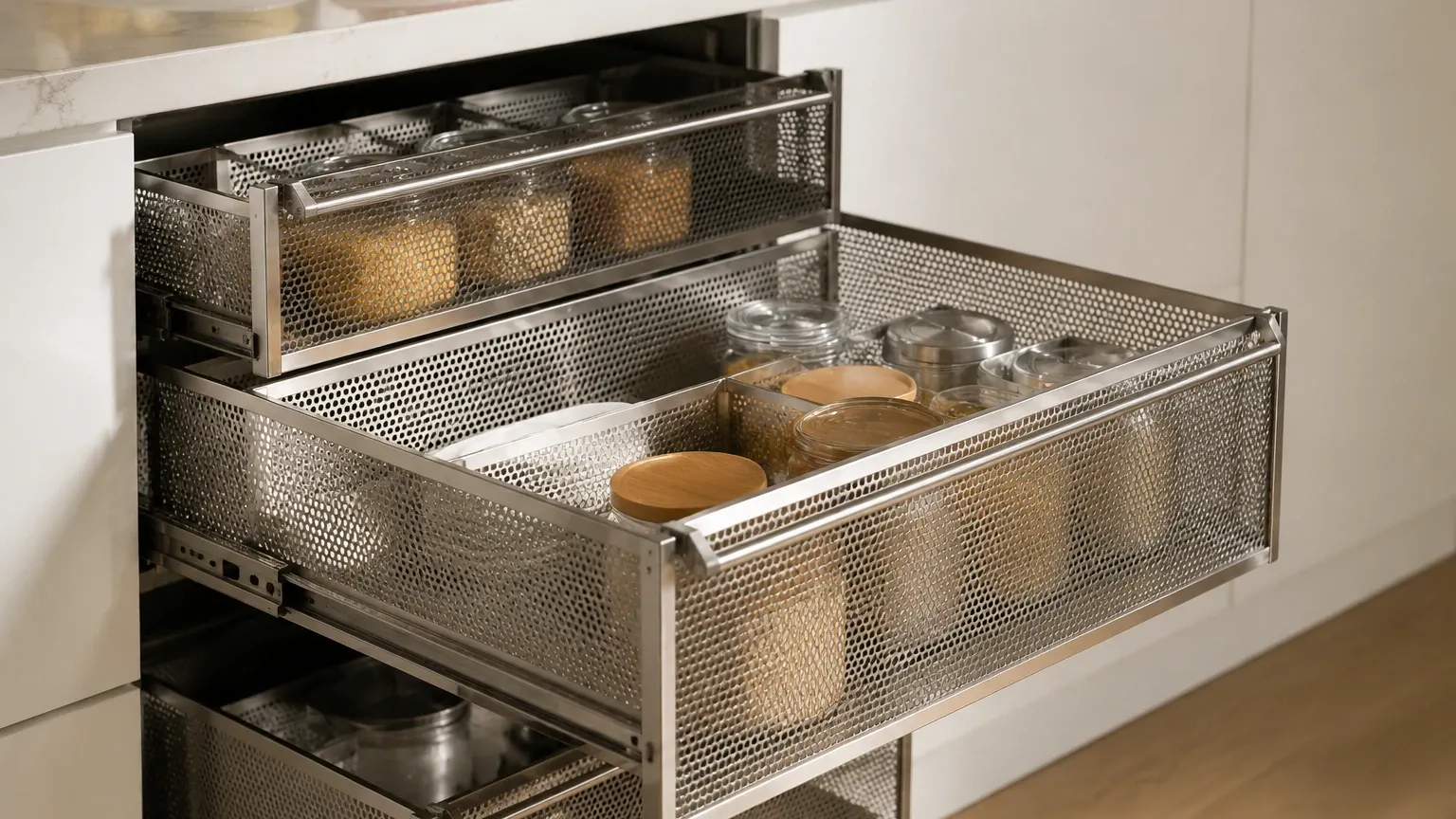
Perforated Metal Mesh Drawers for Kitchen
In high-demand environments such as commercial kitchens, food processing facilities, and industrial laboratories, storage solutions must meet rigorous standards for hygiene, durability, and airflow. Perforated metal mesh drawers for kitchen applications represent a specialized engineering choice, moving beyond simple aesthetics to provide functional advantages in moisture management and structural integrity. For technical professionals and purchasing teams, selecting the correct Perforated & Expanded Metal components is essential to ensuring long-term performance and compliance with industry safety standards.
Industrial-grade drawers utilizing metal mesh are distinct from residential alternatives. They are designed to withstand heavy load cycles, frequent chemical sanitization, and the corrosive nature of high-humidity environments. Understanding the technical specifications—ranging from material grade to the open area ratio—is critical for optimizing storage efficiency and equipment lifespan.
Technical Fundamentals of Perforated and Expanded Metal
When specifying metal mesh for kitchen drawers, engineers typically choose between two primary manufacturing methods: perforating and expanding. Each offers distinct mechanical properties that influence the drawer's performance.
Perforated Metal
Perforated metal is produced by punching a series of holes into a solid metal sheet. This process allows for high precision in hole size, shape, and arrangement. For kitchen drawers, round holes are the most common due to their structural stability and ease of cleaning. The remaining metal, known as the "bridge," provides the necessary stiffness to prevent sagging under the weight of heavy cookware or bulk ingredients.
Expanded Metal
Expanded metal is created by simultaneously slitting and stretching a sheet of metal, resulting in a diamond-shaped pattern. This process is highly cost-effective as it involves no material waste. In a kitchen drawer context, expanded metal provides a high strength-to-weight ratio and an inherently slip-resistant surface. However, the raised edges of standard expanded metal may require flattening (flattened expanded metal) to ensure a smooth surface that does not snag fabrics or scratch delicate equipment.
Material Selection: The Priority of Stainless Steel
In professional kitchen environments, material selection is non-negotiable. While aluminum and galvanized steel are available, stainless steel is the industry standard for perforated metal mesh drawers due to its metallurgical properties.
1. Grade 304 Stainless Steel: This is the most widely used grade in food service. It offers excellent corrosion resistance to most oxidizing acids and is highly durable. It is suitable for dry storage, vegetable bins, and general equipment drawers.
2. Grade 316 Stainless Steel: For environments involving high salt concentrations or frequent exposure to aggressive cleaning chemicals (such as in seafood processing or high-salinity coastal kitchens), Grade 316 is preferred. The addition of molybdenum provides superior resistance to pitting and crevice corrosion.
Using stainless steel ensures that the drawers remain non-reactive, preventing metallic contamination of food products and maintaining a sterile surface that does not harbor bacteria in microscopic pits or rust spots.
Engineering Considerations for Drawer Design
When designing or procuring perforated metal mesh drawers for kitchen use, several engineering parameters must be evaluated to ensure the component meets the application's physical demands.
Open Area Ratio
The open area ratio refers to the percentage of the sheet that is occupied by holes. In kitchen drawers, airflow is a primary requirement. Perforated mesh allows for 360-degree ventilation, which is critical for:
* Moisture Dissipation: Preventing the growth of mold and mildew on stored items.
* Temperature Regulation: Allowing cold air to circulate in refrigerated storage units.
* Drainage: Enabling water to escape after washing, which is vital for "wash-down" environments.
Typically, an open area of 40% to 60% provides an optimal balance between ventilation and structural rigidity.
Gauge and Load-Bearing Capacity
The thickness of the metal sheet, or gauge, determines the drawer's ability to support weight without permanent deformation. For standard kitchen utensils, a lighter gauge (18 to 22 gauge) may suffice. However, for drawers intended to hold heavy pots, industrial mixers, or bulk dry goods, a heavier gauge (14 to 16 gauge) is required. Engineers must calculate the maximum expected load and select a gauge that maintains a safety factor, especially when the drawer is fully extended on its slides.
Hole Pattern and Pitch
The arrangement of holes—whether staggered or straight—affects the directional strength of the drawer bottom. A 60-degree staggered pattern is the most popular because it offers the highest strength in all directions and a high open area. The "pitch" (the distance between the centers of adjacent holes) must be calculated to ensure the bridge width is sufficient to prevent the mesh from tearing under stress.
Advantages in Professional and Industrial Kitchens
Switching from solid-bottom drawers or plastic bins to perforated metal mesh drawers offers several operational benefits that impact the total cost of ownership and facility efficiency.
Enhanced Hygiene and Sanitization
Solid drawers often accumulate debris, dust, and moisture in the corners, which can become breeding grounds for pathogens. Perforated metal mesh drawers allow small particles to fall through to a collection tray or the floor, where they can be easily cleaned. Furthermore, stainless steel mesh can withstand high-temperature steam cleaning and aggressive detergents without degrading, ensuring compliance with HACCP (Hazard Analysis and Critical Control Point) protocols.
Improved Visibility and Organization
In a fast-paced commercial kitchen, speed is essential. Mesh drawers allow staff to identify the contents of a drawer from the side or bottom without having to open it fully. This transparency reduces the time spent searching for specific tools or ingredients and assists in inventory management.
Weight Reduction
Large-scale storage systems can become incredibly heavy when fully loaded. By utilizing perforated or expanded metal, the tare weight of the drawer itself is significantly reduced compared to solid steel. This reduction puts less strain on the drawer slide mechanisms and the overall cabinetry structure, leading to fewer mechanical failures and lower maintenance costs over time.
Customization and OEM Requirements
For manufacturers of kitchen equipment and industrial storage systems, off-the-shelf solutions rarely meet specific spatial or functional requirements. Customization of Perforated & Expanded Metal components is often necessary.
Edge Treatments and Safety
One of the primary concerns with metal mesh is the presence of sharp edges. In a kitchen environment, these can cause injuries or damage gloves. Professional fabrication involves "safe edges" or U-edging, where the perimeter of the mesh is encased in a solid metal frame or folded over to hide sharp points. This also adds significant structural reinforcement to the drawer's perimeter.
Surface Finishes
While stainless steel is naturally resistant to corrosion, additional finishes can enhance performance:
* Electropolishing: This process removes a microscopic layer of material, smoothing out surface irregularities. It results in a high-luster finish that is even easier to clean and provides maximum corrosion resistance by enriching the chromium layer.
* Powder Coating: While less common for the mesh itself in food-contact areas, powder coating can be used for non-food-contact drawer fronts to match facility branding or provide color-coded organization (e.g., red for raw meat tools, green for produce).
Selection Criteria for Purchasing Teams
When evaluating suppliers for perforated metal mesh drawers, purchasing teams should focus on technical compliance rather than just unit price. Key questions to ask include:
* Dimensional Tolerances: Are the drawers manufactured to tight tolerances to ensure smooth operation within the cabinet housing?
* Burr Removal: Does the manufacturer guarantee a burr-free finish to prevent injury and facilitate cleaning?
* Material Certification: Can the supplier provide mill test reports (MTRs) to verify the grade of stainless steel used?
* Load Testing: Has the drawer design been tested for deflection under the specific weight loads required by the application?
Maintenance and Lifecycle Management
The longevity of perforated metal mesh drawers is one of their strongest selling points. Unlike plastic, which can crack or warp over time, or wood, which absorbs moisture and odors, stainless steel mesh is virtually permanent if maintained correctly.
Maintenance involves regular inspection of the mesh for any signs of physical impact damage and ensuring that the drainage holes remain clear of debris. Because the material is resistant to high temperatures, these drawers can be processed through industrial dishwashers, significantly reducing the labor required for manual scrubbing. In the long run, the durability of stainless steel mesh results in a lower total cost of ownership by eliminating the need for frequent replacements.
Conclusion
Perforated metal mesh drawers for kitchen and industrial storage are more than just organizational tools; they are engineered components that contribute to the safety, hygiene, and efficiency of a professional facility. By selecting the appropriate material grade, hole pattern, and gauge, engineers can create storage solutions that withstand the rigors of the most demanding environments.
For those seeking to integrate these high-performance components into their equipment designs or facility upgrades, it is essential to partner with a manufacturer that understands the nuances of metal fabrication. For detailed specifications and to explore the range of available patterns and materials, technical professionals should Review product options and application support to ensure their selection aligns with both functional requirements and industry standards.
