


Perforated Metal Options
In industrial filtration and separation, selecting the correct perforated metal configuration is a critical engineering decision that impacts flow rates, structural integrity, and the longevity of the filtration system. Perforated metal serves as both a primary filter medium for coarse particles and a vital support structure for finer wire mesh or synthetic filter media. Understanding the breadth of perforated metal options allows engineers to optimize performance while managing the total cost of ownership.
As a specialized manufacturer, Kaifil provides precision-engineered solutions that address the rigorous demands of chemical processing, pharmaceutical production, and hydraulic systems. This guide examines the technical variables involved in specifying perforated metal, from material properties to geometric configurations.
Material Selection Criteria for Industrial Perforated Metal
The environment in which a filter operates dictates the material requirements. For most industrial B2B applications, stainless steel remains the gold standard due to its mechanical strength and resistance to environmental degradation.
Stainless Steel Grades
* Grade 304/304L: The most common choice for general industrial use. It offers excellent formability and weldability, making it suitable for standard water treatment and industrial equipment components.
* Grade 316/316L: Contains molybdenum, which provides superior resistance to chlorides and pitting. This is the preferred option for marine environments, chemical processing, and pharmaceutical applications where rigorous cleaning protocols are standard.
* Specialty Alloys: For extreme environments involving high temperatures or highly corrosive acids, alloys such as Monel, Inconel, or Duplex stainless steel may be required to prevent premature failure of the filtration component.
Surface Finishes and Treatments
Beyond the base metal, surface treatments can enhance performance. Electropolishing is frequently utilized in the food and beverage and pharmaceutical sectors to remove surface imperfections, thereby reducing the risk of bacterial growth and improving the ease of cleaning (CIP/SIP processes).
Geometry and Pattern Configurations
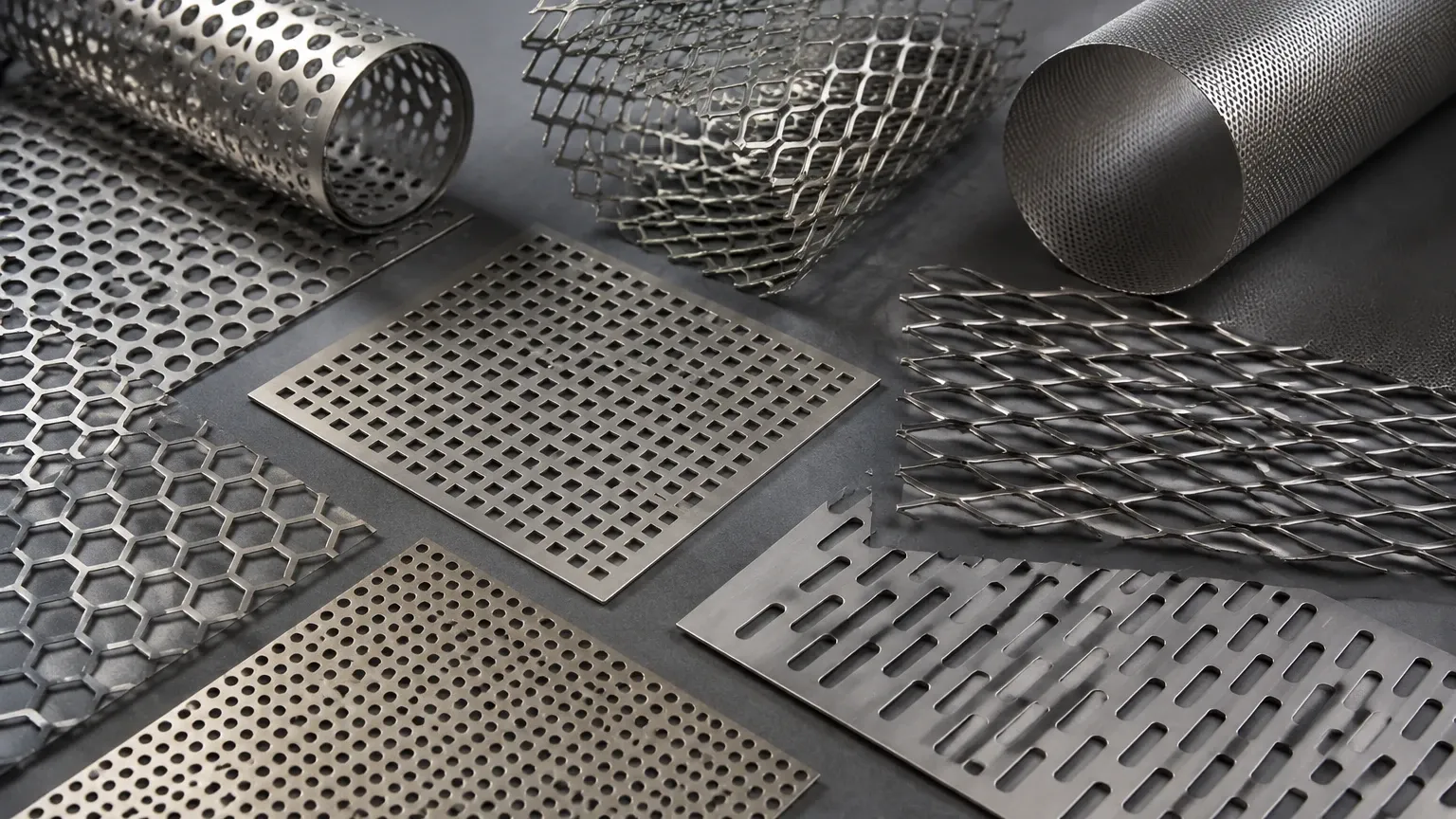
The arrangement and shape of the perforations determine the mechanical behavior of the sheet and its efficiency as a filter. When evaluating perforated metal options, engineers must balance the need for high flow rates with the requirement for structural rigidity.
Hole Shapes
* Round Holes: The most efficient and common shape. Round holes provide the highest structural strength and are the easiest to manufacture with high precision. They are ideal for supporting pressure-driven filtration.
* Square Holes: Offer a higher open area than round holes but at the cost of reduced structural strength. They are often used when a high flow rate is prioritized over pressure resistance.
* Slotted Holes: Frequently used for the filtration of elongated particles or in applications requiring specific directional flow characteristics. Slotted patterns can be oriented side-staggered or end-staggered depending on the mechanical load requirements.
Pattern Arrangements
* 60-Degree Staggered: The industry standard for round holes. This configuration provides the maximum open area and uniform strength across the sheet.
* Straight Row: Holes are aligned in both vertical and horizontal rows. While simpler to align with other components, this pattern generally offers lower structural integrity than staggered arrangements.
* 45-Degree Staggered: An alternative that provides a different aesthetic and mechanical profile, though less common in heavy industrial filtration than the 60-degree variant.
Calculating Open Area and Flow Efficiency
The "Open Area" is the percentage of the sheet that is occupied by holes. This is perhaps the most critical metric for engineers, as it directly correlates to the pressure drop across the filter and the velocity of the fluid passing through.
The Relationship Between Hole Size and Pitch
The pitch is the distance from the center of one hole to the center of the adjacent hole. The relationship between the hole diameter (D) and the pitch (P) determines the open area. For a standard 60-degree staggered round hole pattern, the formula is:
Open Area % = (D² × 90.69) / P²
Engineering Constraints: The 1:1 Rule
A common manufacturing constraint in perforated metal production is the relationship between hole diameter and material thickness. Generally, the hole diameter should not be smaller than the thickness of the metal sheet (the 1:1 rule). Attempting to punch holes smaller than the material thickness increases the risk of tool breakage and can lead to irregular hole shapes or excessive burr formation. For applications requiring extremely fine filtration that exceeds this ratio, laser drilling or the use of multi-layered sintered mesh supported by a perforated core is recommended.
Comparing Perforated & Expanded Metal for Filtration Support
In many industrial designs, the choice between Perforated & Expanded Metal depends on the specific mechanical stresses the component will face. While both are used as support structures for filter cartridges, they are manufactured differently and offer distinct advantages.
Perforated Metal Characteristics
Perforated metal is produced by punching holes into a solid sheet. This process allows for high precision in hole size and placement. It provides a smooth surface, which is critical when the perforated sheet is used as a support for delicate wire mesh or filter paper, as it prevents tearing or abrasion of the finer media.
Expanded Metal Characteristics
Expanded metal is created by simultaneously slitting and stretching the metal sheet. This process results in a diamond-shaped opening. Because no material is lost during production, expanded metal is often more cost-effective for large-scale applications. It offers an excellent strength-to-weight ratio and a three-dimensional surface that can help in pre-breaking the flow of fluids, though it may require deburring or flattening (flattened expanded metal) to be used safely with fine filter media.
Selection Guide
* Use Perforated Metal when: High precision, smooth surfaces, and specific open area percentages are required for high-pressure filtration.
* Use Expanded Metal when: Weight reduction and cost-efficiency are prioritized, and the filtration media is robust enough to handle the textured surface of the expanded diamonds.
Manufacturing Tolerances and Customization Capabilities
Off-the-shelf perforated sheets rarely meet the exacting standards of specialized industrial equipment. Customization is often necessary to ensure seamless integration into filter housings and to meet performance specifications.
Margins and Blank Areas
Standard perforated sheets often have "minimal margins," meaning the holes run close to the edge. However, for many OEM applications, specific blank areas (unperforated margins) are required for welding, mounting, or structural reinforcement. Specifying exact margin dimensions is essential during the design phase to avoid interference with housing seals.
Flatness and Leveling
The perforation process introduces internal stresses into the metal, which can cause the sheet to curl or bow. Precision leveling is a critical secondary process that ensures the finished component meets flatness tolerances, which is vital for automated assembly lines or when the perforated metal must be rolled into a perfect cylinder for filter cartridges.
Forming and Welding
Perforated metal can be fabricated into various shapes, including cylinders, cones, and baskets. Kaifil specializes in the precision welding of perforated cylinders, ensuring that the seam strength matches the integrity of the base material. This is particularly important in hydraulic applications where the filter must withstand high collapse pressures.
Selection Checklist for Engineering and Procurement
To ensure the selected perforated metal option meets the application requirements, engineering teams should confirm the following parameters before moving to production:
1. Chemical Compatibility: Does the selected grade (e.g., 316L) withstand the process fluid and cleaning agents?
2. Pressure Requirements: Will the material thickness and hole pattern support the maximum expected differential pressure without deforming?
3. Filtration Rating: Is the hole size appropriate for the target particle retention, or is the perforated metal intended only as a support for a finer mesh?
4. Open Area Requirements: Is the open area sufficient to maintain the required flow rate at an acceptable pressure drop?
5. Edge Requirements: Are specific unperforated margins needed for welding or mechanical fastening?
6. Surface Finish: Does the application require a specific Ra (Roughness Average) value or electropolishing for hygienic compliance?
Maintenance and Replacement Cycles
While stainless steel perforated metal is highly durable, it is not immune to wear. In abrasive environments, such as those found in mining or heavy industrial slurry processing, the edges of the perforations can round off over time, altering the filtration characteristics.
Regular inspection should focus on:
* Blinding/Clogging: Build-up of material that cannot be removed by standard backwashing or cleaning.
* Erosion: Thinning of the bridges between holes, which can lead to structural failure.
* Corrosion: Any signs of pitting or stress corrosion cracking, especially near weld seams.
By selecting the appropriate material and geometric configuration at the outset, companies can significantly extend the replacement cycle and reduce downtime. Kaifil’s engineering team works closely with clients to analyze these variables, ensuring that every perforated metal component is optimized for its specific industrial environment.
For more detailed technical specifications or to discuss a custom design for your filtration system, you can Review product options and application support to find the ideal solution for your project.
