


Perforated Metal or Mesh
In the field of industrial filtration and structural engineering, selecting the correct media is a critical decision that dictates the efficiency, durability, and cost-effectiveness of a system. Engineers and procurement specialists often face the choice between perforated metal or mesh. While both serve as permeable barriers, their manufacturing processes, mechanical properties, and performance characteristics differ significantly. Understanding these nuances is essential for optimizing filtration systems in demanding environments such as chemical processing, pharmaceutical manufacturing, and hydraulic applications.
Defining the Functional Differences in Industrial Filtration
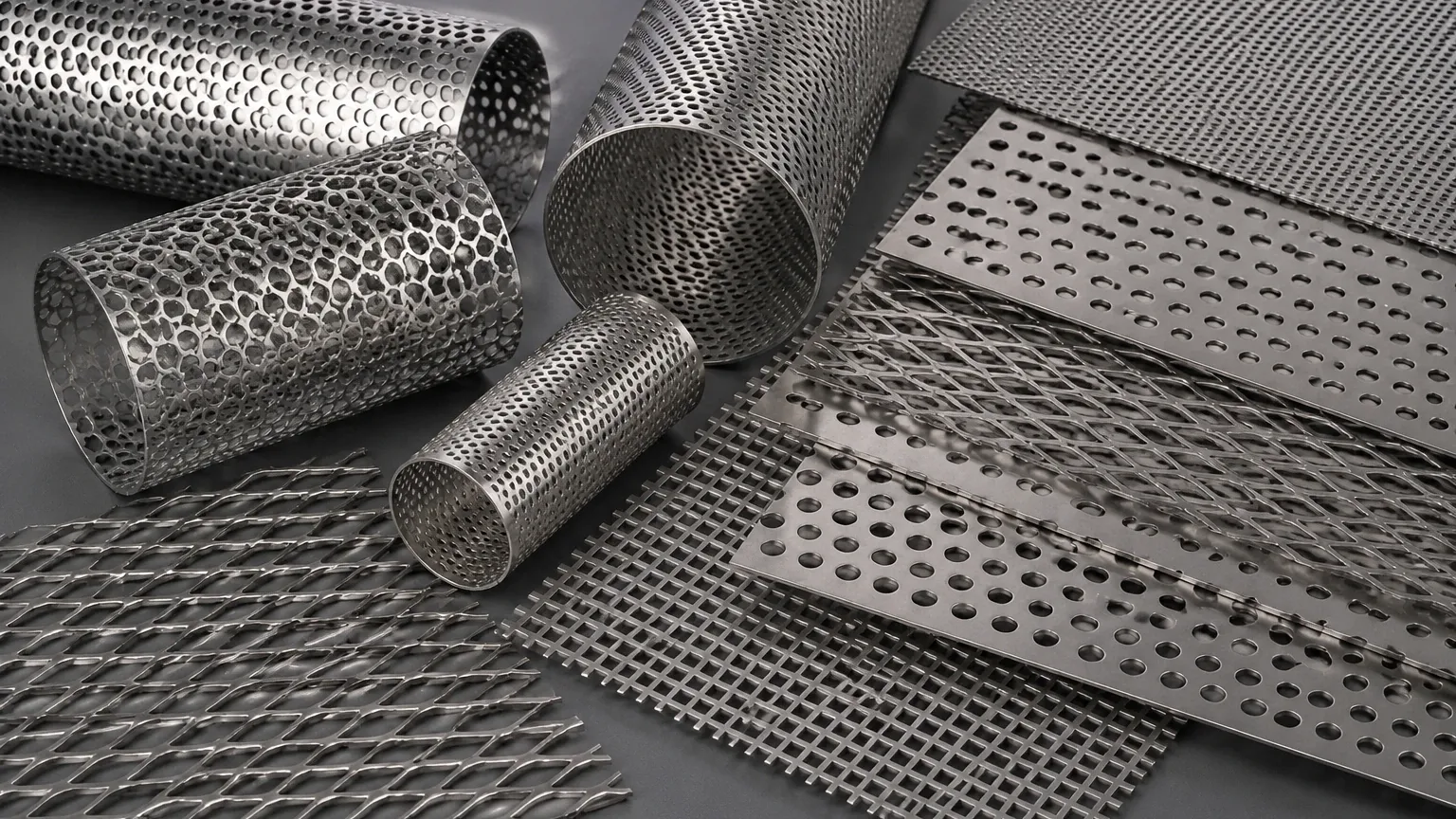
The choice between perforated metal or mesh is rarely about which material is "better" in a general sense, but rather which is better suited for the specific mechanical and hydraulic requirements of the application. Perforated metal is produced by punching holes into a solid metal sheet, resulting in a robust, rigid component. In contrast, wire mesh is created by weaving or welding individual metal wires together, offering a higher degree of flexibility and a significantly larger range of filtration precisions.
From an engineering perspective, the primary distinction lies in the relationship between structural integrity and open area. Perforated metal provides superior mechanical strength and can often serve as a self-supporting structural element. Wire mesh, particularly fine woven mesh, provides exceptional filtration accuracy—down to the micrometer level—but typically requires a support structure to withstand high differential pressures.
Technical Characteristics of Perforated Metal
Perforated metal is characterized by its precision and repeatability. Because the holes are punched using CNC machinery or high-speed presses, the pattern, hole size, and bridge (the space between holes) remain perfectly consistent across the entire sheet. This consistency is vital for applications requiring specific flow rates or calculated bypass.
Structural Rigidity and Durability
Perforated metal is inherently stronger than woven mesh of the same material thickness. Since it remains a single, continuous piece of metal, it does not suffer from the "wire migration" or shifting that can occur in some woven products under high-velocity flow. This makes it an ideal candidate for high-pressure environments where the media must resist deformation.
Customizable Hole Geometries
Unlike wire mesh, which is generally limited to square or rectangular openings, perforated metal can be manufactured with a variety of hole shapes, including round, square, slotted, and hexagonal. Round holes are the most common for filtration due to their structural stability and ease of cleaning. Slotted holes are frequently used in applications involving fibrous materials to prevent clogging.
Material Versatility
While stainless steel (304, 316, and 316L) is the standard for industrial filtration due to its corrosion resistance, perforated metal can be produced from a wide range of alloys, including carbon steel, aluminum, and specialty high-temperature alloys. This allows engineers to match the material precisely to the chemical and thermal demands of the process.
Technical Characteristics of Wire Mesh
Wire mesh, specifically woven stainless steel wire cloth, is the gold standard for precision filtration. It is defined by its mesh count (the number of openings per linear inch) and the wire diameter. The interplay between these two factors determines the filtration rating and the open area.
High Open Area and Flow Efficiency
One of the primary advantages of wire mesh over perforated metal is the percentage of open area. Woven mesh can achieve significantly higher open area ratios, which translates to lower pressure drops and higher flow capacities. For systems where energy consumption and pump efficiency are priorities, mesh is often the preferred choice.
Micronic Filtration Precision
While perforated metal is typically limited to hole sizes of 0.5mm or larger, woven wire mesh can achieve filtration ratings as fine as 5 microns or less. This makes mesh indispensable for pharmaceutical, food and beverage, and high-purity chemical applications where the removal of microscopic particulates is mandatory.
Flexibility and Formability
Wire mesh is more pliable than perforated metal, allowing it to be pleated to increase surface area or formed into complex shapes. Pleated filter cartridges utilize this flexibility to provide up to five times the filtration surface area of a cylindrical filter of the same footprint, significantly extending the service life between cleaning cycles.
Comparative Analysis: Perforated Metal or Mesh?
When evaluating perforated metal or mesh for a specific project, several technical parameters must be compared side-by-side.
| Feature | Perforated Metal | Woven Wire Mesh |
| :— | :— | :— |
| Filtration Range | Coarse (typically >500 microns) | Fine to Coarse (2µm to 10mm) |
| Structural Strength | High; often self-supporting | Moderate to Low; often needs support |
| Open Area | Moderate (typically 20% – 60%) | High (can exceed 80%) |
| Cleaning | Very Easy (smooth surface) | Moderate (particles can trap in weaves) |
| Cost (Large Scale) | Generally lower for coarse specs | Higher for fine micronic specs |
| Surface Texture | Smooth and flat | Textured/Uneven due to weave |
In many industrial designs, these two materials are not used in isolation. Instead, they are combined into a multi-layer composite. For instance, a fine wire mesh layer may be sintered or mechanically bonded to a Perforated & Expanded Metal support core. This hybrid approach leverages the filtration precision of the mesh and the mechanical robustness of the perforated plate.
Engineering Factors for Material Selection
To make an informed decision, engineers must analyze the operating conditions of the filtration system. The following factors are critical:
1. Differential Pressure (ΔP)
Every filter media creates a resistance to flow. If the application involves high-viscosity fluids or high flow velocities, the pressure drop across the media will be significant. Perforated metal is better suited to handle high differential pressures without collapsing, whereas mesh may require a perforated backup tube to maintain its shape.
2. Particle Morphology
The shape and nature of the contaminants influence the choice. Hard, spherical particles are easily captured by both. However, soft, deformable particles or long fibers can become wedged in the intersections of a woven mesh, leading to "blinding" or permanent clogging. In such cases, a smooth perforated surface or a wedge wire screen might be more effective.
3. Cleaning and Regeneration
In B2B industrial environments, the total cost of ownership is heavily influenced by how many times a filter can be cleaned and reused. Perforated metal is exceptionally easy to clean via backwashing or ultrasonic cleaning because it lacks the deep crevices found in woven mesh. If the process requires frequent sterilization (SIP) or cleaning-in-place (CIP), the simplicity of perforated metal is a distinct advantage.
4. Chemical Compatibility and Corrosion
Since both perforated metal and mesh are available in various grades of stainless steel, chemical compatibility is usually managed through material selection. However, the manufacturing process of mesh creates small gaps at the wire intersections which can be susceptible to crevice corrosion in highly aggressive environments. Perforated metal, being a single sheet, has fewer areas where stagnant fluids can accumulate, potentially offering better resistance to localized corrosion.
Application-Specific Recommendations
Chemical Processing
In the chemical industry, filters must withstand aggressive solvents and varying temperatures. Perforated metal is frequently used as a strainer for large particulates or as a support for catalyst beds. For fine chemical filtration, multi-layered sintered mesh is often used, supported by a heavy-gauge perforated stainless steel cylinder.
Food and Beverage
Hygiene is the priority here. Perforated metal is favored for coarse separation (such as fruit pulp or grain) because its smooth surface prevents bacterial growth and is easy to sanitize. For beer or juice clarification, fine mesh is necessary, but it is almost always supported by a perforated metal frame to ensure the assembly can withstand the pressures of high-speed bottling lines.
Hydraulic Systems
Hydraulic filters must handle high-pressure pulses. Typically, these filters use a pleated wire mesh design to maximize dirt-holding capacity, but they rely on a perforated metal inner core to prevent the pleats from collapsing under the intense pressure of the hydraulic fluid.
Maintenance and Total Cost of Ownership
When choosing between perforated metal or mesh, the initial purchase price is only one part of the equation. Engineers must consider the replacement cycle. A thin wire mesh may be cheaper initially but may fail due to fatigue or abrasion, requiring frequent replacements. A perforated metal component, while potentially more expensive upfront due to material thickness, may last for years with proper maintenance.
Furthermore, the "dirt-holding capacity"—the amount of contaminant a filter can trap before the pressure drop becomes unacceptable—is generally higher in mesh due to its complex pore structure. This means mesh filters may require less frequent cleaning than perforated metal filters of the same surface area, reducing labor costs and system downtime.
Sourcing Custom Filtration Components
For many specialized industrial applications, standard off-the-shelf solutions are insufficient. Customization is often required to meet specific flow rates, housing dimensions, or mechanical load requirements. Working with a manufacturer that understands the interplay between different metal media is essential for developing a reliable solution.
Kaifil specializes in bridging the gap between raw materials and finished industrial components. By providing custom Perforated & Expanded Metal and integrating them with precision wire mesh, Kaifil helps engineers design filtration systems that do not compromise on either strength or precision. Whether the application requires a simple perforated strainer or a complex, multi-stage stainless steel filter cartridge, the selection of the base media remains the most critical engineering step.
Before finalizing a specification, it is recommended that engineering teams confirm the following with their supplier:
* The exact alloy grade (e.g., 316L for better weldability and corrosion resistance).
* The required burst pressure and collapse pressure of the finished component.
* The cleaning protocols that will be used (to ensure the media can withstand the mechanical or chemical stress).
* The required filtration efficiency (beta rating) for the specific particle size of concern.
By carefully weighing the pros and cons of perforated metal or mesh, and considering the use of hybrid designs, industrial operators can achieve a balance of high performance and long-term durability in their filtration processes.
