


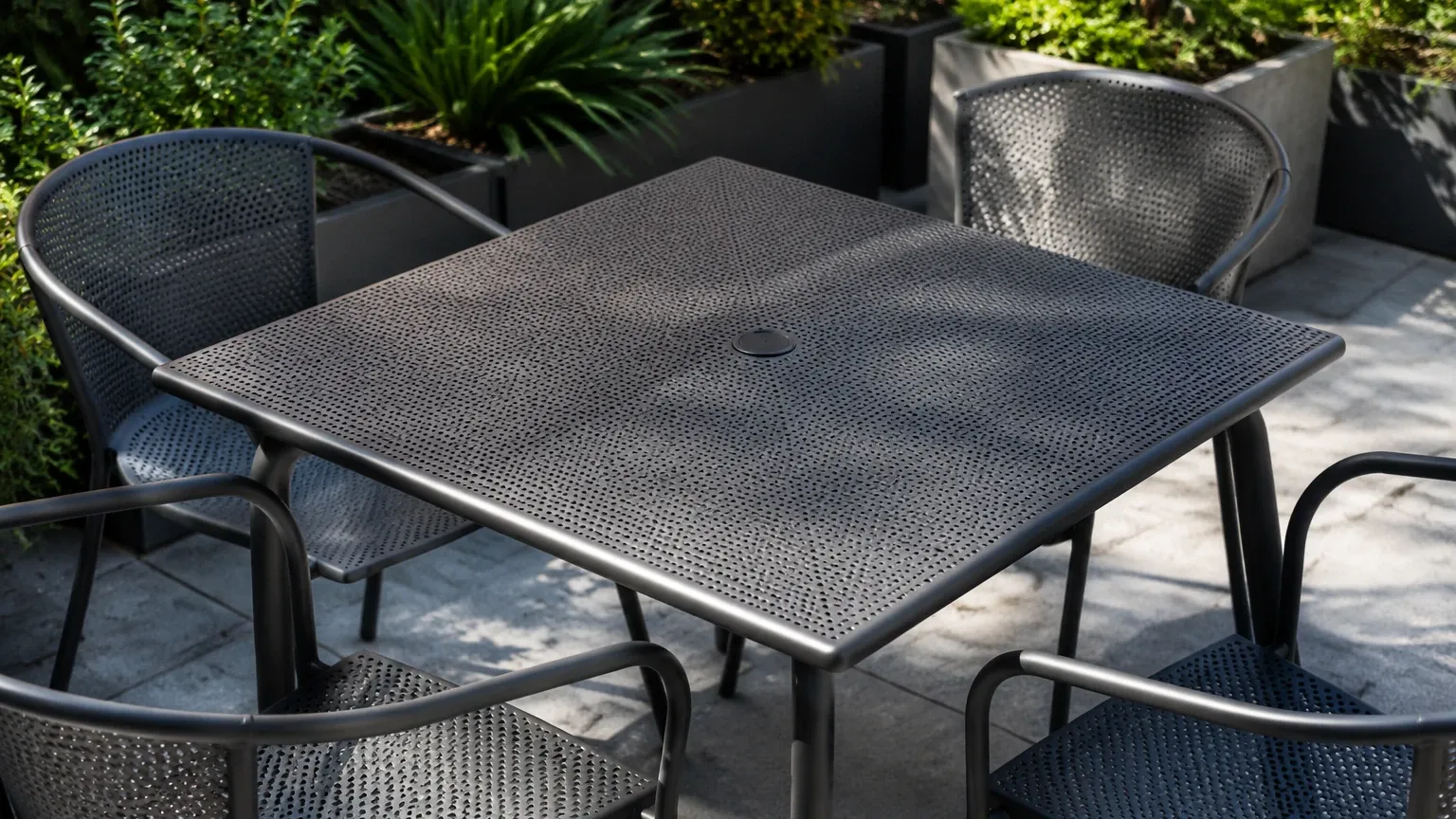
Perforated Metal Outdoor Table
In industrial and commercial environments, the selection of outdoor furniture is governed by more than just aesthetics; it is a matter of structural engineering, material science, and long-term maintenance costs. A perforated metal outdoor table represents a specialized application of industrial metal fabrication, where the functional properties of the surface—such as drainage, wind resistance, and thermal regulation—are prioritized. For engineers and facility managers, understanding the technical nuances of Perforated & Expanded Metal is essential for ensuring that these components withstand the rigors of heavy use and environmental exposure.
Industrial-grade outdoor tables are often deployed in demanding settings, including chemical processing plants, food and beverage facilities, and pharmaceutical campuses. In these contexts, the choice of material and the precision of the perforation pattern directly impact the safety, hygiene, and durability of the installation. This guide examines the engineering considerations, material specifications, and procurement criteria necessary for selecting high-performance perforated metal solutions for outdoor applications.
Engineering Advantages of Perforated and Expanded Metal
The use of perforated or expanded metal in outdoor furniture offers several technical advantages over solid surfaces. From a structural perspective, these materials provide a high strength-to-weight ratio, allowing for the creation of robust tables that are easier to transport and install without sacrificing load-bearing capacity.
Fluid and Debris Management
One of the primary reasons for utilizing a perforated metal outdoor table in an industrial setting is its inherent ability to manage fluids. In outdoor environments, rain, snow, and cleaning chemicals can pool on solid surfaces, leading to corrosion, bacterial growth, or safety hazards. Perforated surfaces allow for immediate drainage, keeping the work or rest area dry and reducing the risk of slip-and-fall accidents. In food processing or pharmaceutical environments, this feature is critical for maintaining sanitary standards, as it prevents the accumulation of organic matter.
Wind Resistance and Aerodynamics
In high-wind areas or rooftop installations, solid tables can act as sails, creating significant uplift and lateral forces that may destabilize the furniture or the underlying structure. Perforated and expanded metals allow air to pass through the surface, significantly reducing the wind load. This aerodynamic transparency ensures that the table remains stable even during severe weather events, reducing the need for heavy-duty anchoring systems.
Thermal Regulation
Metal surfaces exposed to direct sunlight can reach high temperatures, making them uncomfortable or even hazardous to touch. The open area in a perforated metal outdoor table facilitates better airflow and heat dissipation. Furthermore, by reducing the total mass of the metal surface, the material retains less thermal energy, allowing it to cool down more rapidly when shaded or when ambient temperatures drop.
Material Selection: Stainless Steel vs. Alternatives
For industrial applications, the choice of alloy is the most significant factor in determining the lifecycle of the product. While carbon steel and aluminum are common in residential furniture, industrial environments usually demand the superior properties of stainless steel.
Stainless Steel 304 and 316
Stainless steel is the preferred material for high-performance perforated metal components due to its exceptional corrosion resistance.
- Grade 304: This is the standard industrial grade, providing excellent resistance to atmospheric corrosion and many organic and inorganic chemicals. It is suitable for most general-purpose industrial outdoor tables.
- Grade 316: For environments located near coastal areas or those exposed to harsh chemicals (such as chloride-rich cleaning agents), Grade 316 is recommended. The addition of molybdenum enhances its resistance to pitting and crevice corrosion, ensuring the structural integrity of the perforated metal outdoor table over decades.
Surface Finishes and Treatments
In addition to the base material, surface treatments play a vital role in performance. For stainless steel, passivation is a critical step to remove free iron from the surface and enhance the protective oxide layer. In some industrial contexts, powder coating may be applied over the perforated metal to provide additional chemical resistance or to meet specific safety color coding requirements. However, the coating must be applied with precision to ensure it does not clog the perforations or peel at the edges of the holes.
Technical Specifications: Hole Patterns and Open Areas
The performance of a perforated metal outdoor table is defined by its geometric configuration. Engineers must specify the hole shape, size, and pitch (the distance between the centers of the holes) to balance functionality with structural requirements.
Round vs. Square Perforations
- Round Holes: These are the most common and cost-effective patterns. They provide high structural stability and are easier to clean, as they lack the sharp corners where debris can accumulate. Round hole patterns are typically staggered to maximize the open area while maintaining the strength of the metal bridges.
- Square Holes: While offering a modern aesthetic, square holes provide a larger open area for the same hole size compared to round holes. However, they can be more prone to stress concentrations at the corners, which engineers must account for in high-load applications.
Calculating Open Area Percentage
The "open area" is the ratio of the total area of the holes to the total area of the sheet, expressed as a percentage. For an outdoor table, an open area of 30% to 50% is often ideal. This range provides sufficient drainage and airflow while ensuring the surface remains comfortable for use and strong enough to support heavy equipment or multiple users. High-precision manufacturing ensures that these percentages are consistent across the entire surface, preventing weak spots.
Manufacturing Precision and Customization
Quality manufacturing is what distinguishes an industrial-grade perforated metal outdoor table from a mass-market product. Precision in the punching or expanding process is essential to ensure that there are no burrs, sharp edges, or deformations that could compromise safety or hygiene.
OEM and Custom Fabrication
Industrial projects often require custom dimensions or specific hole patterns to integrate with existing infrastructure. Advanced manufacturers utilize CNC punching and laser cutting to achieve tight tolerances. When sourcing Perforated & Expanded Metal, purchasing teams should look for suppliers capable of providing custom edge margins. A solid margin (an unperforated border) around the edge of the table surface increases the overall rigidity and provides a smooth surface for welding the top to the frame.
Structural Integrity and Reinforcement
For larger tables, the perforated sheet must be supported by a robust frame. Engineers often specify a sub-frame of stainless steel tubing or angle iron. The method of attachment—typically TIG or MIG welding—must be executed cleanly to prevent crevices where moisture could sit and initiate galvanic corrosion. In high-precision manufacturing, the perforated panels are often leveled after the punching process to ensure a perfectly flat surface, which is critical for tables used in technical or laboratory settings.
Maintenance, Durability, and Total Cost of Ownership
While the initial capital expenditure for a high-quality stainless steel perforated metal outdoor table may be higher than for plastic or wood alternatives, the total cost of ownership (TCO) is significantly lower in industrial settings.
Long-Term Durability
Unlike wood, which can rot, or plastic, which can degrade under UV exposure and become brittle, stainless steel perforated metal maintains its structural properties for decades. It is resistant to fire, impact, and heavy cleaning protocols. In industries like pharmaceutical manufacturing or food processing, where surfaces must be sanitized frequently with aggressive agents, the durability of stainless steel is an operational necessity.
Ease of Maintenance
The open design of the perforated metal outdoor table makes it virtually self-cleaning in rain. For scheduled maintenance, the surfaces can be power-washed or steam-cleaned without risk of damage. Because the material does not absorb liquids, there is no risk of deep-seated staining or internal structural decay. This ease of maintenance translates to lower labor costs and less downtime for facility upkeep.
Procurement Checklist for Engineers and Purchasing Teams
Before finalizing a specification or placing an order for perforated metal components for outdoor use, technical professionals should confirm several key data points with their manufacturer:
1. Material Grade Certification: Ensure the supplier provides Mill Test Reports (MTRs) to verify the alloy composition (e.g., 304 vs. 316 stainless steel).
2. Load Requirements: Define the maximum expected weight the table must support. This will dictate the thickness (gauge) of the metal and the necessary sub-frame reinforcement.
3. Environmental Factors: Identify if the installation is in a high-corrosion zone (coastal, chemical-heavy) to determine if specialized coatings or higher-grade alloys are required.
4. Edge Finishing: Specify whether the perforated panels require solid margins or if the pattern should be "full-bleed." For safety, always specify deburred edges.
5. Compliance Standards: Ensure the manufacturing process aligns with relevant industrial standards for safety and hygiene, particularly if the table is used in food or medical environments.
By focusing on these technical parameters, organizations can procure a perforated metal outdoor table that provides reliable service, safety, and performance throughout its extended service life. The integration of high-quality Perforated & Expanded Metal into industrial furniture design is a strategic investment in facility infrastructure that pays dividends in reduced maintenance and enhanced durability.
