


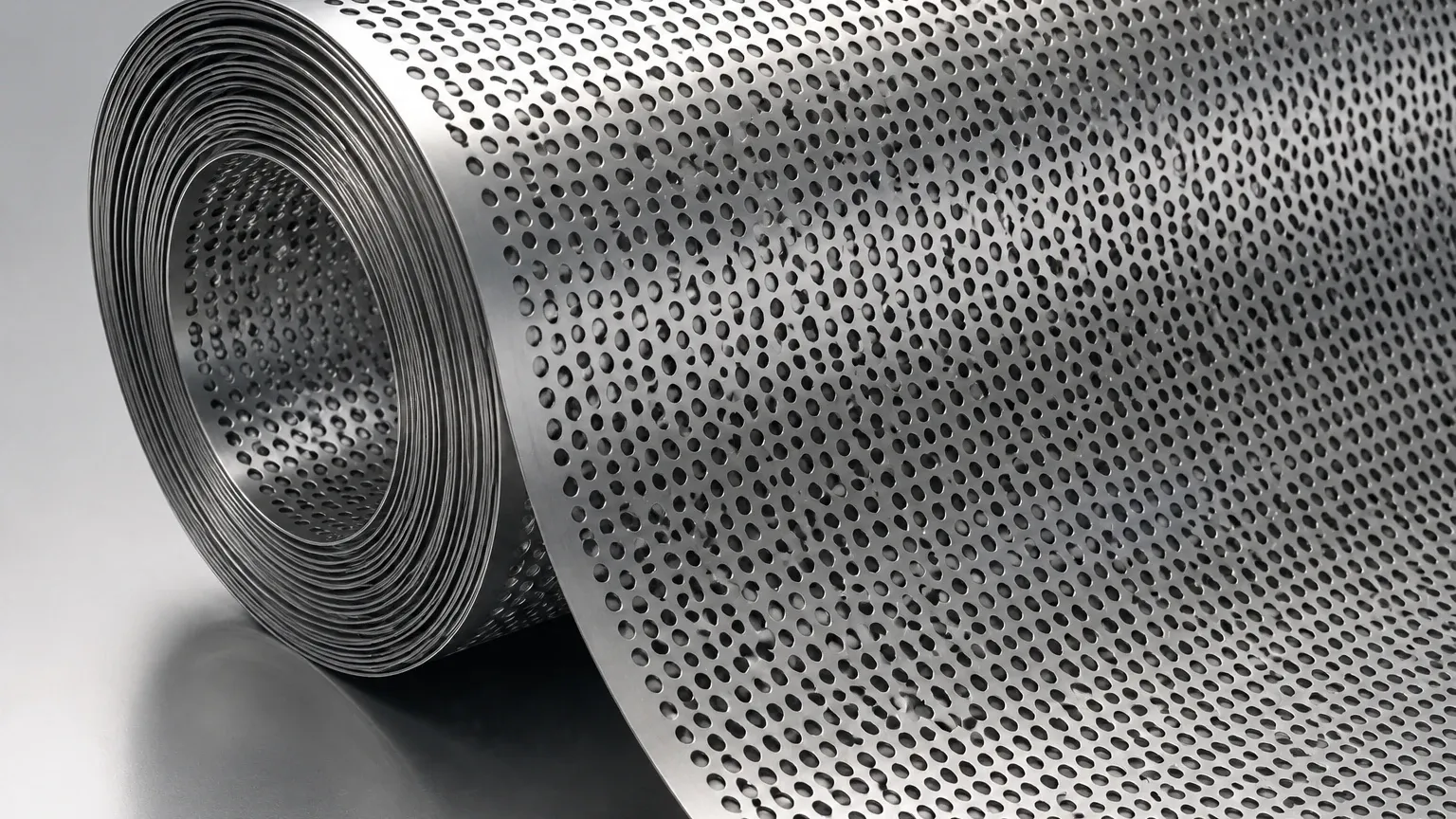
Perforated Metal Roll
In industrial manufacturing and filtration engineering, the perforated metal roll serves as a versatile and essential component. Unlike discrete flat sheets, perforated metal in roll form provides significant advantages for continuous production processes, automated stamping, and large-scale architectural or industrial installations. As a specialized manufacturer of stainless steel filtration solutions, Kaifil provides precision-engineered Perforated & Expanded Metal products designed to meet the rigorous demands of chemical processing, water treatment, and hydraulic systems.
Selecting the correct perforated metal roll requires a deep understanding of material properties, hole geometries, and mechanical tolerances. This guide examines the technical specifications and engineering considerations necessary for integrating these components into industrial applications.
Technical Specifications of Perforated Metal Rolls
A perforated metal roll is defined by several critical parameters that dictate its performance in filtration and structural support. Engineers must specify these dimensions with precision to ensure compatibility with downstream equipment.
Hole Patterns and Geometries
The most common pattern for industrial use is the 60-degree staggered round hole. This configuration is preferred because it offers the highest degree of structural integrity and a uniform distribution of open area. Other patterns include:
* Straight Line Round Holes: Used primarily for aesthetic applications or specific sorting tasks where structural load is minimal.
* Square Holes: Provide a higher open area percentage but may sacrifice some material strength compared to round holes.
* Slotted Holes: Ideal for filtering elongated particles or for use in drainage systems where directional flow is required.
The Importance of "Open Area"
The open area is the percentage of the total surface area that consists of holes. In filtration, this directly impacts the flow rate and pressure drop across the medium. For a standard 60-degree staggered round hole pattern, the open area percentage is calculated using the formula:
Open Area % = (D² × 90.69) / P²
Where *D* is the hole diameter and *P* is the pitch (the distance between the centers of two adjacent holes). Engineers must balance the need for a high open area (to reduce flow resistance) with the requirement for mechanical strength (to withstand system pressure).
Material Selection for Industrial Environments
The choice of alloy for a perforated metal roll is determined by the operating environment, including temperature, chemical exposure, and mechanical stress. Kaifil specializes in stainless steel options due to their superior longevity in harsh conditions.
Stainless Steel 304 vs. 316
* Type 304: The most common grade, offering excellent formability and resistance to atmospheric corrosion. It is suitable for food processing and general industrial applications.
* Type 316: Contains molybdenum, which provides enhanced resistance to chlorides and pitting. This is the standard choice for marine environments, pharmaceutical manufacturing, and aggressive chemical filtration.
Specialized Alloys and Coatings
For applications involving extreme temperatures or highly acidic environments, specialized alloys such as Duplex stainless steel or Monel may be used. Additionally, rolls can be supplied with specific finishes, such as passivated surfaces to enhance corrosion resistance or electropolished finishes for high-purity pharmaceutical applications.
Manufacturing Advantages of the Roll Format
Ordering perforated metal in roll form rather than individual sheets offers several operational efficiencies for OEMs and large-scale fabricators.
Continuous Processing
In automated production lines, a perforated metal roll allows for continuous feeding into stamping presses, laser cutters, or welding stations. This reduces the downtime associated with loading individual sheets and minimizes material waste. For manufacturers of cylindrical filter cartridges, rolls are particularly efficient as they can be fed into tube-rolling machines to create seamless or welded support cores.
Custom Dimensions and Margins
Precision manufacturing allows for the inclusion of "safe margins"—unperforated areas along the edges of the roll. These margins are critical for subsequent welding or mounting processes. Engineers can specify:
* Side Margins: Solid metal strips along the length of the roll.
* End Margins: Solid areas at the beginning and end of a specific cut length.
* Custom Slitting: Rolls can be slit to precise widths to match the height of a filter element, eliminating the need for secondary trimming.
Applications in Industrial Filtration
While perforated metal is used in everything from acoustic panels to architectural facades, its primary role in the Kaifil ecosystem is as a foundational element in complex filtration systems.
Support Cores for Filter Cartridges
In high-pressure hydraulic or chemical systems, fine wire mesh filters lack the structural rigidity to withstand differential pressure. A perforated metal roll is often fabricated into an inner support core or an outer protective guard. The perforated metal provides the mechanical strength to prevent the fine mesh from collapsing or bursting, while the mesh provides the actual filtration at the micron level.
Pre-Filtration and Coarse Screening
In water treatment and food processing, perforated metal serves as a primary screen to remove large debris before the fluid reaches more sensitive downstream components. The durability of stainless steel rolls ensures that these screens can be cleaned repeatedly via backwashing or mechanical scraping without losing their shape.
Centrifuge Liners
In the chemical and pharmaceutical industries, perforated rolls are used to line centrifuge baskets. The precision of the hole diameter is vital here to ensure consistent solids retention while allowing the liquid phase to exit at high velocities.
Engineering Considerations: Strength vs. Performance
When integrating a perforated metal roll into a system design, engineers must account for the mechanical trade-offs inherent in perforated materials.
Yield Strength and Pressure Ratings
Perforating a metal sheet significantly reduces its yield strength. When designing a filter housing or a pressurized vessel component, engineers must use the "equivalent solid material" properties. This involves calculating the effective thickness and strength of the perforated area to ensure it can handle the maximum operating pressure (MAOP) of the system without permanent deformation.
Flow Dynamics and Turbulence
The transition of fluid through a perforated roll can induce turbulence. In sensitive applications, such as laminar flow hoods or precision cooling systems, the hole size and pitch must be engineered to minimize vortex formation and ensure a uniform flow profile.
Edge Conditions and Safety
For components that will be handled during maintenance, such as removable strainer baskets, the edge condition of the perforated metal is paramount. Kaifil ensures that rolls are deburred and that margins are handled to prevent sharp edges, facilitating safer installation and replacement cycles.
Customization and Procurement Guidance
Procuring a perforated metal roll involves more than just selecting a hole size. To ensure the product meets the specific needs of an industrial project, several logistical and technical details must be confirmed.
Specifying Roll Weight and Diameter
Industrial handling equipment often has limits on the maximum weight or outer diameter (OD) of a roll. When ordering, it is essential to specify the maximum allowable roll weight to ensure compatibility with your facility's uncoiling mandrels.
Quality Control and Tolerances
Standard industrial tolerances for perforation usually allow for slight variations in hole diameter and pitch. However, for precision filtration, tighter tolerances may be required. Engineers should confirm the following before purchase:
1. Flatness Requirements: Ensuring the roll does not have excessive "coil set" or camber that could interfere with automated machinery.
2. Hole Accuracy: Verifying that the hole diameter stays within the specified micron range across the entire length of the roll.
3. Material Certification: Requesting Mill Test Reports (MTRs) to verify the chemical composition of the stainless steel, especially for regulated industries like food and beverage or pharmaceuticals.
Maintenance and Lifecycle Considerations
The longevity of a perforated metal roll in a filtration system depends largely on the cleaning protocols and the nature of the filtered media. Stainless steel components are favored because they support various cleaning methods:
* Chemical Cleaning: Resistance to caustic or acidic washes used to remove organic buildup.
* Ultrasonic Cleaning: Effective for removing fine particulates lodged in the holes or at the interface between the perforated support and the wire mesh.
* Mechanical Cleaning: The rigid surface of the perforated metal allows for the use of brushes or scrapers in self-cleaning filter systems.
By selecting the appropriate material grade and hole pattern, engineers can significantly extend the replacement cycle of these components, reducing the total cost of ownership (TCO) for the filtration system.
Conclusion
The perforated metal roll is a critical engineering component that bridges the gap between raw material and high-performance industrial equipment. Whether used as a structural backbone for a stainless steel filter cartridge or as a primary screen in a chemical reactor, its performance is dictated by precise technical specifications. By understanding the relationship between open area, material strength, and manufacturing format, purchasing teams and engineers can optimize their systems for efficiency and durability.
For more information on custom configurations and material options, review Perforated & Expanded Metal solutions to find the exact match for your industrial requirements. Kaifil remains committed to providing technical expertise and high-quality manufacturing to support the world's most demanding filtration applications.
