


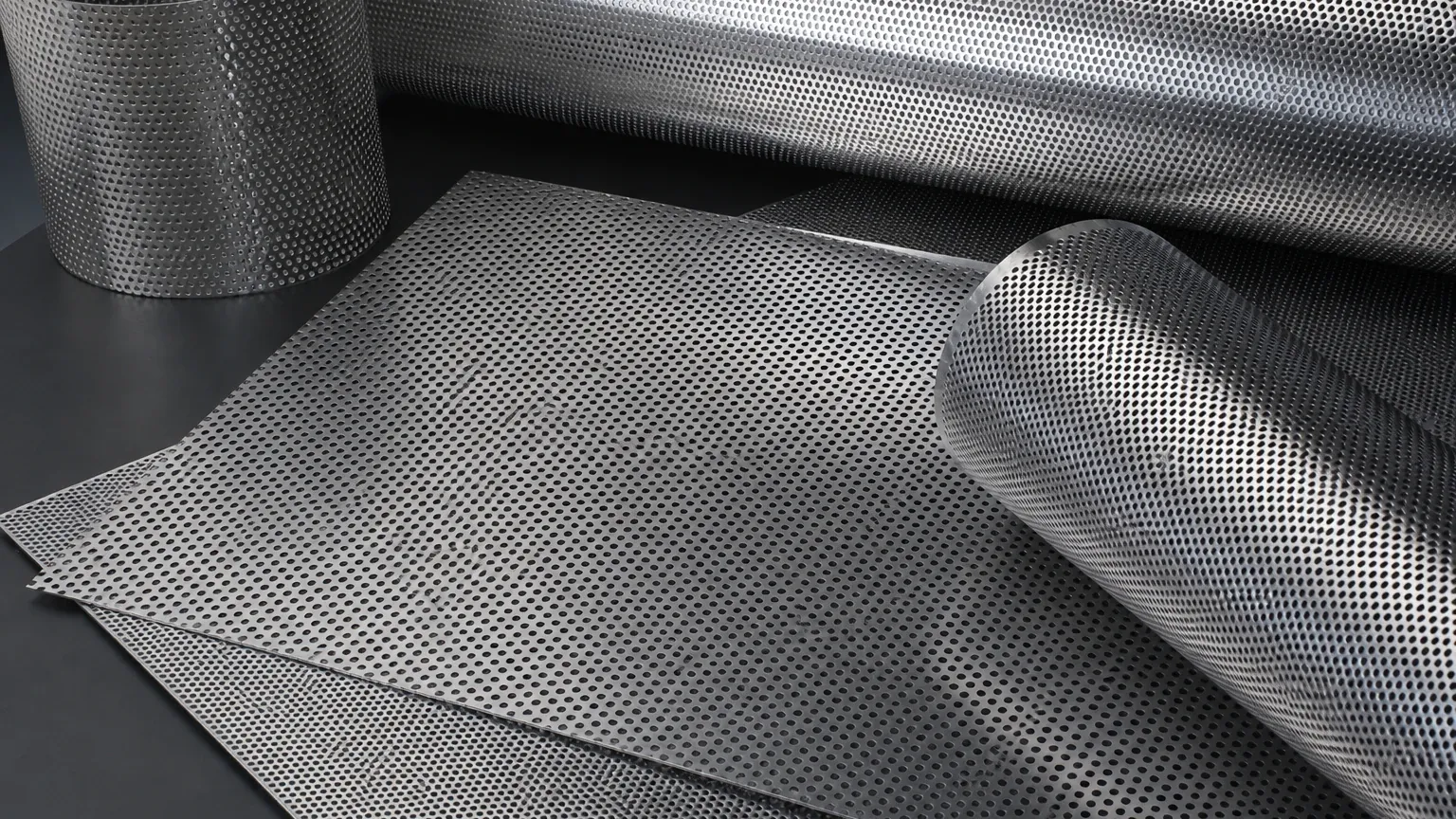
Perforated Metal Sheet 1mm Hole
In industrial filtration and separation, the precision of a perforated metal sheet 1mm hole serves as a critical specification for engineers managing fine particulate matter. While larger perforations are often used for structural support or coarse debris removal, the 1mm hole diameter sits at a technical threshold where the material must balance mechanical strength with high-resolution screening capabilities. For manufacturers like Kaifil, producing these sheets requires a deep understanding of metallurgy, punch-press tolerances, and the fluid dynamics associated with small-aperture filtration.
Selecting the right Perforated & Expanded Metal involves more than just identifying the hole size. Technical professionals must evaluate the material thickness, the pitch (distance between hole centers), the open area percentage, and the specific alloy's resistance to the operating environment. This guide explores the engineering considerations, manufacturing constraints, and application-specific advantages of utilizing 1mm perforated metal sheets in industrial contexts.
Technical Specifications and Engineering Considerations
The performance of a perforated metal sheet is defined by its geometric configuration. When specifying a 1mm hole, the relationship between the hole diameter (D), the pitch (P), and the sheet thickness (T) determines the structural integrity and filtration efficiency of the component.
Open Area Calculation
The open area is the ratio of the total area of the holes to the total area of the sheet, expressed as a percentage. For a standard 60-degree staggered pattern—the most common and structurally sound configuration—the formula for open area is:
Open Area % = (D² × 90.69) / P²
For a perforated metal sheet 1mm hole with a 2mm pitch, the open area is approximately 22.6%. Increasing the pitch reduces the open area but increases the sheet's strength. Conversely, narrowing the bridge (the material between holes) increases flow rates but may lead to material deformation during the punching process or premature failure under high-pressure loads.
The Thickness-to-Diameter Ratio
A fundamental rule in precision perforating is the 1:1 ratio. Ideally, the sheet thickness should not exceed the hole diameter. Punching a 1mm hole through a 2mm thick stainless steel plate significantly increases the risk of tool breakage and can result in distorted holes or excessive burr formation. For most industrial applications, a 1mm hole is typically paired with sheet thicknesses ranging from 0.5mm to 1.0mm to ensure clean, consistent perforations and optimal tool longevity.
Material Selection for 1mm Perforated Sheets
The choice of material is dictated by the chemical and thermal demands of the application. Because 1mm perforations are often used in sensitive environments like food processing or chemical filtration, stainless steel is the industry standard.
Stainless Steel 304
Grade 304 is the most versatile and widely used stainless steel for perforated sheets. It offers excellent corrosion resistance in standard atmospheric conditions and is highly weldable, making it suitable for forming into filter cartridges or cylinders. It is a cost-effective choice for general industrial screening where extreme chemical exposure is not a primary concern.
Stainless Steel 316 and 316L
For marine environments, pharmaceutical production, or high-chloride chemical processing, SS316 is preferred. The addition of molybdenum enhances its resistance to pitting and crevice corrosion. SS316L (the low-carbon version) is specifically used when the perforated sheet must be welded into a larger assembly, as it prevents carbide precipitation that can lead to intergranular corrosion in the heat-affected zones.
Specialty Alloys
In high-temperature or highly corrosive environments, alloys such as Monel, Inconel, or Hastelloy may be required. These materials maintain their structural integrity and perforation accuracy even under extreme thermal cycling, though they require specialized tooling and slower production speeds due to their work-hardening characteristics.
Manufacturing Precision and Quality Control
Producing a perforated metal sheet 1mm hole requires high-speed CNC punch presses or all-across perforating presses. The quality of the final product is defined by several manufacturing benchmarks that engineers must verify before procurement.
Burr Control and Deburring
During the punching process, the exit side of the hole often develops a "burr" or sharp edge. In filtration applications, these burrs can trap particles, impede flow, or even break off and contaminate the downstream fluid. High-quality perforated sheets undergo secondary processes such as leveling and mechanical deburring (sanding or brushing) to ensure a smooth surface finish on both sides.
Flatness and Stress Relief
The perforating process introduces significant internal stresses into the metal sheet, often causing it to curl or bow. To meet industrial standards, sheets must pass through a precision roller leveler. This process flattens the material, ensuring it can be accurately integrated into larger machinery or formed into pleated filter elements without alignment issues.
Margin and Blank Area Specifications
Engineers must define the "margins"—the unperforated areas along the edges of the sheet. Custom margins are often necessary for welding or clamping the sheet into a frame. Providing a detailed drawing that specifies the perforated area versus the solid borders prevents assembly failures during the fabrication of the final filtration component.
Comparing Perforated Metal with Woven Wire Mesh
When designing a filtration system, a common question is whether to use a perforated metal sheet 1mm hole or a woven wire mesh with a 1000-micron (1mm) aperture. While both serve similar screening functions, their mechanical properties differ significantly.
1. Structural Rigidity: Perforated metal is a monolithic structure. Unlike wire mesh, the holes cannot shift or enlarge under pressure. This makes perforated sheets superior for high-pressure hydraulic applications or as a support medium for finer mesh layers.
2. Cleanability: The smooth, flat surface of a perforated sheet is much easier to clean via backwashing or mechanical scraping compared to the complex geometry of woven wires, which can trap debris in the "knuckles" of the weave.
3. Durability: Perforated sheets are generally more resistant to abrasion and mechanical impact. In heavy-duty industrial vibratory screens, a 1mm perforated plate will typically outlast a 1mm wire mesh screen.
Application-Specific Solutions
The 1mm hole size is a versatile specification found across diverse industrial sectors. Its primary function is usually to protect downstream equipment or to grade raw materials by size.
Food and Beverage Processing
In the food industry, 1mm perforated sheets are used for sorting grains, seeds, and pulses. They are also integrated into centrifugal screens for juice extraction and dairy processing. Because these applications require strict hygiene, the sheets must be burr-free and made from food-grade stainless steel to prevent bacterial growth in crevices.
Chemical and Petrochemical Filtration
Within chemical reactors, perforated plates serve as support grids for catalyst beds. A 1mm hole allows for the passage of liquid or gas while retaining the solid catalyst pellets. The precision of the 1mm diameter ensures that no catalyst is lost, which would otherwise lead to process inefficiency or damage to pumps and valves.
Electronics and Acoustic Shielding
Beyond filtration, 1mm perforated sheets are utilized in the electronics industry for EMI/RFI shielding and ventilation. The small hole size allows for heat dissipation while preventing electromagnetic interference from escaping or entering sensitive enclosures. In acoustics, these sheets are used as facing materials for sound-absorbent panels, where the perforation pattern is tuned to specific frequency ranges.
Procurement: What Engineers Need to Confirm
To ensure the successful integration of a perforated metal sheet 1mm hole into a project, the following technical details should be confirmed with the manufacturer:
* Hole Pattern: Staggered (60-degree or 45-degree) or straight row.
* Pitch and Open Area: Does the flow rate meet the system requirements?
* Material Grade: Is the alloy compatible with the fluid's pH and temperature?
* Tolerances: What is the allowable variance in hole diameter and sheet thickness?
* Secondary Fabrication: Does the sheet need to be cut to size, rolled into a cylinder, or degreased for oxygen service?
As a specialist in Perforated & Expanded Metal, Kaifil provides the technical expertise necessary to navigate these variables. By focusing on precision manufacturing and material integrity, we ensure that every 1mm perforated component meets the rigorous demands of industrial filtration environments. Whether you are designing a new filtration system or replacing existing components, understanding these factual boundaries ensures long-term performance and reduced total cost of ownership.
