


Perforated Sheet Metal 16 Gauge
In the landscape of industrial filtration and structural engineering, material thickness is a critical variable that dictates both performance and longevity. Among the various specifications available, perforated sheet metal 16 gauge stands out as a versatile standard, particularly for applications requiring a balance between structural rigidity and ease of fabrication. For engineers and procurement teams, understanding the technical nuances of this specific gauge is essential for optimizing filtration efficiency and ensuring the mechanical integrity of industrial components.
As a core component in the production of Perforated & Expanded Metal, 16-gauge sheets provide the necessary durability for demanding environments, ranging from chemical processing plants to high-pressure hydraulic systems. This article explores the technical specifications, material considerations, and engineering factors that define the use of 16-gauge perforated metal in B2B industrial applications.
Understanding the Technical Specifications of 16 Gauge
The term "gauge" refers to a standard measure of thickness, but it is important to note that the actual decimal thickness varies depending on the material being measured. For industrial professionals, precision is paramount:
* Stainless Steel 16 Gauge: Approximately 0.0598 inches (1.519 mm).
* Carbon Steel 16 Gauge: Approximately 0.0598 inches (1.519 mm).
* Aluminum 16 Gauge: Approximately 0.0508 inches (1.290 mm).
In the context of perforated sheet metal 16 gauge, this thickness is often selected because it offers sufficient "meat" for high-quality welding—such as TIG or plasma welding—without the risk of excessive warping or burn-through that thinner gauges might face. Simultaneously, it remains flexible enough to be rolled into cylinders for filter cartridges or formed into complex shapes for basket strainers.
Weight is another crucial factor. A standard 16-gauge stainless steel sheet weighs approximately 2.52 pounds per square foot (before perforation). Once perforated, the weight decreases proportionally to the "open area" percentage, which is a vital calculation for logistics and structural load-bearing assessments.
Material Selection for Industrial Environments
Selecting the right alloy for a 16-gauge perforated sheet is as important as the thickness itself. The choice is usually driven by the chemical composition of the fluid being filtered or the environmental conditions of the installation site.
Stainless Steel (304 and 316L)
Stainless steel is the industry standard for 16-gauge perforated sheets used in filtration. Grade 304 offers excellent corrosion resistance for general industrial use, while Grade 316L (low carbon) is preferred for pharmaceutical, food and beverage, and marine applications due to its superior resistance to chlorides and pitting. The 16-gauge thickness in these alloys provides a robust foundation for multi-layer filter elements, acting as a support core that can withstand high differential pressures.
Carbon Steel and Galvanized Steel
For applications where corrosion is less of a concern or where the component is protected by oils, carbon steel provides a cost-effective alternative with high tensile strength. Galvanized 16-gauge perforated metal is often used in HVAC and outdoor architectural-industrial applications where a protective zinc coating is required to prevent oxidation.
Specialty Alloys
In high-temperature or highly corrosive chemical processing, alloys like Monel, Inconel, or Hastelloy may be used. While more expensive, a 16-gauge specification in these materials ensures that the filter remains structurally sound even as it faces aggressive chemical attack or thermal cycling.
Engineering the Hole Pattern: Open Area and Flow Dynamics
The performance of perforated sheet metal 16 gauge is defined by its hole pattern. The pattern determines the filtration accuracy (if used as a primary screen) and the pressure drop across the medium.
Round Hole Staggered Pattern
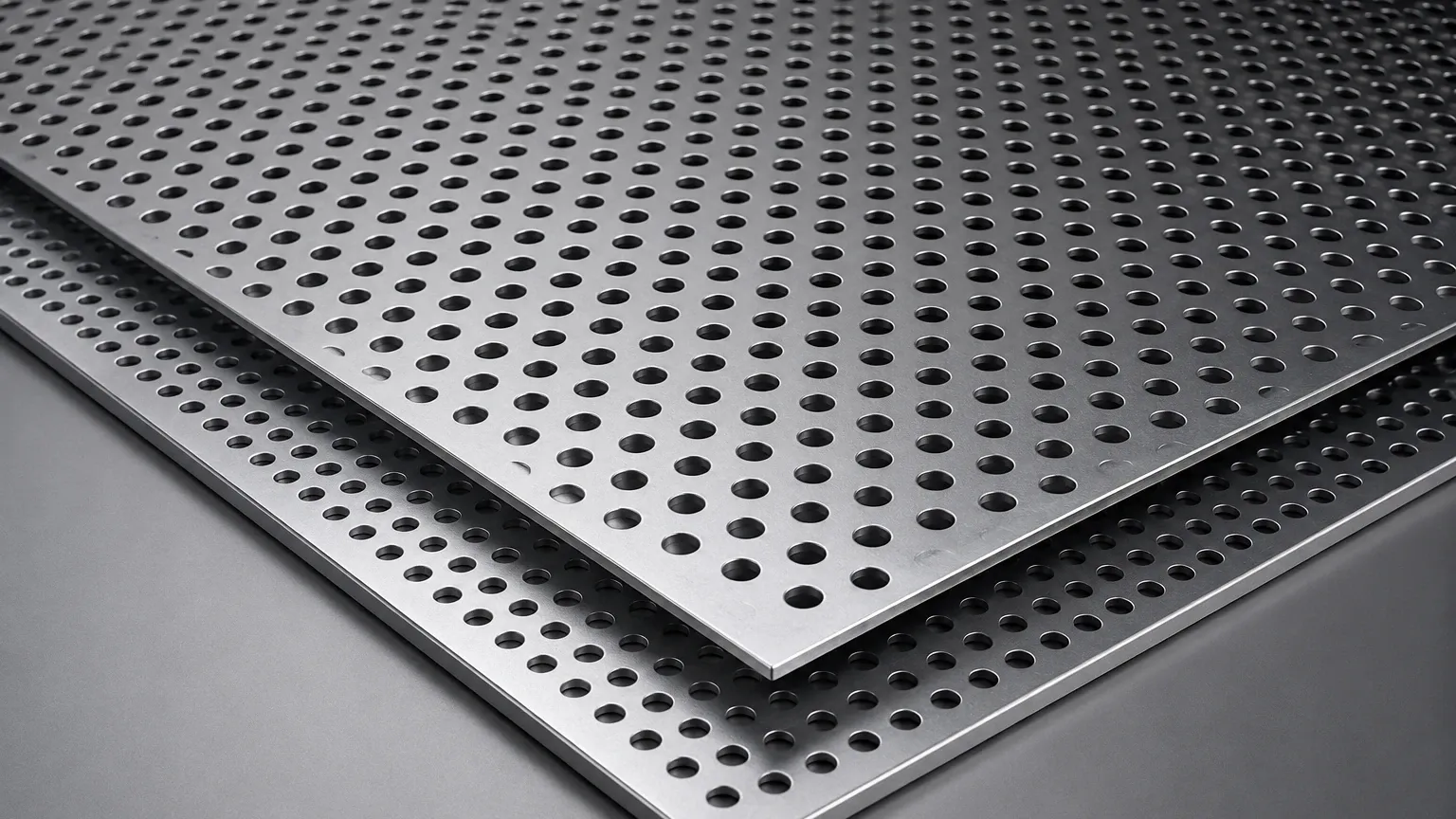
This is the most common configuration for industrial use. A 60-degree staggered pattern provides the highest strength-to-open-area ratio. For example, a common specification for 16-gauge sheets is 1/8" diameter holes on 3/16" centers. This configuration yields an open area of approximately 40%. This balance is ideal for support cores in Perforated & Expanded Metal assemblies, providing ample flow while maintaining the hoop strength necessary to prevent collapse under hydraulic pressure.
Square and Slotted Holes
Square holes offer a higher open area percentage (often exceeding 60%), which is beneficial for high-flow applications like grain drying or ventilation. Slotted holes are frequently utilized in solid-liquid separation where the shape of the particles requires a specific orientation for efficient screening.
Calculating Open Area
Engineers must confirm the open area percentage to predict the "clean pressure drop." The formula for a 60-degree staggered round hole pattern is:
$$Open Area \% = \frac{D^2 \times 90.69}{P^2}$$
Where D is the hole diameter and P is the center-to-center pitch. Accurate calculation ensures that the 16-gauge sheet does not become a bottleneck in the system.
Perforated vs. Expanded Metal for Support Structures
When designing filtration systems, engineers often compare perforated sheet metal with expanded metal. While both fall under the category of Perforated & Expanded Metal, they serve different mechanical purposes.
* Perforated Metal (16 Gauge): Created by punching holes into a solid sheet. This process allows for precise margins (unperforated edges), which are critical for welding and assembly. It offers a smooth surface, which is easier to clean and less likely to trap contaminants in a food-grade environment.
* Expanded Metal: Created by slitting and stretching the sheet. This process is more material-efficient as there is no "slug" waste. However, expanded metal typically has a textured, three-dimensional surface. While excellent for grip or as a coarse pre-filter, it may not provide the same uniform support for fine wire mesh as a flat 16-gauge perforated sheet.
For high-precision industrial filter cartridges, 16-gauge perforated metal is generally preferred due to its dimensional stability and the ability to control the exact placement of holes relative to the edges of the component.
Critical Customization Factors for 16 Gauge Perforated Components
Ordering perforated sheet metal 16 gauge involves more than just selecting a hole size. Several customization factors influence the final performance and ease of installation:
1. Margins (Borders): Standard perforated sheets often come with "minimum margins," meaning the holes go right to the edge. For B2B applications, "finished margins" are often required. This provides a solid metal border around the perimeter, which is essential for seam welding or bolting the sheet into a frame.
2. Flatness and Leveling: The punching process introduces internal stresses into the metal, which can cause the sheet to curl or bow. For precision filtration components, the material must undergo a leveling process to ensure it meets strict flatness tolerances.
3. Deburring and Surface Finish: Industrial filters often require a burr-free surface to prevent damage to secondary filter media (like fine wire mesh) or to ensure safety during handling. Secondary processes such as pickling, passivation, or electropolishing are often applied to 16-gauge stainless steel to enhance corrosion resistance and provide a sterile surface for pharmaceutical applications.
4. Forming and Fabrication: 16-gauge material is robust enough to handle secondary fabrication such as rolling into tubes, bending into U-channels, or deep drawing into cups. Confirming the bend radius with the manufacturer is vital to prevent cracking along the lines of perforation.
Maintenance, Durability, and Total Cost Considerations
From a procurement perspective, the total cost of ownership (TCO) for perforated sheet metal 16 gauge is influenced by its durability. While a thinner 20-gauge sheet might have a lower initial material cost, it is more susceptible to mechanical damage and vibration fatigue in high-flow environments.
16-gauge metal provides a "heavy-duty" service life, reducing the frequency of replacement. In many industrial filtration systems, the perforated sheet acts as a permanent or semi-permanent housing for disposable filter bags or replaceable fine mesh screens. Investing in a high-quality 16-gauge stainless steel support structure ensures that the system remains operational for years, even under the stress of backwashing or chemical CIP (Clean-in-Place) cycles.
When evaluating suppliers, engineers should confirm:
* Material Certification: Ensure the alloy meets ASTM or ISO standards.
* Perforation Accuracy: Precision in hole diameter and pitch to ensure consistent flow.
* Quality of Welds: If the sheet is supplied as a finished component (like a cylinder), the integrity of the longitudinal seam is the most common point of failure.
Conclusion
Perforated sheet metal 16 gauge represents a standard of reliability in the industrial sector. Its thickness provides the structural integrity required for high-pressure filtration and industrial screening, while its versatility allows for extensive customization in terms of material, hole pattern, and finish. By carefully evaluating the open area, material grade, and fabrication requirements, engineering teams can leverage Perforated & Expanded Metal solutions to achieve optimal balance between flow performance and mechanical strength. Whether used as a standalone screen or a support core for complex filtration media, the 16-gauge specification remains a cornerstone of durable industrial design.
