


Perforated Metal Sheet Hole Size
In industrial filtration and structural engineering, the specification of perforated metal components is a critical factor in determining the efficiency, durability, and safety of a system. Among the various parameters involved in the design of Perforated & Expanded Metal, the perforated metal sheet hole size stands as perhaps the most significant variable. It directly influences the flow rate, pressure drop, particle retention, and mechanical strength of the finished product. For engineers and procurement teams, understanding the technical nuances of hole sizing is essential for optimizing performance in demanding environments such as chemical processing, food production, and hydraulic systems.
The Importance of Precision in Perforated Metal Hole Sizing
The hole size in a perforated metal sheet refers to the diameter of the openings (for round holes) or the width/length dimensions (for square or slotted holes). In B2B industrial applications, precision is paramount. A discrepancy of even a few microns in hole size can lead to significant operational failures, such as the bypass of contaminants in a filtration system or an unacceptable pressure build-up in a ventilation unit.
When specifying the perforated metal sheet hole size, engineers must consider the intended function of the material. Is it designed for coarse straining, fine filtration, architectural aesthetics, or sound attenuation? Each application requires a specific balance between the size of the opening and the structural integrity of the remaining metal, often referred to as the "bar" or "bridge."
Calculating Open Area and Its Impact on Filtration
The relationship between the perforated metal sheet hole size and the "pitch" (the center-to-center distance between adjacent holes) determines the percentage of open area. The open area is a vital metric for calculating the flow capacity of a filter or screen.
For a standard 60-degree staggered round hole pattern—the most common and efficient configuration—the formula for calculating the percentage of open area is:
Open Area % = (D² × 90.69) / P²
Where:
* D = Hole Diameter (Hole Size)
* P = Pitch (Center-to-center distance)
Increasing the hole size while keeping the pitch constant increases the open area, which reduces the pressure drop across the media but also reduces the structural strength of the sheet. Conversely, decreasing the hole size increases the filtration accuracy but may necessitate a higher pump pressure to maintain flow rates. In industrial filtration, Kaifil emphasizes a balanced design where the open area is maximized without compromising the mechanical stability required to withstand high-pressure differentials.
The Relationship Between Hole Size and Material Thickness
A fundamental engineering constraint in the production of perforated metal is the ratio between the hole size and the material thickness. In the punching process, there is a physical limit to how small a hole can be relative to the thickness of the metal sheet.
As a general rule of thumb for stainless steel and other high-strength alloys, the perforated metal sheet hole size should not be smaller than the material thickness. For example, if you are using a 2mm thick stainless steel sheet, the minimum recommended hole diameter is typically 2mm.
Attempting to punch holes smaller than the material thickness increases the risk of tool breakage, results in excessive burrs, and can cause significant internal stresses in the metal, leading to warping. If an application requires a hole size significantly smaller than the thickness (e.g., a 0.5mm hole in a 2mm plate), alternative manufacturing methods such as laser drilling or chemical etching may be required, though these often come at a higher cost per unit compared to traditional CNC punching.
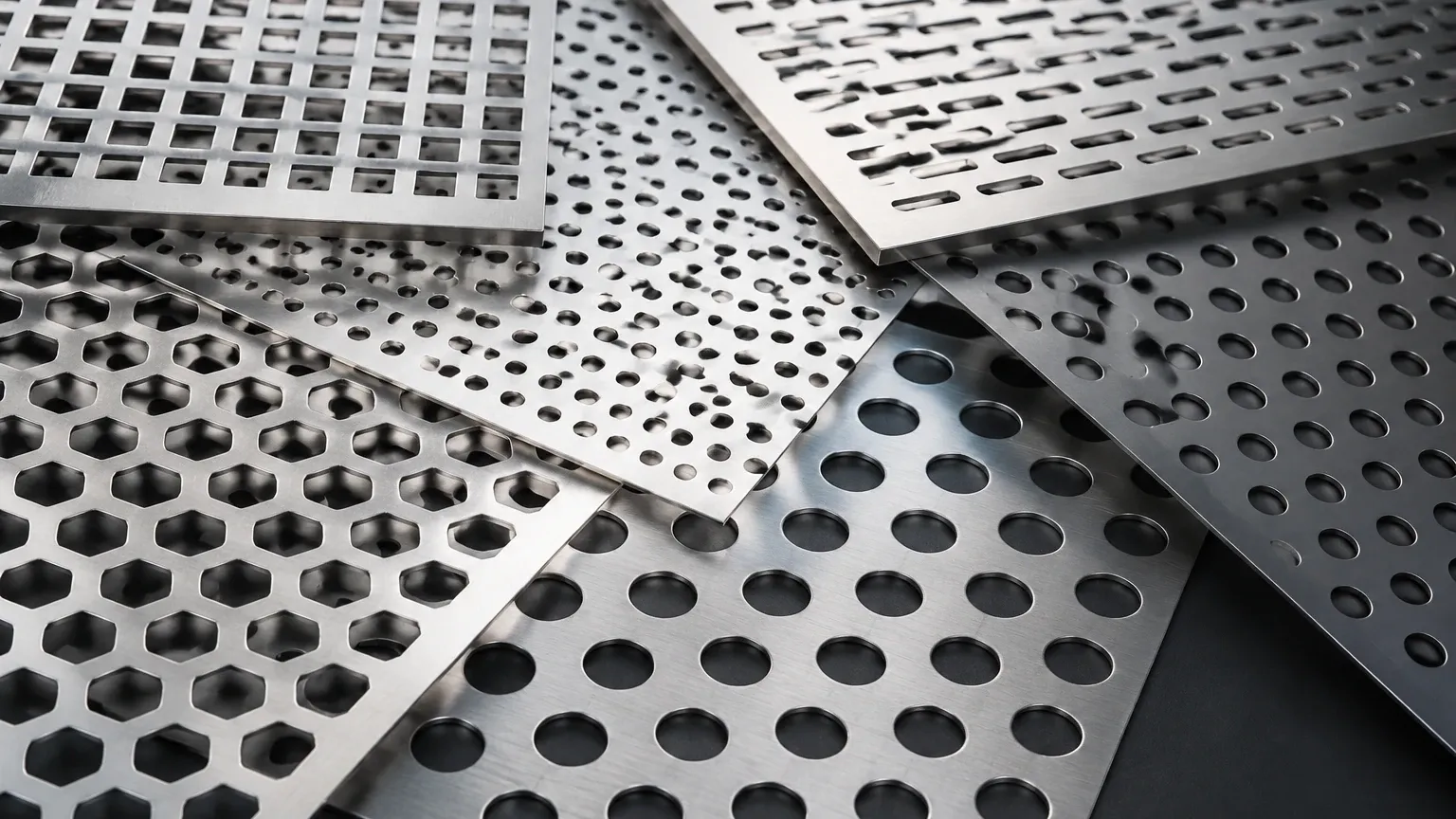
Common Hole Patterns and Pitch Configurations
While the hole size defines the "what" of the filtration, the pattern defines the "how." The arrangement of the holes affects how the fluid or gas moves through the media and how the sheet handles mechanical loads.
1. 60-Degree Staggered Pattern: This is the industry standard. It provides the highest degree of structural strength and the most uniform distribution of open area. It is the preferred choice for most Perforated & Expanded Metal applications in industrial filtration.
2. 45-Degree Staggered Pattern: Often used for aesthetic purposes or specific directional flow requirements, this pattern offers a different visual profile but generally provides less open area than the 60-degree configuration.
3. Straight Line Pattern: In this configuration, holes are aligned in both horizontal and vertical rows. While simpler to manufacture, this pattern is inherently weaker because it creates continuous "fail lines" where the metal can bend or break under stress.
The choice of pitch is as important as the perforated metal sheet hole size. A "tight" pitch (where the holes are close together) maximizes flow but leaves very thin bridges of metal, which may fail under high-pressure hydraulic loads. A "wide" pitch increases durability but restricts flow.
Application-Specific Selection Criteria for Industrial Filtration
Different industries have varying requirements for hole sizes based on the media being processed and the environmental conditions.
Chemical and Petrochemical Processing
In these environments, perforated metal is often used as a support structure for finer wire mesh or as a primary strainer for large particulates. The hole size must be calculated to resist the corrosive effects of the chemicals, which can cause "pitting" or gradual enlargement of the holes over time. Stainless steel 316L is frequently specified here due to its superior corrosion resistance.
Food and Beverage Industry
For food-grade applications, the perforated metal sheet hole size is often dictated by the size of the organic matter being separated (e.g., fruit pulp, grain husks). Furthermore, the holes must be punched cleanly with minimal burrs to ensure that the equipment can be effectively cleaned and sanitized (CIP – Clean-in-Place), preventing bacterial growth in crevices.
Hydraulic and Water Treatment
In hydraulic systems, perforated metal serves as a protective barrier for sensitive components like pumps and valves. The hole size is selected to catch debris that could cause mechanical wear. In water treatment, perforated sheets often act as pre-filters, where the hole size is determined by the expected sediment load of the source water.
Manufacturing Tolerances and Quality Control
When ordering perforated metal, it is not enough to simply state the desired perforated metal sheet hole size; one must also define the acceptable tolerances. Standard industrial tolerances for hole diameters usually range from +/- 0.05mm to +/- 0.1mm, depending on the thickness of the material and the punching equipment used.
Quality control processes at a professional manufacturer like Kaifil involve several steps to ensure the hole size remains consistent across the entire sheet:
* Tooling Inspection: Ensuring that punches and dies are sharp and within dimensional specs to avoid "slugging" or irregular hole shapes.
* Leveling: The perforation process naturally causes the metal sheet to curl. Precision leveling is required to return the sheet to a flat state without distorting the hole dimensions.
* Deburring: Removing the sharp edges from the exit side of the hole is essential for safety and to prevent flow turbulence.
Specifying Custom Perforated Metal Solutions
For engineers looking to integrate perforated components into their systems, the following checklist should be confirmed before moving to the production phase:
1. Hole Diameter: Specify the exact perforated metal sheet hole size required for the application.
2. Material Type: Choose a grade (e.g., SS304, SS316L, Carbon Steel) that matches the chemical and thermal environment.
3. Sheet Thickness: Ensure the thickness is compatible with the hole size (ideally D ≥ T).
4. Pattern and Pitch: Define the orientation (staggered vs. straight) and the distance between hole centers.
5. Margins: Specify if the sheet requires "blank" areas (unperforated edges) for welding or mounting purposes.
6. Flatness Requirements: Determine if the sheet requires specialized leveling after punching.
By focusing on these technical boundaries, purchasing teams can ensure they receive a product that meets the rigorous demands of industrial filtration. Whether the goal is to achieve a specific micron rating or to provide a robust support structure for other filter media, the precision of the hole size remains the foundation of a successful filtration solution.
For more detailed technical guidance on material selection and custom configurations, reviewing the available options for Perforated & Expanded Metal can provide a clearer path toward optimizing your specific industrial application. Kaifil’s engineering team works closely with global clients to develop high-performance components that balance filtration accuracy with long-term structural reliability.
