


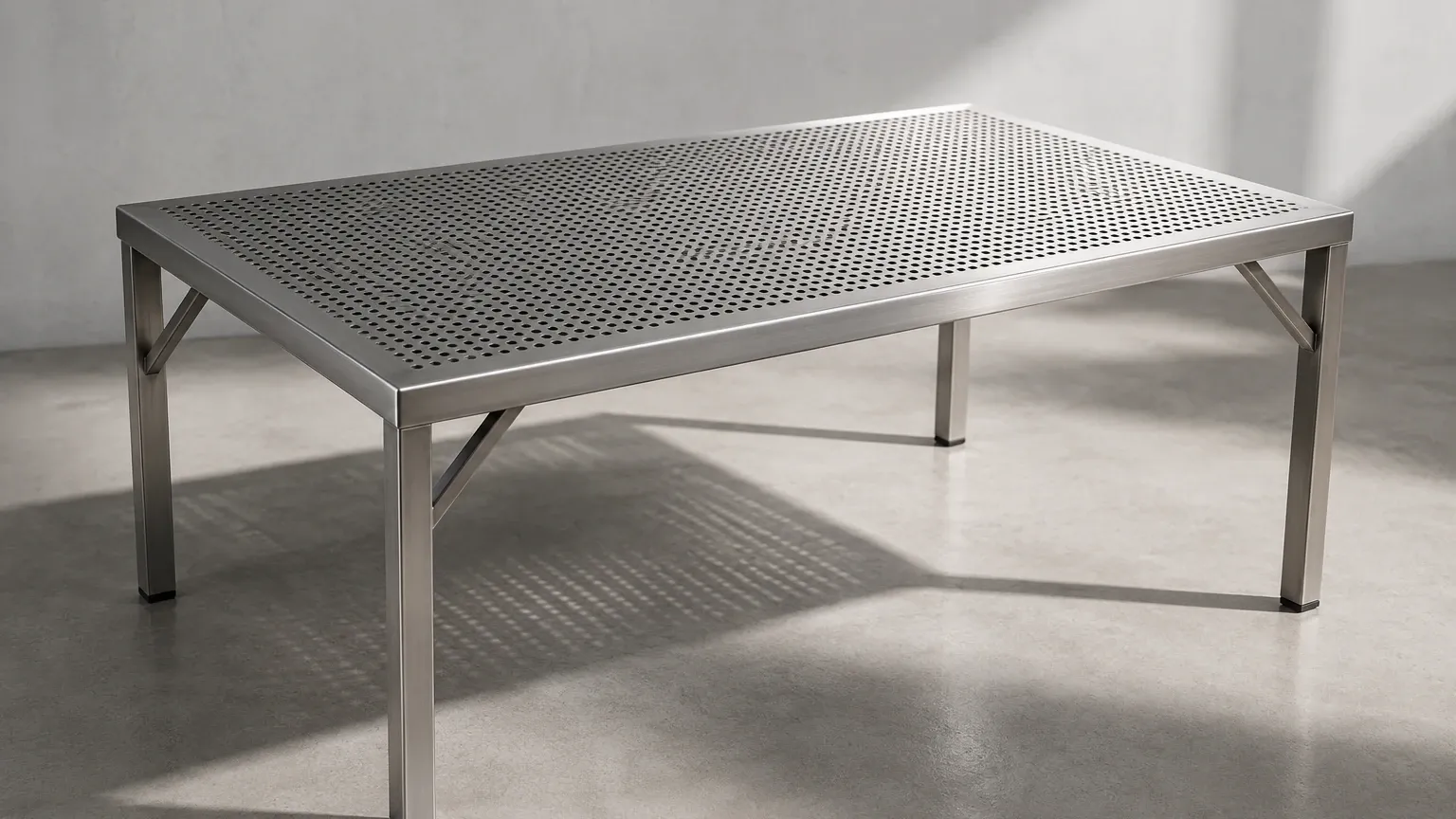
Perforated Metal Table
In industrial processing and filtration environments, a perforated metal table serves as a critical piece of equipment designed for material handling, sorting, drying, and preliminary filtration. Unlike standard work surfaces, these tables utilize specialized Perforated & Expanded Metal sheets to facilitate airflow, liquid drainage, or particle separation. For engineers and procurement teams in the chemical, pharmaceutical, and food processing sectors, selecting the right perforated surface is not merely a matter of dimensions but a complex engineering decision involving material science, load-bearing physics, and filtration precision.
The Role of Perforated Metal Surfaces in Industrial Applications
Industrial tables equipped with perforated surfaces are foundational in facilities where hygiene, drainage, and ventilation are paramount. The "perforated metal table" is rarely a standalone product in a B2B context; rather, it is a precision-engineered component of a larger processing line.
In the food and beverage industry, these tables are used for dewatering produce or cooling baked goods. In pharmaceutical cleanrooms, they allow laminar airflow to pass through the work surface, reducing the risk of turbulence and contaminant accumulation. For chemical processing, they serve as sorting platforms where corrosive materials must be rinsed, requiring the surface to withstand both mechanical stress and chemical exposure. Understanding the specific requirements of the application—whether it is simple drainage or complex air distribution—is the first step in specifying the correct metal component.
Key Engineering Specifications for Perforated Metal Tables
When designing or purchasing a perforated metal table for industrial use, several technical parameters must be evaluated to ensure performance and longevity. These specifications dictate how the table interacts with the materials being processed.
Hole Patterns and Open Area
The "open area" is the percentage of the sheet that is comprised of holes. This is a critical metric for filtration and airflow.
* Round Holes: The most common and versatile pattern, offering high structural integrity and ease of cleaning.
* Square Holes: Often used when a higher open area is required, though they may offer slightly less resistance to bending under heavy loads.
* Slotted Holes: Ideal for sorting elongated materials or for applications requiring specific drainage directions.
Calculating the open area is essential. For a staggered round hole pattern, the formula is:
`Open Area % = (D² x 90.69) / R²`
(Where D is the hole diameter and R is the center-to-center distance, or pitch). A higher open area improves drainage but reduces the load-bearing capacity of the table.
Pitch and Arrangement
The arrangement of the perforations—whether staggered (60-degree or 45-degree) or straight—affects the flow of fluids and the strength of the metal. Staggered patterns are generally preferred in industrial filtration because they offer uniform strength across the sheet and prevent "tracking" of materials across the surface.
Material Selection: Why Stainless Steel is the Standard
The environment in which the perforated metal table will operate dictates the material choice. Kaifil specializes in stainless steel solutions because of the material's inherent durability and resistance to the rigors of industrial cleaning.
Stainless Steel 304 vs. 316L
* Grade 304: This is the standard for most industrial applications. It offers excellent corrosion resistance and is suitable for most food processing and general manufacturing environments.
* Grade 316L: Containing molybdenum, 316L provides superior resistance to chlorides and acids. It is the mandatory choice for pharmaceutical applications, marine environments, and chemical processing where the table will be exposed to aggressive cleaning agents or saline solutions.
Surface Finishes
In industries like pharmaceuticals and food processing, the surface finish of the perforated metal is as important as the material itself. A high-polish or electropolished finish reduces surface roughness (Ra), preventing bacteria from adhering to the metal and making the cleaning-in-place (CIP) process more effective. For heavy industrial use, a mill finish may suffice, focusing on structural durability over microscopic smoothness.
Comparing Perforated and Expanded Metal for Industrial Surfaces
While the term "perforated metal table" often refers to punched sheets, expanded metal is a viable alternative for specific applications. Choosing between Perforated & Expanded Metal depends on the balance between cost, weight, and function.
Perforated Metal
Perforated metal is created by punching holes into a solid sheet. This process allows for extremely high precision in hole size and placement. It is the preferred choice for filtration applications where specific particle retention is required. It also provides a smoother surface, which is beneficial when handling delicate materials that might be damaged by sharp edges.
Expanded Metal
Expanded metal is produced by slitting and stretching a single sheet, creating a diamond-shaped mesh. Because no material is lost during the manufacturing process, it is often a more cost-effective solution for large-scale platforms or walkways. However, the raised edges of standard expanded metal can be abrasive. For table surfaces, "flattened" expanded metal is typically used to provide a level work area while maintaining the strength-to-weight advantages of the expanded structure.
Customization Options for Specialized Industrial Tables
Off-the-shelf solutions rarely meet the exacting standards of modern engineering projects. Customization is often necessary to integrate a perforated surface into an existing production line or filtration system.
Precision Bordering and Margins
In many industrial designs, the perforated area must be surrounded by a solid "margin" or border. This allows for easier welding of the sheet to the table frame and increases the overall rigidity of the structure. Custom margins can be specified to accommodate specific mounting brackets or fasteners.
Formed Edges and Reinforcements
For tables that must support significant weight—such as those used in heavy parts washing—the perforated metal can be formed with C-channels or reinforced with support ribs underneath. Engineering these reinforcements ensures that the surface does not sag or deform under cyclic loading, which could compromise the accuracy of sorting or the efficiency of drainage.
Filtration Accuracy
Kaifil’s expertise in precision metal filter components allows for the creation of perforated surfaces with extremely fine tolerances. If a table is being used for primary filtration (separating solids from liquids), the hole size must be precisely controlled to prevent clogging (blinding) while ensuring the desired throughput.
Maintenance and Durability in Demanding Environments
The total cost of ownership for a perforated metal table is heavily influenced by its maintenance requirements and replacement cycle. In B2B environments, downtime is the primary cost driver.
Cleaning Protocols
In food and pharma, the table must withstand frequent high-pressure washdowns and chemical sterilization. Stainless steel’s resistance to pitting and crevice corrosion is vital here. Engineers should ensure that the hole geometry does not create "dead zones" where material can accumulate and harbor microbial growth.
Wear and Replacement
While stainless steel is exceptionally durable, abrasive materials can eventually wear down the edges of the perforations, altering the filtration characteristics or the smoothness of the surface. Regular inspections should focus on checking for structural fatigue (cracking between holes) and ensuring the surface remains flat. Because Kaifil provides OEM and customized solutions, replacement panels can be manufactured to the exact original specifications, ensuring seamless integration back into the production line.
Selecting the Right Partner for Custom Filtration Components
When sourcing components for a perforated metal table, engineers must look beyond the price per square foot. The reliability of the manufacturer, their understanding of filtration principles, and their ability to provide technical documentation are paramount.
Kaifil provides comprehensive support for global customers, offering expertise in material selection and precision manufacturing. Whether the application requires a simple drainage surface or a complex, multi-layered filtration component, working with a manufacturer that understands industrial filtration ensures that the final product will meet performance expectations in demanding environments.
Before finalizing a purchase, technical teams should confirm:
1. Material Certification: Ensuring the alloy meets ASTM or equivalent standards.
2. Tolerances: Confirming that hole diameters and pitch are within the required engineering limits.
3. Load Calculations: Verifying that the chosen gauge (thickness) and open area can support the intended operational weight.
4. Finish Requirements: Specifying the necessary Ra value for hygienic or chemical applications.
By focusing on these technical details, procurement professionals can secure a Perforated & Expanded Metal solution that optimizes filtration performance, enhances operational efficiency, and provides a long service life in the most challenging industrial settings.
