


Perforated Metal Uk
In the landscape of industrial engineering and manufacturing, the selection of specialized metal components is a critical factor in determining the efficiency and longevity of filtration systems. For engineers and procurement specialists sourcing perforated metal uk, understanding the technical nuances between different production methods, material grades, and geometric configurations is essential. High-performance filtration requires more than just a surface with holes; it demands precision-engineered components capable of withstanding mechanical stress, chemical exposure, and rigorous cleaning cycles.
Industrial applications in the United Kingdom—ranging from chemical processing in the North West to pharmaceutical manufacturing in the South East—rely on Perforated & Expanded Metal to serve as support structures, primary filter media, and protective screens. As a professional manufacturer specializing in custom stainless steel filtration solutions, Kaifil provides the technical expertise necessary to navigate these complex specifications, ensuring that every component meets the exacting standards of modern industry.
Technical Fundamentals of Perforated Metal
Perforated metal is produced through a mechanical punching or laser-cutting process that creates a specific pattern of holes in a solid metal sheet. For industrial filtration, the precision of these perforations is paramount. The process allows for absolute control over hole size, shape, and distribution, which directly impacts the flow characteristics and particle retention of the filter.
When evaluating perforated metal uk for technical projects, engineers must consider the following geometric variables:
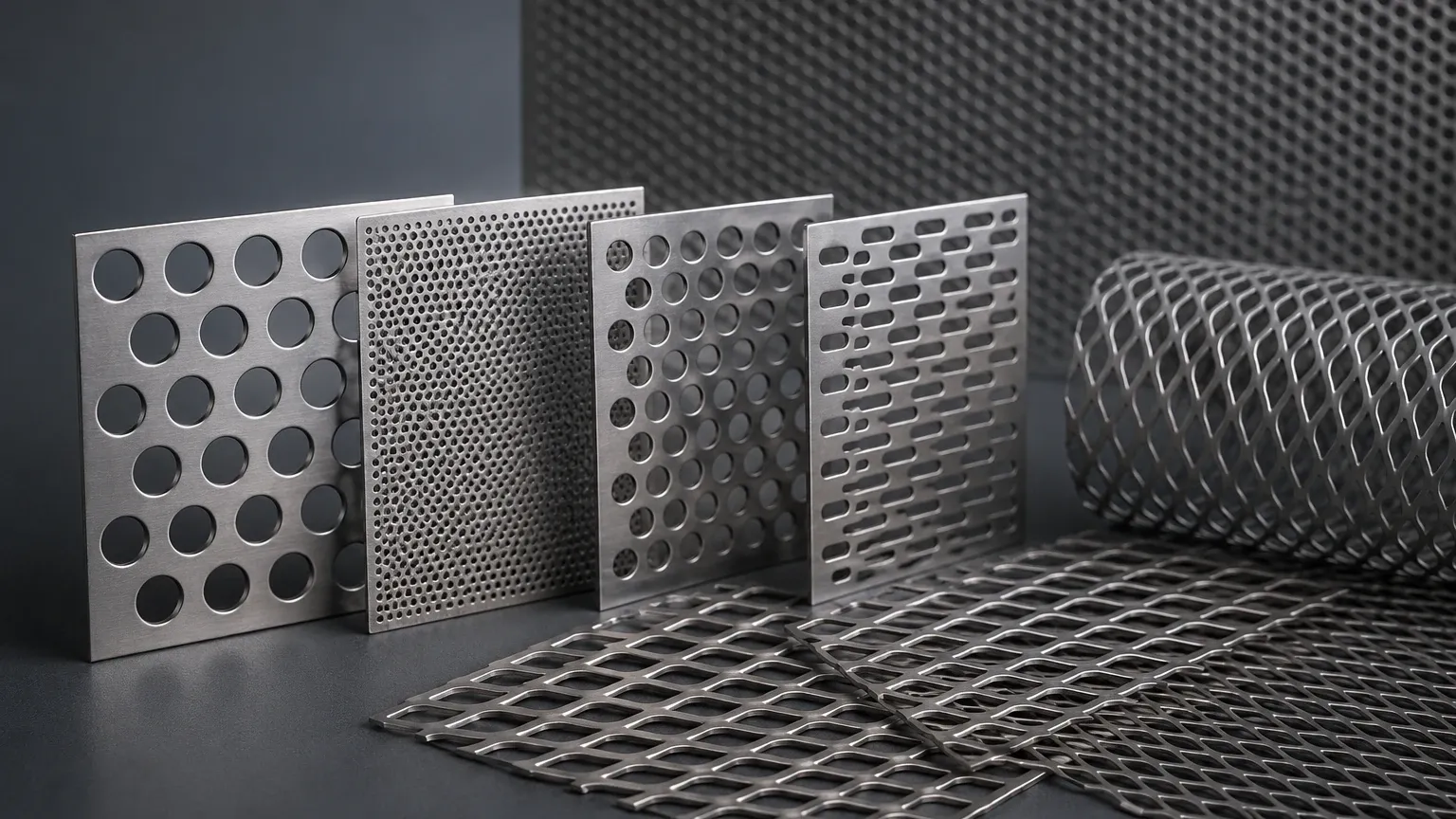
* Hole Shape: While round holes are the most common due to their structural integrity and ease of manufacture, square, slotted, and hexagonal patterns are utilized for specific flow dynamics or aesthetic requirements in architectural filtration.
* Hole Arrangement: Patterns are typically either staggered (60-degree or 45-degree) or straight. Staggered patterns are generally preferred in filtration because they provide a higher open area and greater structural strength across the sheet.
* Pitch: This refers to the distance from the center of one hole to the center of the adjacent hole. The relationship between hole diameter and pitch determines the open area percentage.
Kaifil’s manufacturing capabilities allow for the production of precision metal filter components where these variables are optimized for the specific viscosity and flow rate of the medium being filtered.
Evaluating Open Area and Filtration Efficiency
The "open area" is perhaps the most significant metric when selecting perforated metal for industrial use. It is the ratio of the total area of the holes to the total area of the sheet, expressed as a percentage. In the context of the UK’s heavy industries, calculating the open area accurately is vital for predicting pressure drop and flow velocity.
A higher open area reduces the resistance to flow, which can lower energy costs in pumping systems. However, there is a technical trade-off: as the open area increases, the mechanical strength of the sheet decreases. Engineers must find the "sweet spot" where the metal provides sufficient filtration throughput without risking structural failure under high-pressure differentials.
For example, in hydraulic applications, a perforated metal support core must withstand significant collapse pressure while maintaining maximum flow. Kaifil works closely with technical teams to develop customized designs that balance these competing requirements, often utilizing advanced stainless steel alloys to maintain strength even with high perforation densities.
Comparing Perforated and Expanded Metal for Structural Integrity
While often discussed together, perforated and expanded metals are manufactured differently and offer distinct performance characteristics. Understanding these differences is crucial for any project involving perforated metal uk.
Perforated Metal is created by removing material. This results in a flat, smooth surface that is easy to clean and highly predictable in terms of hole size. It is the preferred choice for precision filtration where specific particle size retention is required.
Expanded Metal, conversely, is produced by slitting and stretching the metal sheet simultaneously. This process creates a diamond-shaped mesh without any material waste. The resulting structure is three-dimensional and exceptionally strong relative to its weight. In industrial filtration, expanded metal is frequently used as a rigid support layer for finer wire mesh filters, providing a robust skeleton that can withstand high mechanical loads.
Choosing between these two depends on the primary function of the component. If the goal is precise particle separation, perforated metal is superior. If the goal is structural reinforcement or high-volume pre-filtration with minimal weight, expanded metal may be the more cost-effective and durable solution.
Material Grade Selection for UK Industrial Compliance
In the UK market, material traceability and compliance with industry standards (such as ISO or BSI) are non-negotiable. For filtration in demanding environments, stainless steel is the gold standard due to its corrosion resistance and thermal stability. Kaifil specializes in several key grades:
1. Grade 304/304L: The most common stainless steel used in general industrial applications. It offers excellent corrosion resistance and formability, making it suitable for food and beverage processing where hygiene is a priority.
2. Grade 316/316L: Containing molybdenum, this grade provides superior resistance to chlorides and acids. It is the standard choice for marine environments, chemical processing plants, and pharmaceutical manufacturing across the UK.
3. Specialty Alloys: For extreme environments involving high temperatures or highly aggressive chemicals, alloys like Duplex stainless steel or Hastelloy may be required to prevent pitting and stress corrosion cracking.
Selecting the correct material grade is a critical step in the procurement of perforated metal uk. Using an inferior grade can lead to premature component failure, system downtime, and potential contamination of the process stream.
Application Focus: Chemical, Food, and Pharmaceutical Sectors
The versatility of Perforated & Expanded Metal allows it to serve diverse roles across various UK sectors. Each industry presents unique challenges that influence the design of the filtration component.
Chemical Processing
In chemical plants, filters are often exposed to aggressive solvents and high pressures. Perforated metal serves as the primary cage for filter bags or as the internal support for pleated cartridges. The focus here is on chemical compatibility and the ability of the metal to maintain its shape under fluctuating pressure cycles.
Food and Beverage
Hygiene and cleanability are the primary concerns in food production. Perforated stainless steel components must have smooth surfaces and burr-free holes to prevent bacterial growth. They are used in everything from grain drying and malt kilning to juice extraction and dairy filtration.
Pharmaceutical Manufacturing
This sector requires the highest levels of precision. Perforated metal components used in pharmaceutical filtration must meet strict surface finish requirements (often requiring electropolishing) and provide absolute consistency in hole diameter to ensure batch-to-batch repeatability.
Procurement and Quality Assurance for the UK Market
When sourcing perforated metal uk, purchasing teams must look beyond the initial unit price and consider the Total Cost of Ownership (TCO). A low-cost filter component that requires frequent replacement or causes a drop in production efficiency is ultimately more expensive than a high-quality, precision-engineered part.
Key factors to confirm before finalizing a purchase include:
* Dimensional Tolerances: Ensure the manufacturer can meet the exact specifications required for integration into existing machinery.
* Burr Removal: In filtration, internal burrs can trap particles or damage delicate filter membranes. High-quality perforated metal should undergo rigorous deburring processes.
* Flatness: For automated assembly or integration into filter housings, the flatness of the metal sheet is critical to avoid installation issues.
* Certification: Request material mill certificates to verify the chemical composition and mechanical properties of the steel.
Kaifil’s commitment to quality ensures that all custom stainless steel filtration solutions are manufactured to meet these rigorous industrial expectations, providing reliable performance in even the most demanding environments.
Customization and OEM Solutions
Standard off-the-shelf perforated sheets rarely meet the specific needs of complex industrial filtration systems. Customization is often necessary to optimize performance. This includes bespoke hole patterns, non-standard sheet sizes, and secondary fabrication such as rolling, welding, and flanging.
As an OEM partner, Kaifil works directly with engineering teams to develop tailored filtration components. Whether it is a custom-diameter stainless steel filter cartridge or a unique perforated support tube, the focus is on providing a solution that integrates seamlessly into the client's specific application. This collaborative approach helps reduce development time and ensures that the final product delivers the required filtration accuracy and durability.
For engineers and technical professionals seeking reliable, high-performance Perforated & Expanded Metal, understanding the intersection of material science and mechanical engineering is the key to success. By focusing on precision, material integrity, and application-specific design, Kaifil supports the UK’s industrial sectors in achieving efficient and cost-effective filtration outcomes.
