


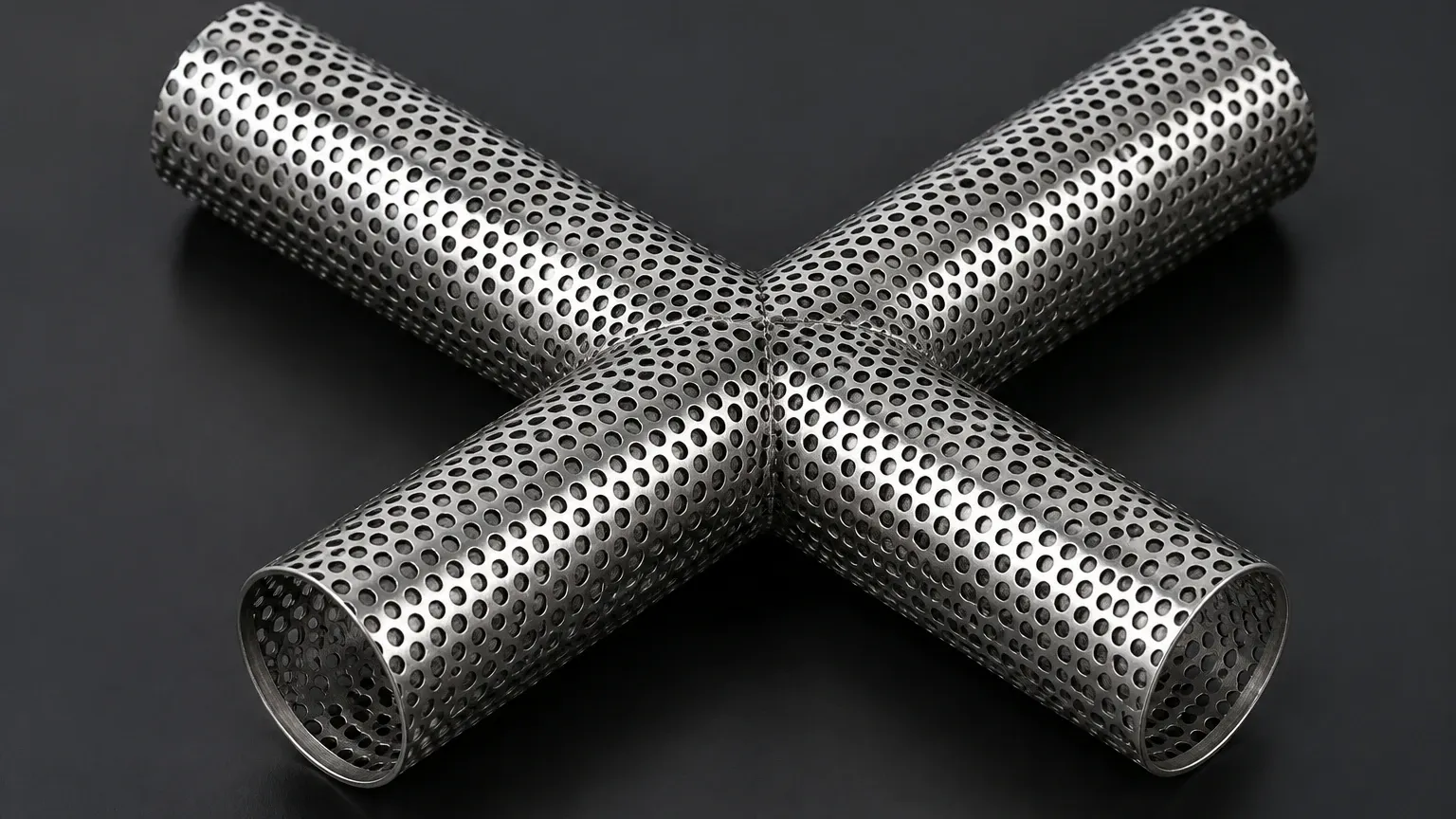
Perforated X Pipe
In the landscape of industrial fluid dynamics and exhaust management, the perforated x pipe stands as a critical component for balancing pressure, attenuating noise, and optimizing flow distribution. Unlike standard solid-wall piping, these components utilize precise perforation patterns to allow for controlled gas or liquid expansion at critical junctions. For engineers and procurement specialists, understanding the technical nuances of these components—ranging from material metallurgy to open area calculations—is essential for ensuring system longevity and operational efficiency.
As a specialized manufacturer, Kaifil focuses on the intersection of structural integrity and filtration precision. By leveraging advanced Perforated & Expanded Metal manufacturing techniques, these pipes are engineered to meet the rigorous demands of chemical processing, hydraulic systems, and high-performance industrial exhaust applications.
Engineering Fundamentals of Perforated X Pipe Design
The primary function of a perforated x pipe is to facilitate the crossover of two flow paths while allowing for internal communication between the streams through a perforated internal wall or outer shell. This geometry is particularly effective in systems where pressure pulses need to be neutralized or where sound waves require dampening through interference and absorption.
The Role of Open Area
The "Open Area" percentage is perhaps the most vital specification in the design of any perforated component. It refers to the ratio of the total area of the holes to the total area of the sheet or pipe surface. In a perforated x pipe, the open area determines the balance between flow permeability and structural rigidity.
* Low Open Area (<20%): Typically used for structural reinforcement or where minimal fluid exchange is required. These designs offer high mechanical strength but may result in higher backpressure.
* Medium Open Area (20%–40%): The standard for most industrial filtration and exhaust applications. It provides an optimal balance between noise reduction and flow efficiency.
* High Open Area (>40%): Used in specialized low-pressure applications where maximum flow-through is required. These require thicker base materials to compensate for the loss of structural metal.
Perforation Patterns and Pitch
The arrangement of holes—known as the pattern—directly influences the structural performance of the pipe.
1. Staggered Pattern (60-degree): This is the most common industrial configuration. It provides the highest strength-to-weight ratio and ensures uniform stress distribution across the pipe surface during thermal expansion or high-pressure cycles.
2. Straight Line Pattern: Holes are aligned in both horizontal and vertical rows. While easier to manufacture, this pattern creates "weak lines" in the material, making it less suitable for high-vibration environments.
3. Hole Geometry: While round holes are the industrial standard due to their ease of fabrication and resistance to stress cracking, square or slotted perforations may be utilized for specific filtration requirements or to manage high-viscosity fluids.
Material Selection: The Stainless Steel Advantage
In industrial environments involving corrosive chemicals, high temperatures, or high-pressure steam, material selection is non-negotiable. Kaifil specializes in stainless steel solutions, which offer distinct advantages over carbon steel or aluminum in perforated x pipe applications.
Grade 304 Stainless Steel
Grade 304 is the most widely used stainless steel for general industrial applications. It offers excellent corrosion resistance and formability. In perforated x pipe manufacturing, 304 is often chosen for its cost-effectiveness in environments where extreme chemical exposure is not a primary concern, such as standard industrial exhaust or water treatment systems.
Grade 316L Stainless Steel
For more demanding applications, Grade 316L (low carbon) is the preferred choice. The addition of molybdenum provides enhanced resistance to pitting and crevice corrosion, particularly in chloride-rich environments. In the pharmaceutical and food processing sectors, 316L is often mandatory due to its superior hygienic properties and resistance to aggressive cleaning agents. Furthermore, the "L" designation ensures that the material remains resistant to sensitization during welding, which is crucial for maintaining the integrity of the X-junction.
Applications in Industrial Filtration and Fluid Management
The versatility of the perforated x pipe allows it to serve multiple roles across various sectors. Its application is rarely just about moving fluid; it is about managing the energy within that fluid.
Chemical and Petrochemical Processing
In chemical reactors, perforated x pipes are used to ensure thorough mixing of reactants. The perforations allow for a controlled "bleeding" of one fluid stream into another at the crossover point, preventing localized pressure spikes and ensuring a more homogenous mixture. The use of Perforated & Expanded Metal components in these pipes ensures that even under high thermal loads, the structural dimensions remain stable.
Industrial Exhaust and Silencing
One of the most common uses for a perforated x pipe is in large-scale industrial exhaust systems. By allowing exhaust gases to expand into a secondary chamber or cross over into a parallel pipe, the system can effectively cancel out specific noise frequencies. This is achieved through destructive interference, where the sound waves from one bank of an engine or compressor are used to neutralize the waves from the other.
Hydraulic and Lubrication Systems
In high-volume hydraulic systems, these pipes act as flow stabilizers. They help in reducing turbulence within the return lines, which prevents aeration of the hydraulic fluid. Aerated fluid can lead to cavitation in pumps and a significant reduction in system efficiency. The perforated internal structure breaks up large turbulent eddies into smaller, more manageable flow patterns.
Manufacturing Precision and Customization
Producing a high-quality perforated x pipe requires more than just drilling holes in a tube. It involves a sophisticated manufacturing process that ensures every hole is burr-free and every weld is penetration-perfect.
CNC Punching and Laser Cutting
Modern manufacturing utilizes CNC (Computer Numerical Control) punching for high-speed, high-accuracy perforation. For thicker materials or complex hole geometries, fiber laser cutting is employed. Laser cutting allows for extremely tight tolerances, which is critical when the perforated x pipe must fit precisely within a larger filtration housing or manifold.
Welding and Assembly
The junction of an X-pipe is its most vulnerable point. Kaifil utilizes advanced TIG (Tungsten Inert Gas) and MIG (Metal Inert Gas) welding techniques to ensure that the seams are as strong as the base material. In many industrial applications, these welds must be ground smooth to prevent fluid stagnation and to ensure that the component can be easily cleaned in CIP (Clean-In-Place) systems.
Surface Finishing
Depending on the application, the pipe may undergo various surface treatments:
* Pickling and Passivation: Removes surface contaminants and restores the protective oxide layer of the stainless steel.
* Electropolishing: Provides a mirror-like finish, reducing surface roughness to the sub-micron level. This is essential for pharmaceutical and food-grade applications to prevent bacterial growth.
* Sandblasting: Used to create a uniform matte finish and to prepare the surface for specialized coatings if required.
Procurement Guide: What Engineers Must Confirm
When sourcing a perforated x pipe for a project, providing a generic specification is often insufficient. To ensure the component performs as expected, technical professionals should confirm the following criteria with their manufacturer:
1. Wall Thickness vs. Perforation Diameter: A general rule of thumb in metal perforation is that the hole diameter should not be smaller than the material thickness. Attempting to punch holes smaller than the thickness can lead to tool breakage and excessive internal stress in the metal.
2. Edge Margins: Engineers must specify the "unperforated" margins required for welding and structural support. A pipe perforated all the way to the edge is difficult to weld and prone to deformation.
3. Concentricity and Alignment: In an X-pipe configuration, the alignment of the two intersecting cylinders must be precise to prevent flow imbalances. Specify the allowable angular tolerance for the crossover.
4. Burr Requirements: For filtration and high-speed gas flow, internal burrs can cause turbulence or trap particulates. Ensure the manufacturer has a reliable deburring process (mechanical or chemical).
5. Pressure Ratings: Provide the maximum operating pressure and temperature. This allows the manufacturer to calculate the required wall thickness and material grade to prevent pipe collapse or bursting.
Total Cost of Ownership (TCO) Considerations
While the initial purchase price of a perforated x pipe is a factor, the total cost of ownership is determined by the component's service life and maintenance requirements.
* Durability: A precision-manufactured stainless steel pipe may have a higher upfront cost than a carbon steel alternative, but its resistance to corrosion means fewer replacements and less downtime.
* Cleaning Cycles: In filtration applications, the ease with which a pipe can be cleaned (determined by surface finish and hole quality) directly impacts operational costs.
* Efficiency: A well-designed perforation pattern minimizes backpressure, which can lead to significant energy savings over the life of the system, particularly in high-volume air or fluid handling units.
Conclusion
The perforated x pipe is a sophisticated engineering solution that demands a deep understanding of material science and fluid dynamics. Whether used for noise attenuation in an industrial exhaust or as a flow distributor in a chemical reactor, the quality of the Perforated & Expanded Metal used in its construction is paramount.
Kaifil’s commitment to technical excellence and OEM customization ensures that every component is tailored to the specific needs of the application. By focusing on precise filtration performance, material durability, and rigorous manufacturing standards, Kaifil provides the reliable components necessary for the most demanding industrial environments. When selecting a partner for custom filtration and metal components, engineers should look for manufacturers who prioritize technical transparency and provide actionable data to support the selection process.
