


Perforated Sheet Metal 4×8 Home Depot
For many engineers, contractors, and facility managers, the search for "perforated sheet metal 4×8 home depot" is often the first step in sourcing materials for a project. The 4×8 foot (48" x 96") dimension is a standard in the construction and fabrication industries, offering a familiar footprint for architectural panels, safety guards, and basic filtration supports. However, while retail outlets provide immediate availability for standard hardware, industrial applications—particularly those involving chemical processing, high-pressure filtration, or sanitary environments—require a deeper understanding of material science and manufacturing precision.
In the industrial sector, selecting Perforated & Expanded Metal involves more than just choosing a sheet size. It requires an evaluation of hole patterns, open area percentages, material grades, and tolerances that retail-grade products typically do not specify. This guide explores the technical considerations of 4×8 perforated sheets and why industrial customization is often necessary for high-performance applications.
The Role of 4×8 Sheets in Industrial and Commercial Applications
The 4×8 sheet is ubiquitous because it aligns with standard machinery and transport dimensions. In a B2B context, these sheets serve as the raw material for various components:
* Filtration Support: Perforated sheets act as the rigid skeleton for finer wire mesh in filter cartridges, providing the structural integrity needed to withstand high differential pressures.
* Acoustic Damping: In industrial environments, perforated metal is used in sound-deadening enclosures, where the hole size and spacing are tuned to specific sound frequencies.
* HVAC and Ventilation: Large 4×8 panels are frequently used for air grilles and ventilation covers where airflow must be balanced with safety and debris exclusion.
* Architectural Facades: Beyond utility, these sheets provide aesthetic value while managing light and airflow in modern building designs.
While a retail search for perforated sheet metal 4×8 home depot might yield results suitable for residential DIY projects, industrial procurement must account for the specific mechanical properties of the metal, such as yield strength and corrosion resistance, which vary significantly between commercial-grade and industrial-grade alloys.
Perforated & Expanded Metal: Understanding the Differences
When sourcing metal panels, it is essential to distinguish between perforated and expanded metal, as they are manufactured differently and serve distinct engineering purposes.
Perforated Metal
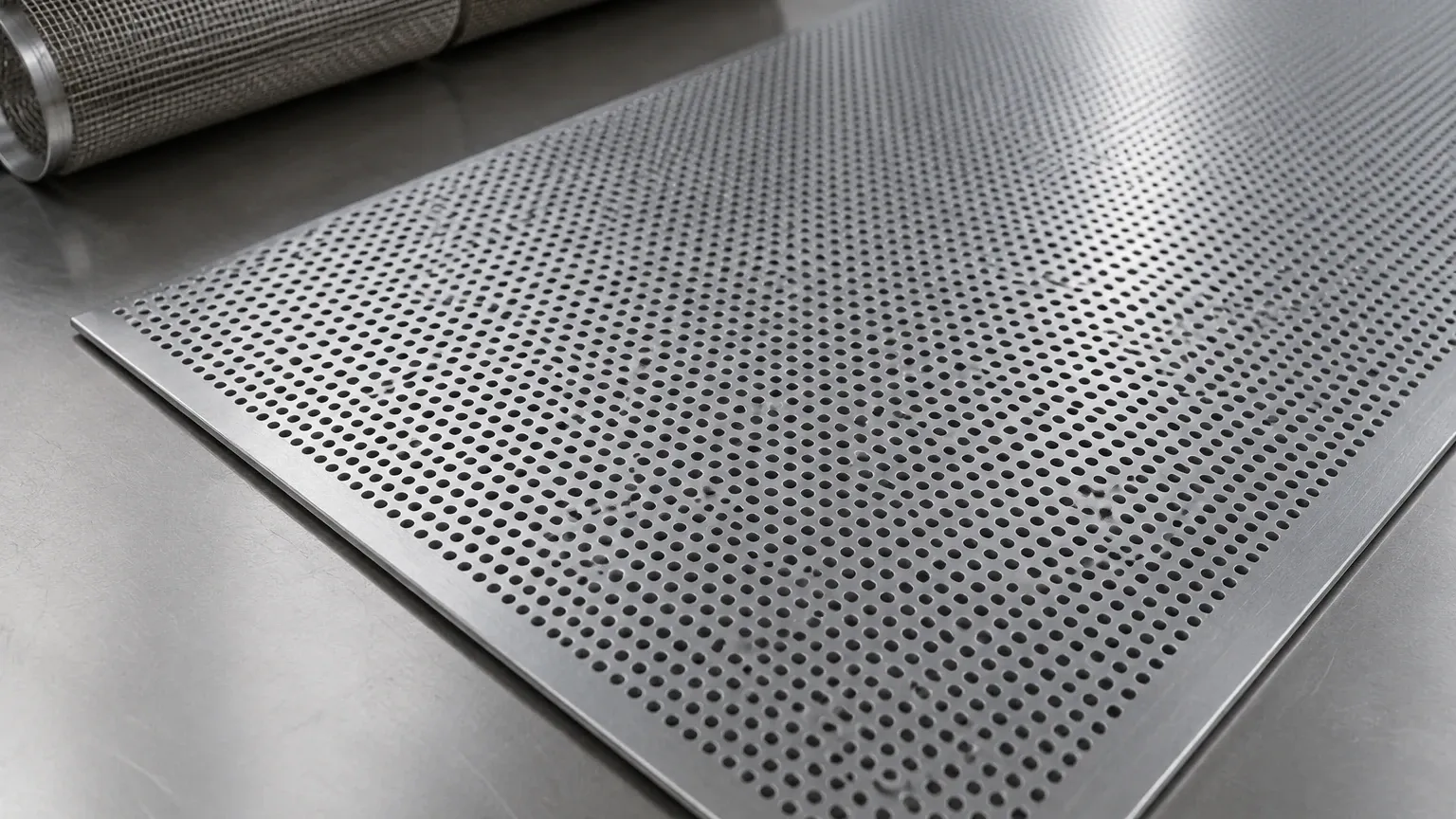
Perforated metal is produced by mechanically punching or laser-cutting holes into a solid sheet. This process allows for extreme precision in hole placement and shape. Engineers can specify the exact diameter, pitch (the distance between hole centers), and pattern (staggered or straight). The primary advantage of perforated metal is its versatility; it can maintain high structural strength while offering specific filtration or ventilation characteristics.
Expanded Metal
Expanded metal is created by simultaneously slitting and stretching a sheet. This process creates diamond-shaped openings. Because no material is lost during manufacturing, expanded metal is often more cost-effective than perforated metal. It is available in two forms: "raised" (where the strands are at an angle to the plane of the sheet) and "flattened" (where the sheet is passed through a cold-roll reducing mill to create a smooth surface). Expanded metal is highly valued for its strength-to-weight ratio and is commonly used for walkways, security fencing, and heavy-duty filter reinforcement.
Key Engineering Specifications for Perforated Metal
When moving beyond retail-grade searches for perforated sheet metal 4×8 home depot, engineers must define several critical parameters to ensure the material performs as expected in an industrial system.
1. Open Area Percentage
The open area is the ratio of the holes to the total area of the sheet, expressed as a percentage. This is the most critical factor for filtration and airflow applications. For a standard 60-degree staggered round hole pattern, the open area is calculated using the formula:
OA = (D² × 90.69) / P²
Where *D* is the hole diameter and *P* is the pitch. A higher open area allows for greater flow but reduces the structural strength of the sheet. Industrial manufacturers provide precise calculations to help engineers balance these competing requirements.
2. Hole Patterns and Pitch
* Staggered Patterns: The most common industrial configuration, providing the highest open area and uniform strength across the sheet.
* Straight Patterns: Used primarily for aesthetic purposes or when specific alignment is required for secondary components.
* Hole Shapes: While round holes are standard, square, hexagonal, and slotted holes are used for specific filtration needs, such as sorting elongated particles or providing higher open areas with hexagonal shapes.
3. Margins and Blank Areas
Unlike retail sheets, which may have holes running to the very edge, industrial 4×8 sheets can be manufactured with specific margins. Margins are the solid areas around the edges of the perforated area, which are essential for welding, bolting, or fitting the sheet into a frame without compromising the integrity of the holes.
Material Selection: Why Grade Matters in Filtration
One of the primary limitations of retail-sourced perforated metal is the limited selection of material grades. For industrial filtration and processing, the choice of alloy is critical to the longevity of the component.
* Stainless Steel 304: The standard for general industrial use, offering good corrosion resistance and excellent formability. It is widely used in food and beverage applications.
* Stainless Steel 316/316L: Contains molybdenum, which provides superior resistance to chlorides and pitting. This is the preferred choice for marine environments, chemical processing, and pharmaceutical applications.
* Carbon Steel: Often used in dry environments or where the part will be coated or galvanized. It offers high strength but lacks inherent corrosion resistance.
* Aluminum: Lightweight and naturally corrosion-resistant, aluminum is frequently used in architectural and aerospace applications, though it lacks the high-temperature stability of stainless steel.
In many B2B scenarios, the "standard" 4×8 sheet found in retail may be a low-carbon steel or a generic aluminum alloy that does not meet the rigorous requirements of ASTM or ISO standards required for industrial equipment.
Procurement: Retail Availability vs. Industrial Customization
Searching for "perforated sheet metal 4×8 home depot" highlights a common procurement challenge: the trade-off between speed and specification. Retail outlets are excellent for immediate, small-scale needs where the exact alloy or hole tolerance is secondary. However, for industrial OEMs and engineering firms, there are several risks associated with retail procurement:
1. Lack of Certification: Industrial projects often require Mill Test Reports (MTRs) to verify the chemical composition and physical properties of the metal. Retail products rarely provide this documentation.
2. Limited Gauges: Retailers typically stock thinner gauges (20ga to 16ga). Industrial applications may require heavy-duty plates (up to 1/4" or thicker) to handle high-pressure loads.
3. Inconsistent Tolerances: Commercial-grade sheets may have variations in flatness, hole alignment, and sheet dimensions that exceed the tolerances required for precision machinery.
4. Finish Quality: Industrial-grade perforated metal undergoes specific degreasing and deburring processes to ensure the sheets are safe to handle and ready for welding or coating.
For those requiring high-performance components, Perforated & Expanded Metal sourced from a specialized manufacturer ensures that every sheet meets the exact mechanical and chemical specifications of the project.
Engineering Considerations for Custom Filtration Solutions
When designing a filtration system that utilizes perforated metal, engineers should consider the following factors during the specification phase:
Flow Velocity and Pressure Drop
The hole size and open area directly impact the pressure drop across the filter. If the holes are too small or the open area is too low, the system may experience excessive backpressure, leading to pump strain or reduced throughput. Conversely, if the holes are too large, the perforated sheet may not provide adequate support for the primary filter media (such as wire mesh).
Compatibility with Filter Media
In multi-layer filtration, the perforated sheet acts as the outer protection or inner core. It is vital that the surface of the perforated metal is smooth (deburred) to prevent tearing or puncturing the finer mesh layers. Custom manufacturers can provide specialized finishes, such as electropolishing, to ensure a sanitary and smooth surface.
Replacement Cycles and Durability
Total cost of ownership (TCO) is a major consideration in B2B procurement. While a retail-grade sheet might be cheaper initially, an industrial-grade stainless steel sheet with the correct alloy and gauge will last significantly longer in corrosive or high-wear environments, reducing downtime and replacement costs.
Conclusion
While the search for "perforated sheet metal 4×8 home depot" serves as a useful starting point for understanding standard dimensions, the requirements of industrial filtration and manufacturing often demand more than what retail stock can offer. By focusing on technical specifications—such as precise open areas, specific material grades like 316L stainless steel, and tight manufacturing tolerances—engineers can ensure their systems operate efficiently and reliably.
For industrial applications where performance and durability are non-negotiable, moving from retail-grade solutions to customized Perforated & Expanded Metal is a necessary step. Whether you are designing a new filtration system, upgrading an industrial facility, or sourcing components for an OEM project, confirming the material certifications, mechanical properties, and custom dimensions will lead to a more successful and cost-effective outcome.
