


Quality Perforated
In the landscape of industrial filtration and structural engineering, the integrity of the base material often determines the efficiency and lifespan of the entire system. Selecting a quality perforated solution is not merely a matter of choosing a metal sheet with holes; it involves a complex evaluation of material science, geometric precision, and manufacturing tolerances. For engineers and procurement professionals, understanding the technical nuances of Perforated & Expanded Metal is essential for optimizing performance in demanding environments such as chemical processing, pharmaceutical manufacturing, and high-pressure hydraulic systems.
Industrial filtration components, such as filter baskets, strainers, and core supports, rely on perforated and expanded metals to provide the necessary mechanical strength while maintaining specific flow characteristics. When quality is compromised, the risks range from premature fatigue failure and corrosion to downstream contamination and inefficient pressure drops. This guide examines the engineering considerations required to specify and source high-performance perforated components.
The Engineering Fundamentals of Perforated & Expanded Metal
While often grouped together, perforated metal and expanded metal are produced through distinct processes that yield different mechanical properties and performance profiles. Choosing between them requires an analysis of the application’s structural requirements and filtration goals.
Perforated Metal Production
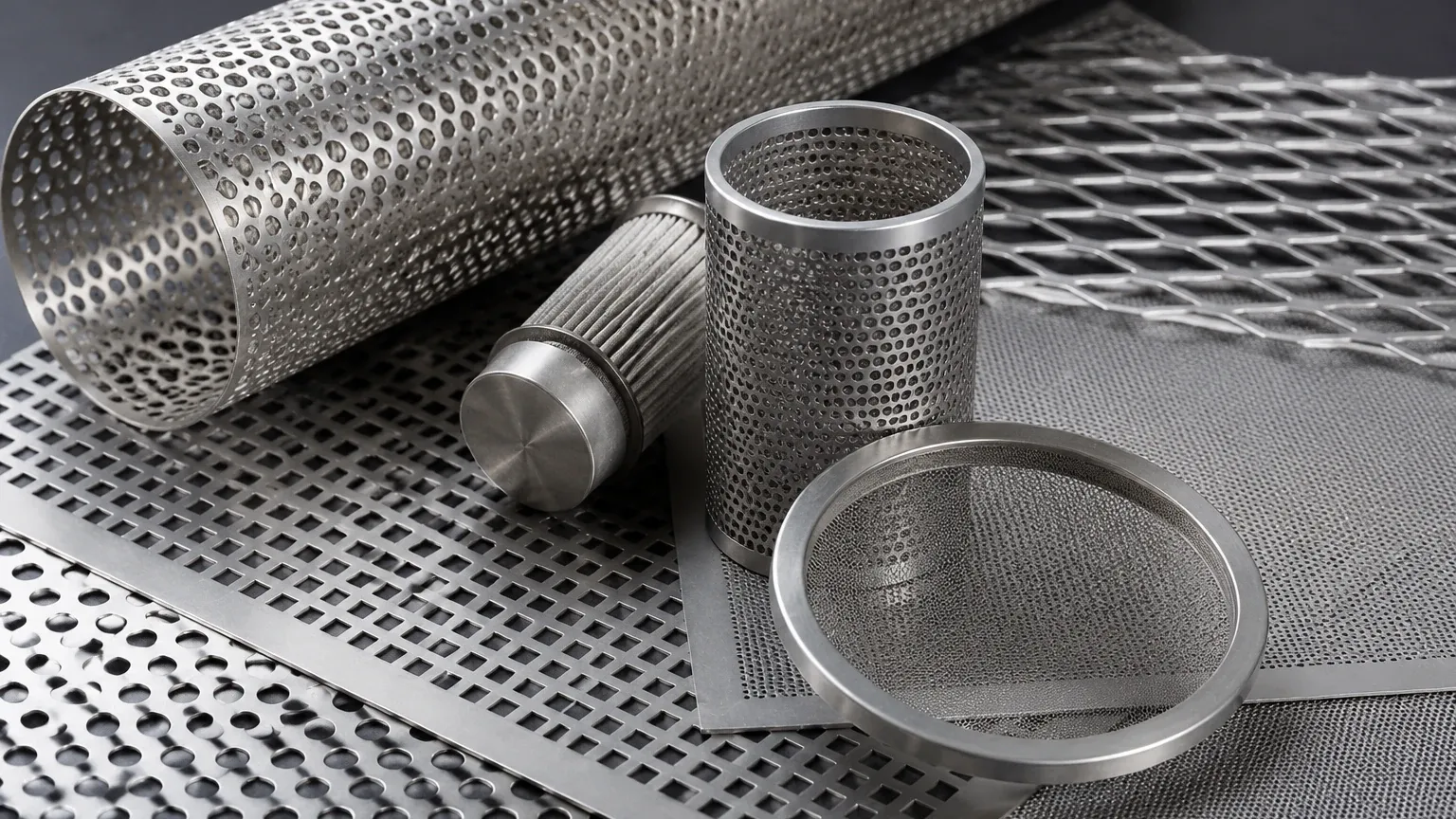
Perforated metal is created through a punching process where CNC-controlled high-speed presses remove material to create specific patterns. This method allows for extreme precision in hole diameter, pitch, and arrangement. Because the material is punched, the remaining "bridges" or "lands" retain the original thickness and flatness of the sheet, making it ideal for applications requiring high dimensional stability and smooth surfaces.
Expanded Metal Characteristics
Expanded metal is produced by simultaneously slitting and stretching the material. This process creates a diamond-shaped opening without any material waste. The resulting mesh is structurally rigid because it is composed of a single piece of metal without joins or welds. For filtration, expanded metal is frequently used as a support layer for finer wire mesh, providing a lightweight yet strong framework that can withstand significant differential pressure.
When evaluating a quality perforated or expanded product, engineers must consider the "bond" (where the strands intersect) and the "strand" width, as these dictate the overall open area and the mechanical load the material can support.
Material Science: Ensuring Durability in Harsh Environments
The performance of any filtration component is fundamentally limited by its material composition. In industrial sectors where exposure to corrosive chemicals, high temperatures, or abrasive slurries is common, material selection is the first line of defense against system failure.
Stainless Steel Grades
Kaifil specializes in stainless steel solutions, primarily utilizing grades 304 and 316L.
- Grade 304: Suitable for general industrial use, providing excellent formability and resistance to oxidation.
- Grade 316L: The "L" denotes low carbon, which is critical for components that require welding. Grade 316L contains molybdenum, significantly enhancing its resistance to pitting and crevice corrosion in chloride-rich environments, making it the standard for pharmaceutical and marine applications.
Exotic Alloys and Specialized Coatings
For extreme conditions, such as highly acidic chemical processing or high-temperature exhaust filtration, materials like Duplex stainless steel or Hastelloy may be required. Furthermore, surface treatments such as electropolishing or passivation are vital steps in ensuring a quality perforated finish. Passivation removes free iron from the surface, enhancing the protective chromium oxide layer, while electropolishing provides a microscopically smooth surface that prevents bacterial growth and facilitates easier cleaning in food and beverage applications.
Precision Engineering: Patterns, Pitch, and Open Area
The geometry of a perforated sheet determines its hydraulic performance. Engineers must balance the need for a high open area (to minimize pressure drop) with the requirement for structural rigidity.
Open Area Calculations
The open area is the percentage of the total sheet area that is occupied by holes. For a standard staggered round hole pattern, the calculation is:
*Percentage of Open Area = (D² × 90.69) / P²*
*(Where D = Hole Diameter and P = Pitch)*
A higher open area allows for greater flow rates but reduces the strength of the sheet. In filtration, a common challenge is "blinding" or clogging; a quality perforated design will optimize the hole arrangement to ensure that the fluid velocity remains consistent across the entire surface, reducing the likelihood of localized debris accumulation.
Pattern Selection
- Round Holes: The most common and versatile pattern, offering the best balance of strength and open area.
- Square Holes: Provide a higher open area than round holes but are more susceptible to stress concentrations at the corners.
- Slotted Holes: Often used for vibrating screens or applications where elongated particles must be separated from a fluid stream.
Manufacturing Standards: Beyond the Punching Process
A significant differentiator in quality perforated metal is the post-perforation processing. Standard industrial punching can leave behind defects that compromise the integrity of a filtration system.
Burr Removal and Leveling
During the punching process, the exit side of the hole often develops "burrs"—sharp edges of displaced metal. In high-precision filtration, these burrs can break off and contaminate the filtrate or damage sensitive filter membranes. Quality manufacturing involves rigorous deburring processes, such as vibratory finishing or brush deburring, to ensure all edges are smooth.
Furthermore, the punching process introduces internal stresses into the metal, often causing the sheet to curl or bow. Precision leveling is required to return the sheet to a specified flatness tolerance, which is critical if the perforated metal is to be rolled into a cylinder or welded into a complex filter housing.
Dimensional Tolerances
For OEM applications, dimensional accuracy is paramount. This includes not only the overall length and width of the sheet but also the "margins"—the unperforated areas along the edges. Consistent margins are essential for clean welding and secure seating within a filter assembly. A quality perforated supplier will maintain tight tolerances on hole diameters and center-to-center distances to ensure predictable flow characteristics across every batch.
Application-Specific Selection: From Chemical to Food Grade
The requirements for perforated and expanded metal vary significantly across different industrial sectors. A one-size-fits-all approach often leads to over-engineering (increasing costs) or under-engineering (increasing risk).
Chemical and Petrochemical Processing
In these environments, the primary concern is chemical compatibility and the ability to withstand high pressure. Perforated metal is often used as a support core for pleated filter elements. Here, the quality of the weld and the roundness of the perforated tube are critical to prevent the filter media from collapsing under high differential pressure.
Food, Beverage, and Pharmaceutical
In these regulated industries, "cleanability" is the priority. Quality perforated components must be free of pits, crevices, and oil residues from the manufacturing process. Stainless steel 316L is typically mandated, and the surface finish must meet specific Ra (Roughness Average) values to ensure that CIP (Clean-In-Place) cycles are effective.
Hydraulic and Industrial Equipment
Expanded metal is frequently used in hydraulic reservoirs and suction strainers. Its ability to act as a flame arrestor and its high strength-to-weight ratio make it ideal for protecting pumps from large particulate ingestion while maintaining a low profile within the tank.
Procurement Considerations: Customization and Long-Term Value
When sourcing Perforated & Expanded Metal, purchasing teams should look beyond the initial price per sheet. The total cost of ownership is influenced by the component’s lifespan, the ease of integration into the final product, and the reliability of the filtration performance.
Customization and OEM Support
Standard off-the-shelf perforated sheets rarely meet the specific needs of advanced industrial filtration. Working with a manufacturer like Kaifil allows for customization in several areas:
- Custom Hole Geometries: Designing specific patterns to match the flow profile of a unique fluid.
- Variable Margins: Creating solid zones within a perforated sheet for mounting brackets or identification tagging.
- Fabrication Services: Sourcing a pre-rolled, welded, and finished perforated cylinder rather than a flat sheet can significantly reduce assembly time and labor costs for the OEM.
Verification and Documentation
A reliable supplier provides more than just the physical product; they provide the data to back it up. This includes Material Test Reports (MTRs) to verify the chemical composition of the steel, dimensional inspection reports, and certificates of compliance with industry standards (such as ISO or FDA requirements). For an engineer, this documentation is the final proof of a quality perforated component.
Conclusion: Optimizing Performance through Quality
The selection of perforated and expanded metal is a critical decision in the design of industrial filtration systems. By focusing on material integrity, geometric precision, and rigorous manufacturing standards, engineers can ensure that their systems operate efficiently and reliably. Whether it is providing the structural backbone for a high-pressure hydraulic filter or acting as the primary screen in a food processing line, a quality perforated solution is the foundation of effective industrial separation.
When evaluating potential solutions, it is important to partner with a manufacturer that understands the technical demands of your specific application. By prioritizing precision and material quality, organizations can reduce maintenance intervals, prevent costly system failures, and achieve a lower total cost of ownership for their filtration infrastructure.
