


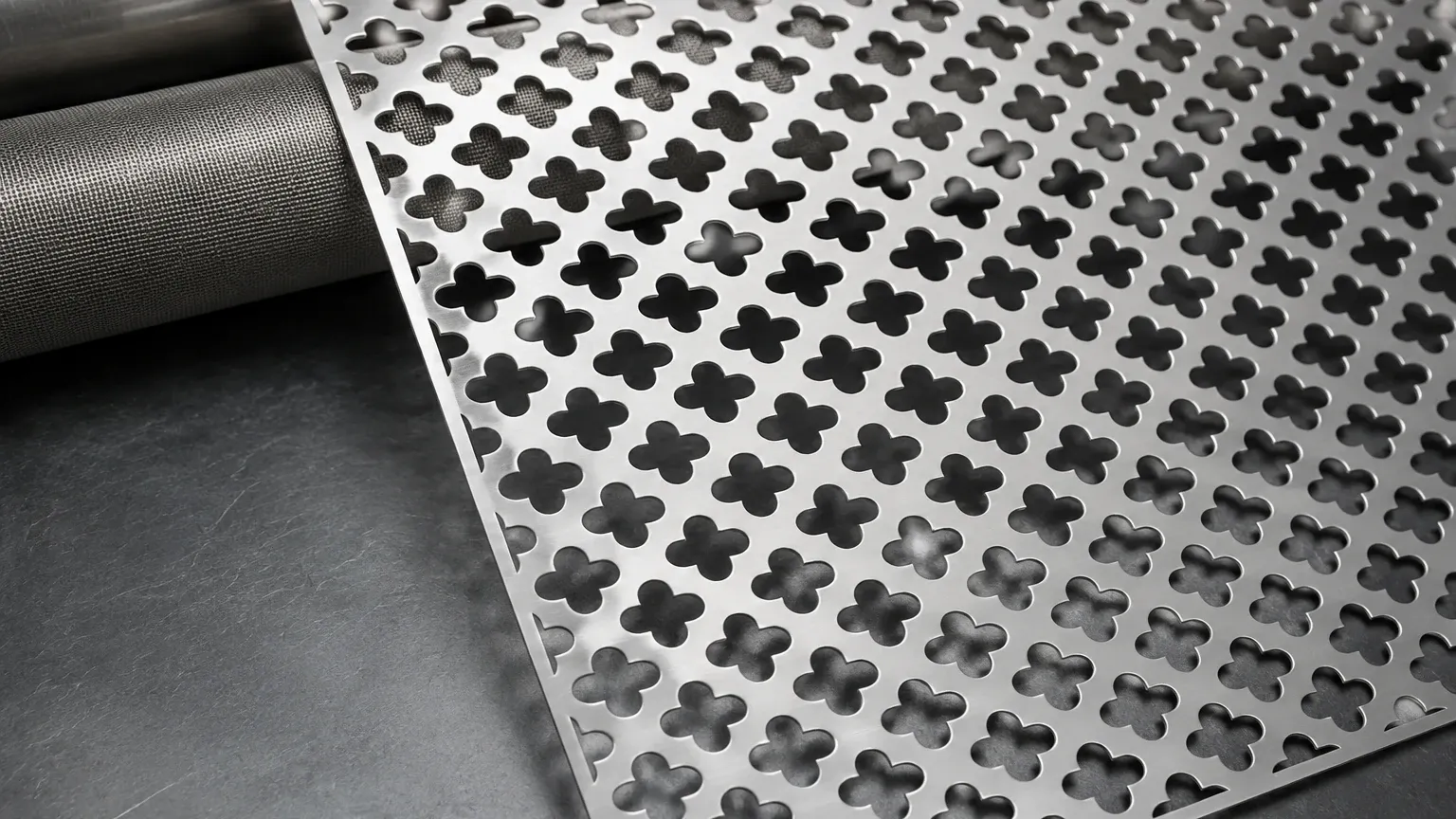
Quatrefoil Perforated Metal Sheet
In the landscape of industrial design and filtration engineering, the selection of a perforation pattern is rarely a purely aesthetic decision. While standard round or square holes dominate high-volume industrial applications, the quatrefoil perforated metal sheet offers a unique intersection of structural integrity, specific open-area ratios, and visual distinction. For engineers and procurement specialists, understanding the technical nuances of this pattern—from its flow dynamics to its mechanical behavior under load—is essential for optimizing system performance in sectors ranging from HVAC and architectural filtration to heavy machinery guarding.
As a specialized component within the broader category of Perforated & Expanded Metal, the quatrefoil pattern presents specific challenges and advantages that differ from conventional geometric perforations. This guide examines the engineering considerations, material selection criteria, and application-specific benefits of utilizing quatrefoil designs in demanding industrial environments.
Understanding Quatrefoil Geometry in Industrial Applications
The term "quatrefoil" originates from Latin, meaning "four leaves." In the context of metal perforation, this translates to a hole pattern characterized by four partially overlapping circles or lobes, often arranged symmetrically around a central point. Unlike a standard circular hole, the quatrefoil shape creates a more complex perimeter-to-area ratio, which can influence both the aesthetic appeal and the physical properties of the metal sheet.
Geometric Complexity and Open Area
One of the primary metrics for any perforated sheet is the "open area percentage." This value determines the transparency of the sheet to air, light, or fluid. In a quatrefoil perforated metal sheet, calculating the open area requires precise geometric modeling because the lobes of the clover-like shape create a non-linear boundary. Typically, quatrefoil patterns provide a moderate open area (often between 30% and 50%), which balances the need for throughput with the requirement for structural rigidity.
The Role of the "Bridge"
The "bridge" refers to the solid metal remaining between the perforated holes. Because of the lobed nature of the quatrefoil, the bridge width varies significantly across the surface of the sheet. Engineers must account for these narrowest points when calculating the maximum allowable stress or pressure drop across the panel. A well-designed quatrefoil pattern ensures that the bridges are thick enough to prevent deformation during the punching process or under operational stress, such as high-velocity airflow or mechanical impact.
Material Selection and Corrosion Resistance
The performance of a quatrefoil perforated metal sheet is heavily dependent on the substrate material. Given that these sheets are often used in environments exposed to moisture, chemicals, or extreme temperatures, material science plays a pivotal role in the selection process.
Stainless Steel: The Industrial Standard
For most B2B applications, stainless steel is the preferred material due to its high strength-to-weight ratio and exceptional corrosion resistance.
* Grade 304: This is the most common grade used for perforated metal. It offers excellent formability and resistance to atmospheric corrosion, making it suitable for indoor ventilation, architectural cladding, and general-purpose machinery guards.
* Grade 316/316L: In more demanding environments, such as chemical processing plants or coastal installations, Grade 316 is required. The addition of molybdenum provides superior resistance to chlorides and pitting. For applications involving welding, the low-carbon version (316L) is recommended to prevent carbide precipitation and maintain the integrity of the quatrefoil pattern at the heat-affected zones.
Alternative Materials
While stainless steel is the benchmark for durability, other materials may be selected based on specific project requirements:
* Aluminum: Chosen for its light weight and natural oxide layer that resists corrosion. It is frequently used in HVAC systems where reducing the load on support structures is a priority.
* Carbon Steel: Often used when cost is the primary driver and the environment is controlled, or where the sheet will be post-treated with powder coating or galvanization.
Flow Dynamics and Filtration Performance
In industrial filtration and ventilation, the shape of the aperture significantly impacts the behavior of the medium passing through it. The quatrefoil perforated metal sheet is often utilized as a decorative yet functional screen in air handling units or as a support layer for finer wire mesh filters.
Turbulence and Pressure Drop
As a fluid or gas passes through a quatrefoil opening, the irregular edges of the lobes can induce localized turbulence compared to a smooth circular hole. While this might increase the pressure drop slightly, it can also be advantageous in applications requiring the mixing of air streams or the diffusion of high-pressure blasts. Engineers must use Computational Fluid Dynamics (CFD) or empirical testing to ensure that the quatrefoil pattern meets the specific flow requirements of the system without causing excessive energy loss.
Particle Retention and Sifting
In coarse filtration or sifting, the quatrefoil shape can capture elongated particles that might otherwise pass through a round hole of the same diameter. The "corners" or indentations where the lobes meet provide additional contact points that can trap debris. However, this also means that the quatrefoil pattern may be more prone to "blinding" (clogging) if the particulate size is closely matched to the lobe dimensions. Regular maintenance and appropriate cleaning protocols are necessary to maintain throughput.
Manufacturing Precision and Quality Control
Producing a high-quality quatrefoil perforated metal sheet requires advanced CNC (Computer Numerical Control) punching technology. The complexity of the pattern necessitates precise tool-and-die sets to ensure consistency across the entire surface of the sheet.
Tolerance and Flatness
During the perforation process, the metal is subjected to significant mechanical stress, which can cause the sheet to curl or warp. A critical step in the manufacturing of Perforated & Expanded Metal is the leveling process. Precision leveling rollers are used to restore the flatness of the sheet, ensuring it can be easily integrated into frames or housings without gaps or misalignments.
Margin Requirements
In many B2B applications, the sheet must be welded or bolted into a larger assembly. This requires "margins"—unperforated solid borders around the edges of the sheet. When ordering a quatrefoil perforated metal sheet, it is vital to specify the exact dimensions of these margins. Standard margins are typically 20mm to 50mm, but custom widths can be engineered to accommodate specific mounting brackets or seal interfaces.
Applications in Modern Industry
While the quatrefoil pattern is often associated with historical architecture, its modern industrial applications are diverse and technically demanding.
HVAC and Ventilation
In high-end commercial and industrial buildings, quatrefoil sheets serve as ventilation grilles. They provide the necessary airflow for climate control systems while obscuring the internal mechanical components from view. The pattern's ability to diffuse air helps in maintaining a consistent temperature profile across large spaces.
Protective Guarding and Safety
Machinery guards require a balance between visibility (for inspection) and protection (to prevent contact with moving parts). The quatrefoil pattern offers a high degree of visibility while maintaining the structural rigidity needed to withstand impacts. In the food and beverage industry, stainless steel quatrefoil guards are favored because they are easy to sanitize and resist the harsh cleaning agents used in washdown procedures.
Acoustic Dampening
When backed with acoustic insulation materials, perforated metal sheets are used to reduce noise levels in factories and engine rooms. The quatrefoil pattern contributes to the sound-breaking properties of the panel, helping to dissipate sound waves before they reflect off the solid metal surface.
Selection Guide for Engineers and Purchasing Teams
To ensure the successful procurement of a quatrefoil perforated metal sheet, technical professionals should confirm several key parameters before finalizing an order. This proactive approach minimizes the risk of component failure and ensures the long-term viability of the filtration or shielding system.
1. Hole Size and Pitch: Define the distance between the centers of adjacent quatrefoils. This determines the density of the pattern and the total open area.
2. Sheet Thickness (Gauge): The thickness must be sufficient to handle the operational pressure or mechanical load. For stainless steel, common thicknesses range from 0.5mm to 3.0mm.
3. Surface Finish: Depending on the application, you may require a 2B (mill) finish, a #4 (brushed) finish for aesthetics, or an electropolished finish for maximum corrosion resistance and ease of cleaning.
4. Flatness and Squareness: Specify the allowable tolerances for sheet dimensions and flatness, especially if the panels are to be used in precision-fit enclosures.
5. Environmental Compatibility: Confirm that the selected alloy (e.g., 304 vs. 316) is appropriate for the chemical exposure and temperature fluctuations of the installation site.
Maintenance and Longevity
The durability of a quatrefoil perforated metal sheet is one of its primary selling points in a B2B context. However, the complex geometry of the quatrefoil means that dust, oils, or biological films can accumulate in the lobes.
In pharmaceutical or food-grade applications, a regular cleaning cycle using high-pressure steam or chemical solvents is recommended. Because these sheets are typically manufactured from high-quality stainless steel, they can withstand rigorous cleaning without degrading. For outdoor or architectural applications, a simple periodic washdown is usually sufficient to prevent the buildup of corrosive pollutants.
By focusing on material integrity and geometric precision, manufacturers like Kaifil provide reliable filtration and shielding components that meet the rigorous standards of modern industry. Whether used for its unique flow characteristics or its structural properties, the quatrefoil perforated metal sheet remains a versatile and dependable choice for engineers worldwide.
