


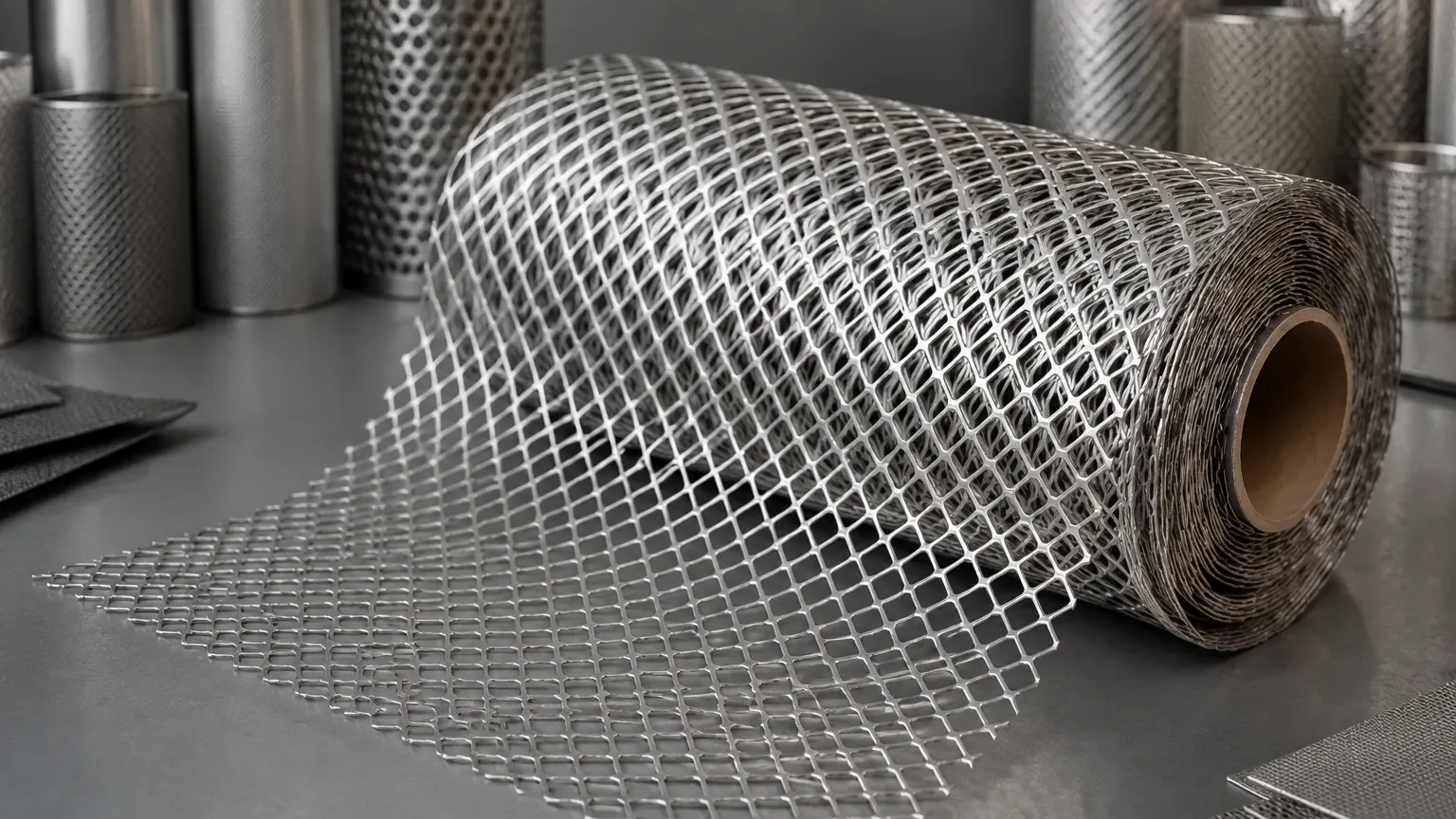
Roll of Expanded Metal
In industrial manufacturing and filtration, the selection of structural media is a critical engineering decision that impacts both the efficiency of the production process and the long-term durability of the end product. A roll of expanded metal represents a versatile and cost-effective solution for applications requiring high strength-to-weight ratios, excellent ventilation, and structural reinforcement. Unlike perforated metals, which are created by punching holes and generating scrap, expanded metal is produced through a process of slitting and stretching, resulting in a continuous mesh with no material waste. When supplied in roll form, this material offers distinct advantages for high-volume industrial operations, particularly in the fabrication of filtration components and protective enclosures.
Understanding the Manufacturing Process of Expanded Metal Rolls
The production of a roll of expanded metal is a precision cold-forming process. It begins with a solid metal coil—typically stainless steel, carbon steel, or aluminum—which is fed into an expanding machine. The machine’s blades simultaneously slit and stretch the metal in a predetermined pattern. This mechanical stretching creates diamond-shaped openings, while the "strands" (the metal remaining between the openings) and "bonds" (the points where the strands intersect) provide the material's inherent structural integrity.
Because the metal is stretched rather than punched, the molecular structure of the material remains intact, and the resulting mesh is often stronger than the original flat sheet of the same weight. For industrial buyers, the roll format is particularly valuable because it allows for continuous feeding into automated CNC machines, stamping presses, or welding stations. This reduces the downtime associated with loading individual sheets and minimizes the "end-of-sheet" waste that occurs in batch processing.
Technical Specifications and Material Selection
When specifying a roll of expanded metal for industrial use, engineers must define several geometric and material parameters to ensure the component meets the application's mechanical and chemical requirements. The two primary measurements used to describe the diamond openings are:
* Short Way of Design (SWD): The distance from the center of one bond to the center of the next bond across the short axis of the diamond.
* Long Way of Design (LWD): The distance from the center of one bond to the center of the next bond across the long axis of the diamond.
In addition to these dimensions, the strand width and strand thickness determine the overall weight and strength of the mesh. For filtration applications, these dimensions are calculated to provide maximum support while maintaining the required open area for fluid or gas flow.
Material Grades
In the context of high-performance filtration and chemical processing, material selection is paramount. Kaifil specializes in stainless steel alloys, which are the industry standard for demanding environments:
1. Stainless Steel 304: Offers excellent corrosion resistance and is suitable for most food processing and general industrial applications.
2. Stainless Steel 316L: Contains molybdenum, providing superior resistance to chlorides and pitting, making it the preferred choice for pharmaceutical and marine filtration.
3. Specialty Alloys: For high-temperature or highly acidic environments, alloys like Monel or Inconel may be used, though stainless steel remains the most common choice for a roll of expanded metal due to its balance of cost and performance.
The Strategic Advantage of Using a Roll of Expanded Metal
For B2B procurement and engineering teams, the decision to source expanded metal in rolls rather than cut-to-size sheets is often driven by logistical and operational efficiency.
1. Continuous Production and Automation
In modern manufacturing, throughput is a key performance indicator. A roll of expanded metal can be mounted on a decoiler and fed directly into production lines. This is essential for the high-speed manufacturing of cylindrical filter cartridges or long-run architectural panels. The continuity of the roll ensures that there are fewer interruptions, leading to more consistent weld quality and dimensional accuracy across large production batches.
2. Waste Reduction and Cost Efficiency
Because expanded metal is produced without creating "slugs" or scrap metal from hole-punching, it is inherently more cost-effective than perforated metal of similar thickness. Buying in rolls further optimizes this by allowing manufacturers to cut exactly what they need for a specific run, reducing the off-cut waste that typically accumulates when working with standard-sized sheets (e.g., 4×8 feet).
3. Storage and Handling
Rolls are often easier to transport and store in a compact manner compared to large stacks of flat sheets. In a warehouse environment, vertical or racked storage of rolls maximizes floor space. However, engineers must account for the "coil set" or the natural tendency of the metal to curve when unrolled, which may require leveling equipment depending on the precision of the downstream application.
Critical Role in Industrial Filtration Systems
Expanded metal is a fundamental component in the architecture of industrial filters. Its primary function is often to serve as a drainage layer or a structural support for finer filtration media, such as woven wire mesh or non-woven membranes. Without the rigid support of Perforated & Expanded Metal, fine filter meshes would collapse under the high-pressure differentials common in hydraulic systems or chemical processing lines.
In a typical multi-layer filter cartridge, the expanded metal roll is cut and formed into an inner core or an outer wrap. The diamond pattern provides a high percentage of open area—often exceeding 60-70%—which ensures that the structural support does not significantly impede the flow of the process fluid. Furthermore, the angled orientation of the strands in "standard" (unflattened) expanded metal can help create turbulence, which in some specialized applications, assists in the separation of particles or the distribution of flow.
Engineering Considerations: Standard vs. Flattened Mesh
When ordering a roll of expanded metal, engineers must choose between two primary finishes: Standard (Raised) and Flattened.
Standard Expanded Metal
Standard expanded metal leaves the machine with the strands and bonds at a sharp angle to the original plane of the sheet. This creates a three-dimensional surface that provides exceptional rigidity and slip resistance. In filtration, the raised edges can provide additional surface area and mechanical interlocking with other filter layers. However, the thickness of a standard roll is significantly greater than the original base metal thickness.
Flattened Expanded Metal
Flattened expanded metal is produced by passing the standard expanded sheet through a cold-roll reducing mill. This process flattens the strands and bonds back into a single plane, resulting in a smooth, flat surface. Flattened rolls are often preferred when the expanded metal must be bonded to a delicate membrane or when a specific overall thickness must be maintained to fit within a tight filter housing. While flattening slightly increases the LWD and reduces the SWD, it provides a more uniform surface that is easier to clean and less likely to cause mechanical wear on adjacent soft materials.
Calculating Open Area and Performance Expectations
For engineers, the "open area" percentage is the most critical metric for filtration performance. It determines the pressure drop (Delta P) across the filter and the total flow capacity of the system. The open area of a roll of expanded metal is calculated based on the relationship between the strand width and the SWD.
A common challenge in filter design is balancing this open area with the required burst strength. In high-pressure hydraulic applications, the expanded metal must withstand significant mechanical stress. Engineering teams must confirm the yield strength of the selected material grade and ensure that the bond strength of the expanded metal is sufficient to prevent deformation during pressure spikes.
Quality Standards and Customization for OEM Applications
In the B2B sector, consistency is the hallmark of quality. When sourcing a roll of expanded metal, it is vital to confirm that the manufacturer adheres to strict tolerances regarding strand width, opening size, and camber (the straightness of the roll edge). Variations in these parameters can lead to misalignment in automated welding equipment or gaps in the final filter assembly.
Kaifil provides customized filtration solutions that involve tailoring the expanded metal to specific OEM requirements. This includes:
* Custom Slitting: Providing rolls in specific widths to match the height of a filter core, eliminating the need for secondary trimming.
* Surface Treatments: Electropolishing or passivating stainless steel rolls to enhance corrosion resistance and ensure the material is suitable for sterile pharmaceutical or food-grade environments.
* Annealing: Heat treating the roll to reduce internal stresses, making the metal easier to form into tight diameters without cracking.
Maintenance, Durability, and Total Cost of Ownership
One of the primary reasons engineers specify stainless steel expanded metal is its longevity. In harsh industrial environments, the total cost of ownership is determined not just by the initial purchase price, but by the replacement cycle and maintenance requirements.
Because a roll of expanded metal made from 304 or 316L stainless steel is highly resistant to oxidation and chemical attack, it can often be cleaned and reused multiple times. In many filtration systems, the expanded metal support structure outlasts the primary filter media. When the primary media becomes blinded or clogged, the expanded metal core can often be ultrasonically cleaned or chemically washed and returned to service.
Before finalizing a purchase, procurement teams should confirm the material's compatibility with the specific chemicals, temperatures, and pressures of their application. By choosing the correct specifications for a roll of expanded metal, manufacturers can ensure a reliable, high-performance solution that optimizes both production efficiency and product lifespan.
