


Stainless Steel Perforated Metal
In the landscape of industrial filtration and structural engineering, stainless steel perforated metal stands as a foundational component. Its utility spans from simple screening to complex, high-pressure filtration support systems. For engineers and procurement specialists, selecting the appropriate perforated metal involves more than choosing a hole size; it requires a deep understanding of material properties, mechanical tolerances, and the specific demands of the operating environment.
As a specialized manufacturer, Kaifil provides precision-engineered Perforated & Expanded Metal solutions designed to meet the rigorous standards of the chemical, pharmaceutical, and food processing industries. This guide explores the technical parameters and engineering considerations essential for optimizing the performance of stainless steel perforated metal in industrial applications.
Understanding Stainless Steel Perforated Metal in Industrial Applications
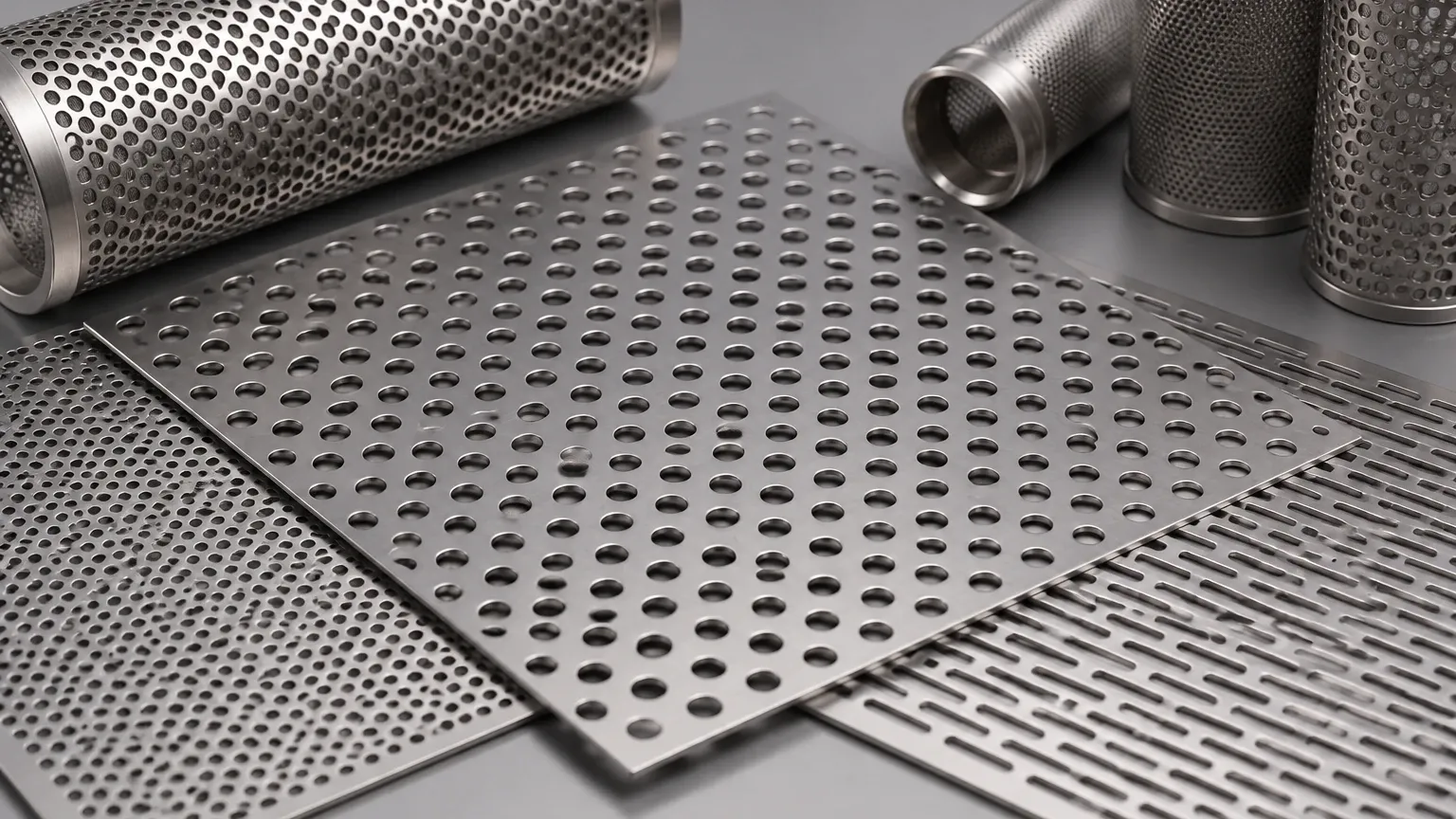
Stainless steel perforated metal is produced by mechanically punching or laser-cutting a series of holes into a solid metal sheet. Unlike woven wire mesh, which is flexible and susceptible to wire displacement under high pressure, perforated metal offers a rigid, one-piece structure. This structural integrity makes it an ideal choice for applications requiring high mechanical strength, such as filter baskets, centrifuge screens, and internal support cores for filter cartridges.
The primary advantage of using stainless steel perforated metal lies in its predictability. Because the holes are punched with precision tooling, the open area and flow characteristics remain constant throughout the service life of the component. This reliability is critical in industries like hydraulic systems or water treatment, where inconsistent flow rates can lead to system failure or inefficient processing.
Material Grades: Selecting the Right Stainless Steel Alloy
The performance of a perforated component is heavily dictated by the alloy selected. In industrial filtration, three primary grades dominate the market, each offering distinct advantages based on the chemical and thermal environment.
Grade 304 Stainless Steel
Grade 304 is the most common choice for general industrial applications. It provides excellent corrosion resistance in most atmospheric conditions and is highly weldable. It is frequently used in food and beverage processing where hygiene is paramount but chemical exposure is relatively mild.
Grade 316 Stainless Steel
For environments involving chlorides or marine conditions, Grade 316 is the industry standard. The addition of molybdenum enhances its resistance to pitting and crevice corrosion. This makes it the preferred material for chemical processing plants and wastewater treatment facilities where the metal is frequently exposed to corrosive agents.
Grade 316L Stainless Steel
Grade 316L is the low-carbon version of 316. It is specifically utilized in applications requiring extensive welding. The lower carbon content prevents carbide precipitation during the welding process, ensuring the heat-affected zones remain as corrosion-resistant as the rest of the sheet. This is a critical requirement in the pharmaceutical industry to maintain sterile conditions and prevent material degradation.
Technical Specifications and Engineering Parameters
When specifying perforated metal for a project, several geometric variables must be defined to ensure the component meets the required filtration and structural benchmarks.
Hole Patterns and Geometry
While square, slotted, and decorative patterns are available, round holes are the most efficient for industrial filtration. They offer the best balance of structural strength and open area.
* 60-Degree Staggered Pattern: This is the most common configuration. It provides the highest open area and uniform strength across the sheet.
* Straight Line Pattern: Holes are aligned in both rows and columns. This is typically used for aesthetic purposes or specific mechanical sorting where a staggered path is undesirable.
Calculating Open Area
The open area percentage determines the flow rate and pressure drop across the filter. For a 60-degree staggered round hole pattern, the formula is:
Open Area % = (D² × 90.69) / C²
Where:
* D = Hole Diameter
* C = Center-to-Center Distance (Pitch)
An engineer must balance the need for a high open area (to minimize pressure drop) with the requirement for structural thickness (to withstand mechanical stress).
Thickness and Pitch
The thickness of the sheet should generally not exceed the hole diameter to avoid "punching difficulties" and excessive tool wear, although advanced manufacturing techniques allow for some exceptions. The pitch, or the distance between the centers of adjacent holes, determines the "bridge" width. A wider bridge increases the strength of the sheet but reduces the open area.
The Role of Stainless Steel Perforated Metal in Filtration Systems
In many industrial processes, stainless steel perforated metal serves two distinct roles: as a primary filter medium or as a support structure for finer media.
Primary Filtration
In coarse filtration or straining applications, perforated metal is used to remove large particulates from liquid or gas streams. In the food industry, for example, perforated baskets are used to strain pulp or seeds. The smooth surface of the perforated metal allows for easy cleaning and sterilization, complying with stringent sanitary standards.
Support Cores and Baskets
In high-pressure applications, fine wire mesh or synthetic filter media lack the structural rigidity to withstand the differential pressure. Here, perforated metal is rolled into cylinders to act as an internal or external support core. This prevents the finer media from collapsing or bursting. In hydraulic systems, these cores must be manufactured to precise tolerances to ensure a perfect fit within the filter housing, preventing bypass leaks.
Manufacturing Precision and Customization Options
At Kaifil, the manufacturing process for Perforated & Expanded Metal is governed by strict quality control measures. Beyond the initial perforation, several secondary processes are often required to prepare the component for industrial use:
1. Leveling: The punching process can introduce internal stresses that cause the sheet to curl. Precision leveling ensures the final product is perfectly flat, which is essential for subsequent welding or assembly.
2. Deburring: Punching leaves sharp edges on the exit side of the hole. For filtration applications, deburring is mandatory to prevent the snagging of fine mesh layers and to ensure the safety of personnel during maintenance.
3. Degreasing and Passivation: To ensure the maximum corrosion resistance of the stainless steel, the metal undergoes degreasing to remove manufacturing oils, followed by passivation to restore the protective chromium oxide layer.
4. Custom Fabrication: Many industrial applications require non-standard shapes. Kaifil provides OEM services to cut, roll, and weld perforated sheets into bespoke configurations, such as conical strainers or multi-layered filter cartridges.
Evaluating Performance: Durability and Pressure Drop
For engineers, the total cost of ownership is a primary concern. While a thinner sheet or a cheaper alloy might reduce initial costs, it often leads to premature failure and increased downtime.
Pressure Drop Considerations
A common mistake in filter selection is underestimating the pressure drop across a perforated plate. As particulates accumulate on the surface, the effective open area decreases, causing a spike in differential pressure. If the perforated metal is not thick enough, this pressure can cause permanent deformation. Engineers should specify a safety factor that accounts for the maximum possible pressure the system's pumps can deliver.
Replacement Cycles and Maintenance
One of the greatest benefits of stainless steel is its longevity. Unlike plastic or low-grade carbon steel, stainless steel perforated metal can be cleaned and reused multiple times. In many chemical processing applications, the filters are cleaned using Clean-in-Place (CIP) systems involving high-temperature caustic or acidic washes. The material must be able to withstand these cycles without losing structural integrity or corroding.
Procurement Considerations: What to Confirm Before Ordering
To ensure the successful integration of perforated metal into an industrial system, the following information should be confirmed with the manufacturer:
* Exact Alloy Grade: Confirm if 304, 316, or 316L is required based on the chemical exposure.
* Dimensional Tolerances: Specify the allowable variance in sheet size, hole diameter, and pitch.
* Margin Requirements: Define the "unperforated" areas around the edges of the sheet, which are often necessary for welding or clamping into a frame.
* Surface Finish: Determine if a mill finish is sufficient or if electropolishing is required for high-purity pharmaceutical applications.
* Compliance Standards: Ensure the material meets relevant standards such as ASTM or ISO for industrial filtration components.
Conclusion
Stainless steel perforated metal is a versatile and indispensable component in modern industrial filtration. By understanding the nuances of material selection, hole geometry, and manufacturing precision, engineers can design systems that are both efficient and durable. Whether used as a primary strainer in food processing or a high-strength support core in chemical filtration, the quality of the perforated metal directly impacts the reliability of the entire system.
Kaifil remains committed to providing technical expertise and high-quality manufacturing to support global industrial needs. By focusing on precision and customization, we help our partners achieve optimized filtration performance in even the most demanding environments. For detailed specifications or to discuss custom filtration requirements, professionals are encouraged to review the available Perforated & Expanded Metal options and consult with our engineering team.
