


Triangular Perforated Metal
In the landscape of industrial filtration and structural engineering, the selection of perforation patterns is a critical decision that dictates the efficiency, durability, and flow characteristics of a component. While round and square perforations are common, triangular perforated metal offers unique mechanical and hydraulic properties that make it indispensable for specific high-performance applications. As a specialized manufacturer, Kaifil provides precision-engineered Perforated & Expanded Metal solutions, ensuring that engineers can optimize their systems for precise filtration and structural integrity.
This guide explores the technical nuances of triangular perforated metal, its engineering advantages, and the factors that procurement teams must consider when sourcing these components for demanding industrial environments.
Understanding Triangular Perforated Metal Geometry
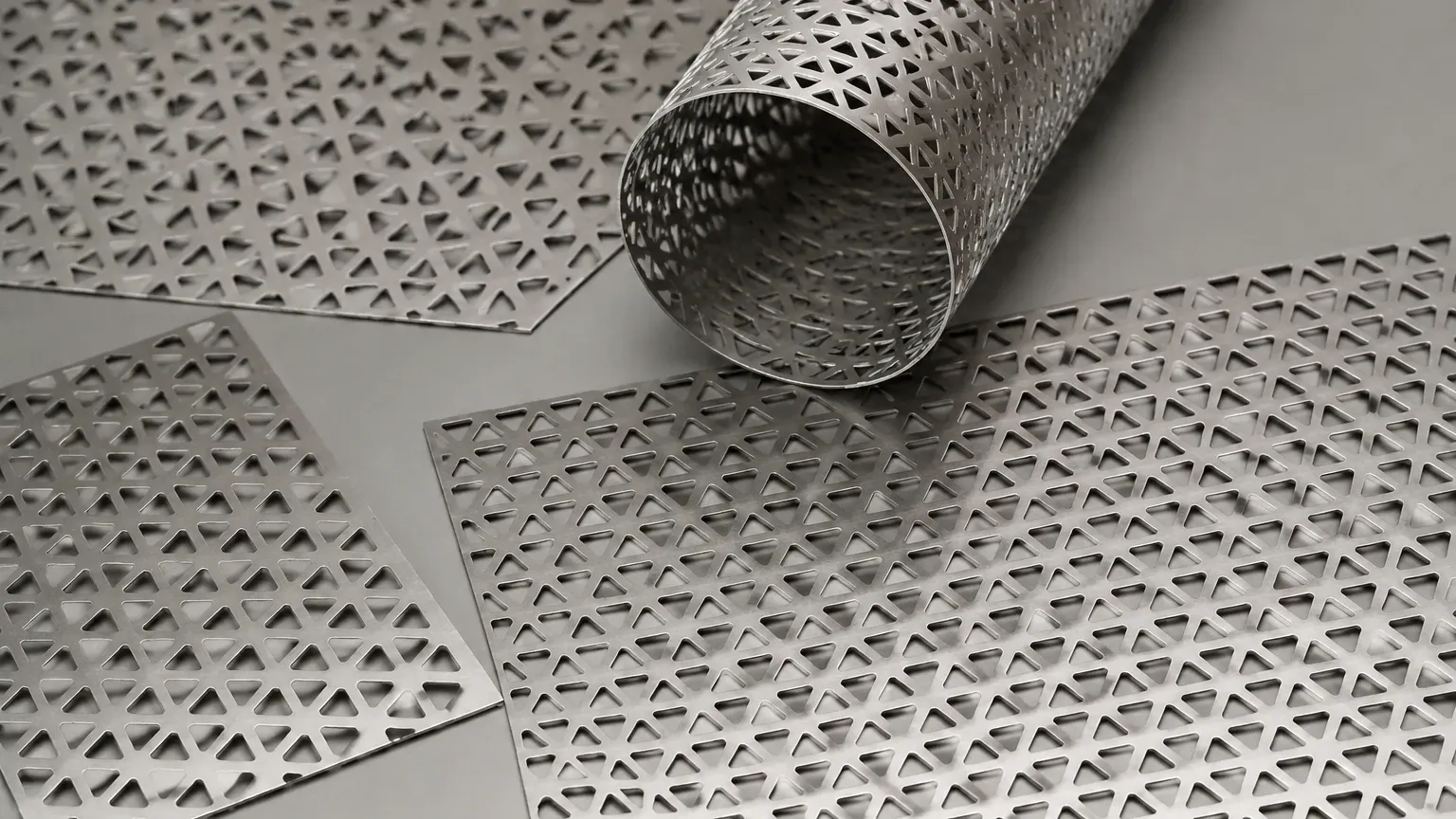
Triangular perforated metal is characterized by a series of triangular holes punched into a metal sheet—typically stainless steel—arranged in either straight or staggered patterns. Unlike standard round holes, the geometry of a triangle introduces sharp corners and varying widths across the aperture, which significantly influences how fluids and solids interact with the surface.
Hole Configurations and Orientations
When specifying triangular perforated metal, engineers must define the specific geometry of the triangle and its orientation relative to the flow or structural load:
1. Equilateral Triangles: All three sides and angles are equal. This provides the most uniform distribution of stress and flow across the sheet.
2. Isosceles Triangles: Two sides are equal. This is often used when a specific directional flow or aesthetic requirement is needed.
3. Apex Orientation: The triangles can be oriented with the apex (point) facing the direction of flow or perpendicular to it. This choice affects the "sieve effect" and how particles are retained or deflected.
Staggered vs. Straight Row Patterns
A staggered pattern is the most common arrangement for industrial filtration. By offsetting the rows of triangles, manufacturers can achieve a higher open area percentage while maintaining the structural rigidity of the metal bridge (the material between the holes). Straight row patterns are less common but are used in specific architectural or sorting applications where linear alignment is required.
Engineering Advantages in Industrial Filtration
The move from standard round perforations to triangular patterns is usually driven by specific performance requirements. In the context of Perforated & Expanded Metal, the triangular shape offers several technical benefits:
Enhanced Particle Retention and Release
One of the primary reasons for choosing triangular perforated metal is its ability to handle non-spherical particles. The tapering width of a triangular hole can trap elongated or irregular particles more effectively than a round hole of the same area. Conversely, in certain vibration-based sorting applications, the sharp angles of the triangle help prevent "blinding" (clogging) by reducing the surface contact between the particle and the hole edge.
Structural Rigidity and Weight Ratios
Triangular patterns often allow for a high open area without compromising the sheet's ability to withstand pressure. Because the triangle is a naturally stable geometric shape, the bridges between the holes can be engineered to resist deformation under high differential pressure. This is particularly important in hydraulic systems and high-pressure chemical processing where the filter media must maintain its shape under stress.
Flow Dynamics and Turbulence
The sharp corners of triangular perforations can induce micro-turbulence in the fluid flow. While this might increase pressure drop slightly compared to round holes, it can be advantageous in applications requiring the mixing of fluids or the prevention of laminar flow layers that might allow small particles to bypass the filter surface.
Material Selection: The Role of Stainless Steel
For industrial applications, the choice of material is as important as the hole pattern. Kaifil specializes in stainless steel filtration solutions because of the material's inherent resistance to corrosion, temperature extremes, and mechanical wear.
* Grade 304 Stainless Steel: The standard choice for general industrial use, offering excellent formability and resistance to oxidation. It is widely used in food and beverage processing where hygiene is paramount.
* Grade 316L Stainless Steel: Contains molybdenum, providing superior resistance to chlorides and acids. This is the preferred material for marine environments, pharmaceutical manufacturing, and aggressive chemical processing.
* Specialty Alloys: In high-temperature or highly corrosive environments, alloys like Duplex stainless steel or Monel may be used to ensure the longevity of the perforated component.
When sourcing triangular perforated metal, it is essential to confirm that the material grade matches the chemical compatibility requirements of the specific application to avoid premature failure due to pitting or stress corrosion cracking.
Key Evaluation Criteria for Procurement and Design
To ensure the successful integration of triangular perforated metal into an industrial system, engineers and purchasing teams should evaluate the following technical parameters:
1. Open Area Percentage
The open area is the ratio of the total area of the holes to the total area of the sheet. For triangular patterns, the calculation is more complex than for round holes. A higher open area increases flow rate and reduces pressure drop but decreases the mechanical strength of the sheet. Engineers must find the "sweet spot" that satisfies both filtration efficiency and structural requirements.
2. Pitch and Bridge Width
The pitch is the distance from the center of one triangular hole to the center of the next. The bridge width is the amount of metal remaining between the holes. If the bridge is too narrow, the sheet may warp during the punching process or fail under operational pressure. If it is too wide, the filtration capacity is unnecessarily restricted.
3. Tolerance and Precision
In precision filtration, even minor deviations in hole size can lead to bypass or inconsistent performance. It is critical to work with a manufacturer that can maintain tight tolerances across the entire surface of the metal. This includes ensuring that the corners of the triangles are cleanly cut without burrs, which could otherwise snag fibers or cause unwanted turbulence.
4. Edge Margins and Blank Areas
Customized filtration components often require unperforated margins for welding, bolting, or sealing into a housing. Specifying exact margin dimensions is necessary to ensure the perforated sheet fits perfectly into the final assembly without requiring extensive post-processing.
Common Risks and Mitigation Strategies
Implementing triangular perforated metal comes with specific challenges that must be addressed during the design phase:
* Stress Concentration: The sharp corners of a triangle are natural points of stress concentration. To mitigate the risk of cracking, manufacturers may use a "radiused corner" triangle, where the points are slightly rounded to distribute stress more evenly while maintaining the overall triangular profile.
* Tooling Wear: Punching triangular shapes is more demanding on manufacturing equipment than punching round holes. This can lead to tool wear that affects the consistency of the holes. Selecting a manufacturer with advanced CNC punching capabilities and a robust quality control process is vital.
* Cleaning Challenges: The corners of triangular holes can sometimes trap fine debris more easily than round holes. In industries like food processing or pharmaceuticals, where Clean-in-Place (CIP) systems are used, the cleaning protocol must be validated to ensure that no residue remains in the vertices of the triangles.
Customization and OEM Capabilities
Every industrial application has unique constraints, which is why off-the-shelf solutions are rarely sufficient for high-performance filtration. Kaifil’s expertise lies in providing customized Perforated & Expanded Metal that meets exact engineering specifications.
Custom Hole Sizes and Patterns
While standard triangular sizes exist, many applications require custom dimensions to target specific particle sizes. Whether you need micro-perforations for fine filtration or large apertures for heavy-duty sorting, custom tooling allows for the creation of patterns that are optimized for your flow rates and pressure requirements.
Secondary Processing
Beyond simple perforation, metal sheets often require secondary processing to become functional components. This includes:
* Forming and Rolling: Shaping the perforated sheet into cylinders, cones, or baskets for use in filter cartridges.
* Welding: Using TIG, MIG, or plasma welding to join edges while maintaining the integrity of the perforation pattern.
* Surface Finishing: Electropolishing or pickling to improve corrosion resistance and ensure a smooth, burr-free surface.
Total Cost Considerations
When evaluating the cost of triangular perforated metal, it is important to look beyond the initial purchase price and consider the Total Cost of Ownership (TCO). High-quality stainless steel components may have a higher upfront cost but offer significant savings over time through:
* Extended Service Life: Durable materials and precise manufacturing reduce the frequency of replacements.
* Reduced Maintenance: Patterns that resist clogging and are easy to clean lower the labor costs associated with system downtime.
* Process Efficiency: Optimized flow characteristics can reduce energy consumption in pumps and other system components.
Conclusion: Confirming Specifications Before Purchase
Before moving forward with a purchase of triangular perforated metal, technical professionals should confirm several key pieces of information with their supplier:
1. Exact Material Grade: Ensure the stainless steel grade (e.g., 304, 316L) is appropriate for the chemical environment.
2. Dimensional Accuracy: Verify the hole size, pitch, and open area percentage.
3. Flatness Requirements: Perforation can introduce internal stresses that cause sheets to bow; confirm if leveling is required.
4. Application Environment: Discuss pressure, temperature, and flow media with the manufacturer to ensure the design is fit for purpose.
By focusing on these technical details and leveraging the expertise of a specialized manufacturer like Kaifil, engineers can secure filtration solutions that provide reliable, long-term performance in even the most demanding industrial settings. For more information on available patterns and technical specifications, review the range of Perforated & Expanded Metal options designed to meet global industrial standards.
