


Types of Perforated Metal
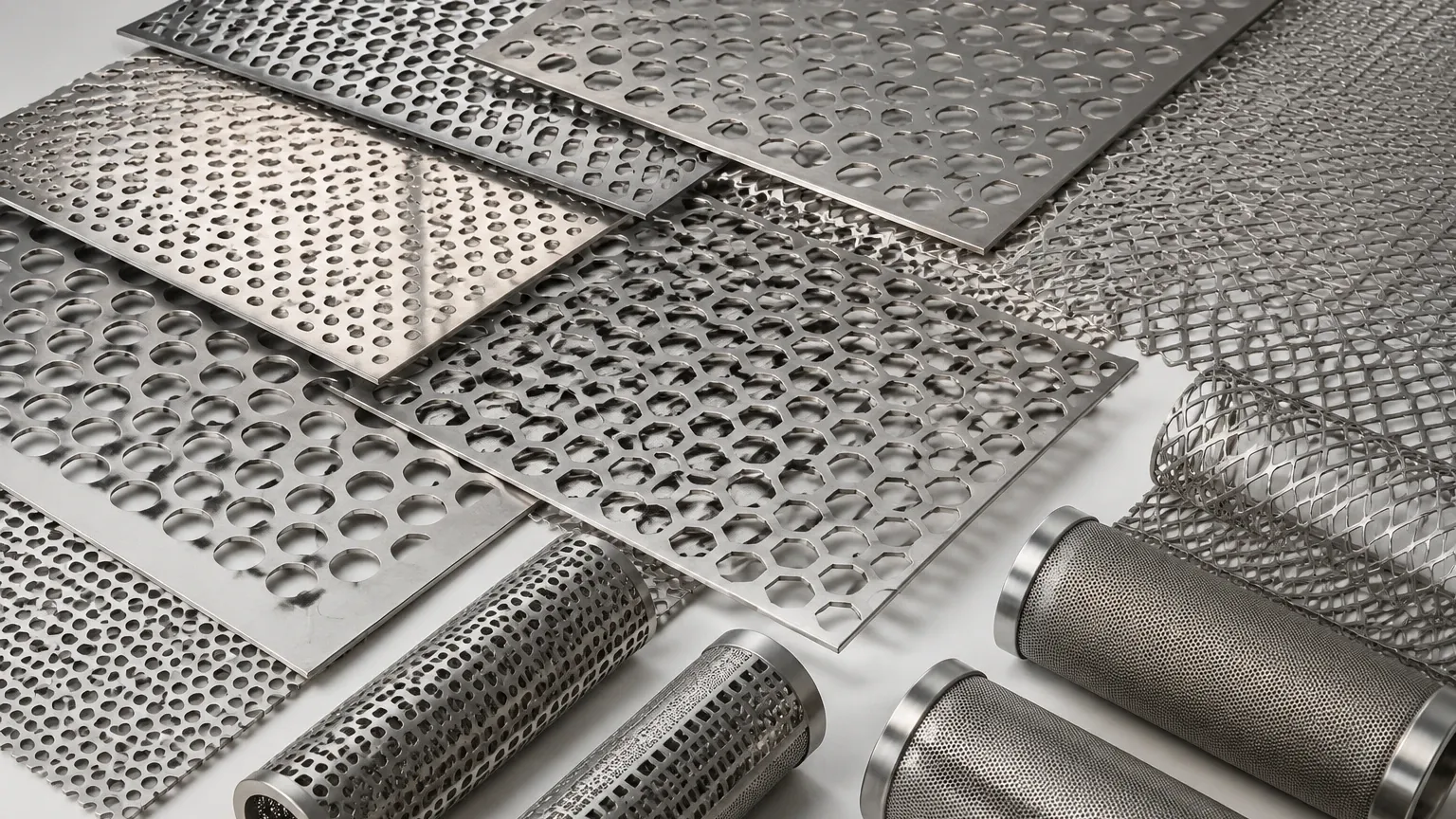
In industrial filtration and structural engineering, selecting the correct substrate is fundamental to the performance, longevity, and efficiency of a system. Perforated metal, a sheet or coil of material—typically stainless steel, carbon steel, or aluminum—that has been mechanically or laser-punched to create a pattern of holes, serves as a critical component in diverse sectors. From serving as the structural core of high-pressure filter cartridges to acting as a primary screen in chemical processing, the specific geometry and material of the perforation dictate the mechanical properties of the final product.
Understanding the various types of perforated metal requires an analysis of hole patterns, material grades, and manufacturing tolerances. For engineers and procurement teams, the choice is rarely about aesthetics; it is about flow rates, pressure drop calculations, and resistance to corrosive environments. This guide examines the technical specifications of perforated and expanded metal to support informed decision-making in industrial applications.
1. Common Hole Patterns and Their Engineering Implications
The geometry of the perforation is the primary factor determining the open area, which directly influences the filtration efficiency and structural integrity of the metal sheet. While custom patterns are available, most industrial applications rely on standardized configurations.
Round Hole Perforations
Round holes are the most versatile and widely used of all the types of perforated metal. They offer the best balance of structural strength and open area. Within this category, two main arrangements exist:
* 60-Degree Staggered: This is the industry standard for filtration. It provides the highest open area and uniform strength in all directions. The staggered alignment ensures that the material between the holes (the "bridges") is distributed evenly, minimizing the risk of tearing under high-pressure flow.
* Straight Line: In this configuration, holes are aligned both horizontally and vertically. While easier to manufacture for certain simple screening tasks, it generally offers lower structural stability than staggered patterns and is less common in high-performance filtration cores.
Square Hole Perforations
Square holes provide a significantly higher open area compared to round holes of the same width. This makes them ideal for applications requiring high airflow or high-volume liquid throughput where the particle size is relatively large. However, square holes create sharp corners that can act as stress concentration points, potentially leading to material fatigue if the sheet is subjected to constant vibration or mechanical stress.
Slotted Hole Perforations
Slotted or oblong perforations are specifically designed for sorting and sifting applications. In the context of industrial filtration, slotted holes are often used when the media contains elongated particles that need to be oriented in a specific direction for removal. These are frequently used in the food and beverage industry for grain processing or in chemical plants for solid-liquid separation.
Hexagonal (Honeycomb) Patterns
Hexagonal patterns offer the maximum possible open area (up to 80% or more) while maintaining a high strength-to-weight ratio. These are often utilized in specialized architectural filtration or in environments where weight reduction is as critical as airflow, such as in aerospace or high-end electronics cooling.
2. Material Selection for Industrial Filtration
The effectiveness of Perforated & Expanded Metal is heavily dependent on the alloy chosen. In industrial filtration, where exposure to chemicals, high temperatures, and high pressures is common, material selection is a primary engineering consideration.
* Stainless Steel (304, 316, 316L): This is the preferred material for the pharmaceutical, food and beverage, and chemical industries. Grade 304 offers excellent corrosion resistance for general use, while Grade 316 contains molybdenum, providing superior resistance to chlorides and pitting. 316L (low carbon) is often specified for components that require welding to prevent carbide precipitation.
* Carbon Steel: Used in hydraulic oil filtration and applications where the environment is non-corrosive or where the metal is protected by coatings. It offers high strength at a lower cost but is susceptible to oxidation if not properly treated.
* Aluminum: Chosen for its lightweight properties and natural resistance to atmospheric corrosion. It is commonly found in HVAC filtration and lightweight structural components.
3. Key Technical Specifications: Open Area and Pitch
When specifying types of perforated metal, engineers must focus on the "Open Area" percentage. This is the ratio of the area of the holes to the total area of the sheet. For a 60-degree staggered round hole pattern, the formula for calculating open area is:
Open Area % = (D² x 90.69) / P²
*(Where D = Hole Diameter and P = Pitch/Center-to-Center distance)*
A higher open area reduces the pressure drop across the filter but also reduces the mechanical strength of the sheet. Finding the "sweet spot" is essential for ensuring that a filter cartridge core can withstand the collapse pressure of a hydraulic system or the back-pulsing force in a self-cleaning filter system.
Margins and Blank Areas
In many OEM applications, perforated sheets are not perforated edge-to-edge. "Margins" are the solid areas around the edges of the sheet. Specifying margins is critical for welding the perforated metal into a cylinder or mounting it into a frame. Engineers should confirm:
* Side Margins: Solid strips along the length of the sheet.
* End Margins: Solid strips at the beginning and end of the sheet.
* No Margins: Perforations that run off the edge of the sheet (finished end patterns).
4. Perforated vs. Expanded Metal: Structural Differences
While often grouped together, perforated and expanded metals are manufactured through different processes, resulting in distinct physical properties.
Perforated Metal
Perforated metal is created by punching holes in a sheet. This process is highly precise, allowing for exact hole sizes and complex patterns. It maintains a flat surface and is easier to form into precise cylindrical shapes for filter cartridges. The main disadvantage is material waste, as the "slugs" punched out of the holes are removed (though usually recycled).
Expanded Metal
Expanded metal is produced by simultaneously slitting and stretching the material. This process creates diamond-shaped openings. Because no material is removed, it is often more cost-effective for large-scale structural applications. Expanded metal can be "raised" (standard) or "flattened."
* Raised Expanded Metal: Features strands that are turned at an angle to the plane of the sheet, providing excellent grip and structural rigidity.
* Flattened Expanded Metal: The sheet is passed through a cold-rolling reducing mill, resulting in a smooth, flat surface similar to perforated metal but with the characteristic diamond pattern.
In filtration, expanded metal is frequently used as a support wrap for pleated wire mesh or as a coarse pre-filter screen where high precision is less critical than cost and rigidity.
5. Manufacturing Considerations for OEM Solutions
When sourcing perforated components for industrial use, the manufacturing process's quality directly impacts the final assembly's performance. Professional manufacturers like Kaifil prioritize several post-perforation processes:
* Leveling: The punching process often introduces internal stresses that cause the metal sheet to bow or curl. Stretcher leveling or roller leveling is required to ensure the sheet is perfectly flat before it is formed into a filter component.
* Deburring: Punching creates sharp edges or "burrs" on the exit side of the hole. In filtration applications, these burrs can trap contaminants prematurely or damage delicate filter media (such as fine wire mesh or membranes) wrapped around the perforated core. Precision deburring is essential for high-quality filter cartridges.
* Degreasing: Lubricants used during the punching process must be thoroughly removed, especially for applications in the food, beverage, and pharmaceutical industries, to prevent contamination of the process fluid.
6. Applications in Industrial Filtration
The versatility of perforated metal allows it to function in multiple capacities within a filtration system:
1. Filter Cartridge Cores: Perforated stainless steel tubes provide the internal structural support for pleated or depth filter media. They must resist high differential pressures without collapsing.
2. Basket Strainers: Used in piping systems to remove large particulates. These typically use heavier gauge perforated metal with larger hole sizes to minimize flow restriction.
3. Diffusers: Perforated metal can be used to break up high-velocity fluid streams, ensuring even distribution across a secondary filter bed or catalyst.
4. Acoustic Damping: In some industrial exhaust systems, perforated metal is used to house sound-absorbing materials while allowing gas flow.
7. Procurement and Customization Checklist
Before finalizing a purchase order for perforated or expanded metal, technical teams should confirm the following parameters with their manufacturer:
* Hole Size and Shape: What is the required filtration rating or airflow?
* Pitch and Pattern: Staggered or straight? What is the required center-to-center distance?
* Material Grade: Is the alloy compatible with the chemical environment and temperature?
* Sheet Thickness (Gauge): Is it thick enough to handle the mechanical load but thin enough to be formed if necessary?
* Tolerances: What are the allowable variances in hole diameter and sheet dimensions?
* Secondary Operations: Does the part need to be rolled, welded, degreased, or electropolished?
By focusing on these technical boundaries, engineers can ensure that the selected types of perforated metal provide the necessary performance for their specific industrial application. Whether the goal is to optimize flow in a chemical reactor or to provide a durable support structure for a hydraulic filter, the precision of the perforation is the key to long-term operational success.
