


Ukuran Lubang Perforated Metal
In the landscape of industrial filtration and structural engineering, the specification of perforated materials is a critical factor that determines the efficiency, durability, and safety of a system. One of the most vital parameters in these specifications is the ukuran lubang perforated metal (hole size of perforated metal). Whether used as a primary filtration medium, a support structure for fine wire mesh, or a protective screen in heavy machinery, the dimensions and geometry of the perforations directly influence fluid dynamics, pressure drop, and mechanical strength.
Selecting the correct hole size requires a deep understanding of the application's technical requirements. For engineers and procurement teams, navigating the trade-offs between open area, material thickness, and filtration accuracy is essential to optimizing performance and minimizing the total cost of ownership.
Understanding the Importance of Ukuran Lubang Perforated Metal
The term "ukuran lubang perforated metal" refers to the diameter or dimensions of the openings punched into a metal sheet. In industrial filtration, this measurement is the primary determinant of the "cut point"—the size of the smallest particle that the metal sheet can reliably retain. Unlike woven wire mesh, which can achieve very fine filtration in the micron range, perforated metal is typically used for coarser filtration or as a robust substrate for finer media.
Filtration Precision and Particle Retention
In liquid and gas filtration, the hole size must be smaller than the particles intended for removal. However, selecting a hole size that is unnecessarily small can lead to premature clogging (blinding) and an excessive increase in differential pressure. Engineers must balance the need for precision with the requirement for high flow rates. When specifying Perforated & Expanded Metal, it is standard practice to choose a hole size that is approximately 20% to 30% smaller than the minimum particle size to be captured, accounting for the irregular shapes of industrial contaminants.
Impact on Flow Velocity and Pressure Drop
The size of the holes, combined with the spacing between them (pitch), determines the percentage of open area. A larger hole size generally allows for higher flow velocities and lower resistance. In hydraulic systems or high-volume chemical processing, maintaining a low pressure drop is crucial to reducing energy consumption and preventing pump cavitation. If the hole size is too restrictive, the system will require more power to push the medium through, leading to increased operational costs.
Common Hole Patterns and Geometries
While the size of the hole is paramount, the shape and arrangement of those holes significantly affect the structural integrity and performance of the filter component.
Round Holes: The Industrial Standard
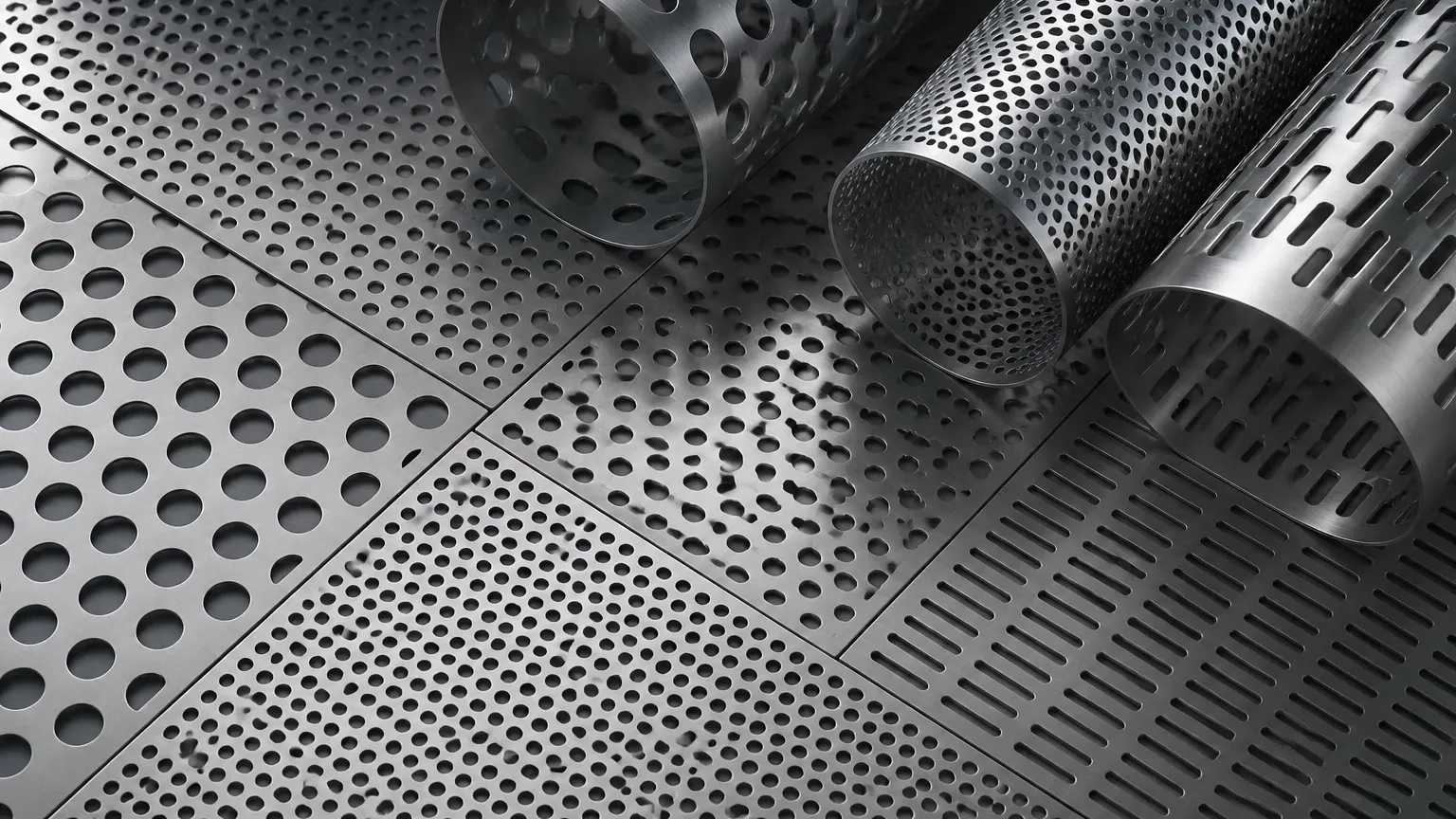
Round holes are the most common specification for perforated metal. They offer a high degree of structural strength and are the easiest to manufacture with high precision. In round hole patterns, the ukuran lubang perforated metal is defined by the diameter. These are typically arranged in a 60-degree staggered pattern, which provides the highest strength-to-weight ratio and the most uniform distribution of stress across the sheet.
Square and Slotted Holes
Square holes offer a higher open area compared to round holes of the same width, making them suitable for applications where maximum throughput is required. Slotted holes, often used in vibrating screens or grain processing, are defined by their length and width. These are particularly effective for filtering elongated particles or fibers that might pass through a round hole of the same width.
Expanded Metal Alternatives
While perforated metal involves punching material out of a sheet, expanded metal is created by slitting and stretching the material. This results in diamond-shaped openings. While the "hole size" in expanded metal is measured by the Long Way of the Diamond (LWD) and Short Way of the Diamond (SWD), it serves a similar purpose in providing a rigid, high-flow support structure for filtration cartridges.
Engineering Considerations: Open Area and Pitch
To accurately specify the ukuran lubang perforated metal, engineers must also calculate the "Open Area Percentage." This is the ratio of the area of the holes to the total area of the sheet.
The Relationship Between Hole Size and Pitch
The pitch is the distance from the center of one hole to the center of the adjacent hole. If the hole size remains constant but the pitch increases, the open area decreases, and the sheet becomes stronger. Conversely, a tighter pitch increases the open area but may compromise the structural integrity of the metal, making it prone to warping or tearing under high pressure.
Standard Calculation for 60-Degree Staggered Round Holes:
`Open Area % = (D² x 90.69) / P²`
*(Where D = Hole Diameter and P = Pitch)*
Understanding this formula allows technical professionals to determine if a specific hole size will meet the flow requirements of their application without sacrificing the durability of the filter cartridge or screen.
Material Selection for Perforated Filtration Components
The environment in which the perforated metal operates dictates the material choice. Because perforated metal is often used in demanding industrial settings, the material must resist corrosion, temperature fluctuations, and mechanical stress.
* Stainless Steel 304/304L: The most common choice for general industrial use, offering good corrosion resistance and excellent formability.
* Stainless Steel 316/316L: Preferred for chemical processing, marine environments, and pharmaceutical applications due to the addition of molybdenum, which enhances resistance to pitting and chloride corrosion.
* Specialty Alloys: For high-temperature or highly acidic environments, materials like Monel, Inconel, or Duplex stainless steel may be required to ensure the longevity of the perforated component.
Selecting the right material ensures that the ukuran lubang perforated metal remains consistent over time. Corrosion can enlarge holes or create jagged edges, which compromises filtration accuracy and can lead to downstream contamination.
Applications Across Key Industries
Perforated and expanded metals are versatile components used across various sectors. The specific hole size required varies significantly depending on the industry.
Chemical and Petrochemical Processing
In these industries, perforated metal often serves as a support basket for fine mesh liners or as internal components in reactor vessels. The hole size must be large enough to allow for the passage of viscous fluids but small enough to provide rigid support for the primary filter media under high-pressure differentials.
Food and Beverage Industry
Hygiene is the priority here. Perforated metal is used in juice extraction, dairy processing, and brewery lautering. The surfaces must be smooth (often electropolished) and the hole sizes precisely controlled to ensure effective separation of solids while allowing for thorough Clean-in-Place (CIP) procedures.
Water Treatment and Desalination
Large-scale water intake screens utilize perforated metal to prevent debris and aquatic life from entering the system. Here, the ukuran lubang perforated metal is often governed by local environmental regulations to protect small organisms, while also needing to withstand the corrosive nature of seawater.
Customization and Manufacturing Precision
At Kaifil, we recognize that off-the-shelf solutions rarely meet the exacting standards of specialized industrial processes. Customization is at the core of our manufacturing philosophy. When developing a filtration solution, we work closely with clients to define the optimal hole size, pattern, and material thickness.
OEM Capabilities
Our advanced manufacturing facilities allow us to produce perforated metal with precise tolerances. Whether you require a specific hole diameter for a custom hydraulic filter or a unique staggered pattern for a pharmaceutical centrifuge, our engineering team provides technical guidance to ensure the final product meets your performance expectations.
Precision Metal Filter Components
Beyond simple sheets, we specialize in forming perforated metal into complex shapes, such as cylindrical filter cartridges, conical strainers, and multi-layered filter assemblies. By integrating perforated metal with fine wire mesh, we create composite filters that offer both the high-strength benefits of perforated sheets and the fine filtration capabilities of stainless steel mesh.
Maintenance, Replacement, and Total Cost Considerations
While perforated metal is inherently durable, it is not immune to wear. Over time, abrasive particles can erode the edges of the holes, effectively changing the ukuran lubang perforated metal and reducing filtration efficiency.
Monitoring Performance
Engineers should monitor the pressure drop across the filter. A sudden decrease in pressure drop may indicate that the holes have enlarged or that the media has been breached. Conversely, a persistent high pressure drop that cannot be resolved through cleaning indicates that the holes are permanently blinded or scaled.
Cleaning Methods
Stainless steel perforated components can often be cleaned using ultrasonic baths, high-pressure water jets, or chemical solvents. The durability of the material allows for multiple cleaning cycles, which significantly reduces the total cost of ownership compared to disposable filter elements.
Conclusion: Selecting the Right Partner for Filtration Solutions
Choosing the correct ukuran lubang perforated metal is a technical decision that impacts the entire production line. It requires a balance of fluid dynamics, material science, and mechanical engineering. By understanding the relationship between hole size, open area, and structural strength, purchasing teams can make informed decisions that enhance system reliability.
Kaifil provides the expertise and manufacturing depth required to deliver high-performance filtration components. From initial material selection to the final customized design, we ensure that every perforated and expanded metal product we manufacture meets the rigorous demands of your specific industrial application.
For more information on our technical capabilities and to explore our range of custom filtration solutions, we invite you to Review product options and application support and consult with our engineering team for your next project.
