


Vital Expanded Metal
In industrial filtration and structural engineering, the integrity of a system often depends on the components that provide both permeability and mechanical strength. Expanded metal is a versatile material produced by simultaneously slitting and stretching a solid metal sheet, creating a diamond-shaped pattern of openings. Unlike woven wire or perforated sheets, expanded metal is a single-piece construction without joins or welds. This unique structure makes it a vital expanded metal solution for applications requiring high strength-to-weight ratios, such as support cores for filter cartridges, protective grilles, and heavy-duty industrial strainers.
For engineers and procurement teams, understanding the technical nuances of Perforated & Expanded Metal is essential for optimizing system performance and longevity. This guide examines the engineering fundamentals, material considerations, and application-specific selection criteria for expanded metal in industrial environments.
Engineering Fundamentals of Expanded Metal
The manufacturing process of expanded metal is inherently efficient, as it produces no scrap material. A metal plate or coil is fed through a machine equipped with a reciprocating knife that slits the metal while a stretching mechanism pulls the material outward. This process creates a series of interconnected strands and bonds.
Key Terminology and Measurements
To specify expanded metal accurately, engineers must use standardized terminology to describe the geometry of the mesh:
* Long Way of the Diamond (LWD): The distance from a point on one diamond to the corresponding point on the next diamond, measured across the long axis.
* Short Way of the Diamond (SWD): The distance measured across the short axis of the diamond.
* Long Way of the Opening (LWO): The internal dimension of the diamond across the long axis.
* Short Way of the Opening (SWO): The internal dimension across the short axis.
* Strand Width: The amount of metal fed into the knives between each stroke.
* Strand Thickness: The original thickness of the base metal sheet.
* Bond: The intersection where two strands meet, forming a solid connection.
Raised vs. Flattened Expanded Metal
There are two primary forms of expanded metal used in industrial applications:
1. Standard (Raised) Expanded Metal: This is the product as it comes off the expanding machine. The strands and bonds are set at a uniform angle to the plane of the sheet, providing extra strength and rigidity. This form is often used in filtration for its high surface area and ability to disrupt flow, which can be beneficial in certain mixing or pre-filtration stages.
2. Flattened Expanded Metal: Standard expanded metal is passed through a cold-roll reducing mill to flatten the strands and bonds. This results in a smooth, level surface. Flattened metal is preferred when the component must be integrated into a tight assembly, such as an inner support core for a pleated filter cartridge, where a smooth surface prevents damage to the delicate filter media.
Material Selection for Demanding Environments
The performance of vital expanded metal components is heavily influenced by the choice of alloy. In the B2B sector, where chemical processing, food production, and pharmaceutical manufacturing are common, material compatibility is paramount.
Stainless Steel Alloys
Stainless steel is the most common choice for industrial filtration due to its corrosion resistance and mechanical properties.
* Grade 304: Suitable for general industrial applications where moderate corrosion resistance is required. It is commonly used in water treatment and food processing equipment.
* Grade 316/316L: Contains molybdenum, which provides superior resistance to chlorides and pitting. This is essential for chemical processing and marine environments. The "L" (low carbon) version is preferred for components that require extensive welding to prevent carbide precipitation.
* Specialty Alloys: For extreme environments involving high temperatures or highly aggressive chemicals, alloys such as Monel, Inconel, or Duplex stainless steel can be expanded to meet specific durability requirements.
Aluminum and Carbon Steel
While stainless steel is the standard for high-purity applications, aluminum is frequently used in aerospace and HVAC filtration due to its lightweight and natural oxidation resistance. Carbon steel, often galvanized or powder-coated, serves as a cost-effective solution for structural supports or protective guards in non-corrosive environments.
The Role of Expanded Metal in Filtration Systems
In the context of industrial filtration, expanded metal serves two primary functions: as a structural support and as a primary filtration medium for coarse particles.
Structural Support Cores
One of the most critical uses of expanded metal is as the internal or external support core for filter cartridges. High-pressure hydraulic systems or high-viscosity chemical flows exert significant force on filter media. Without a robust support structure, the media can collapse, leading to bypass or system failure.
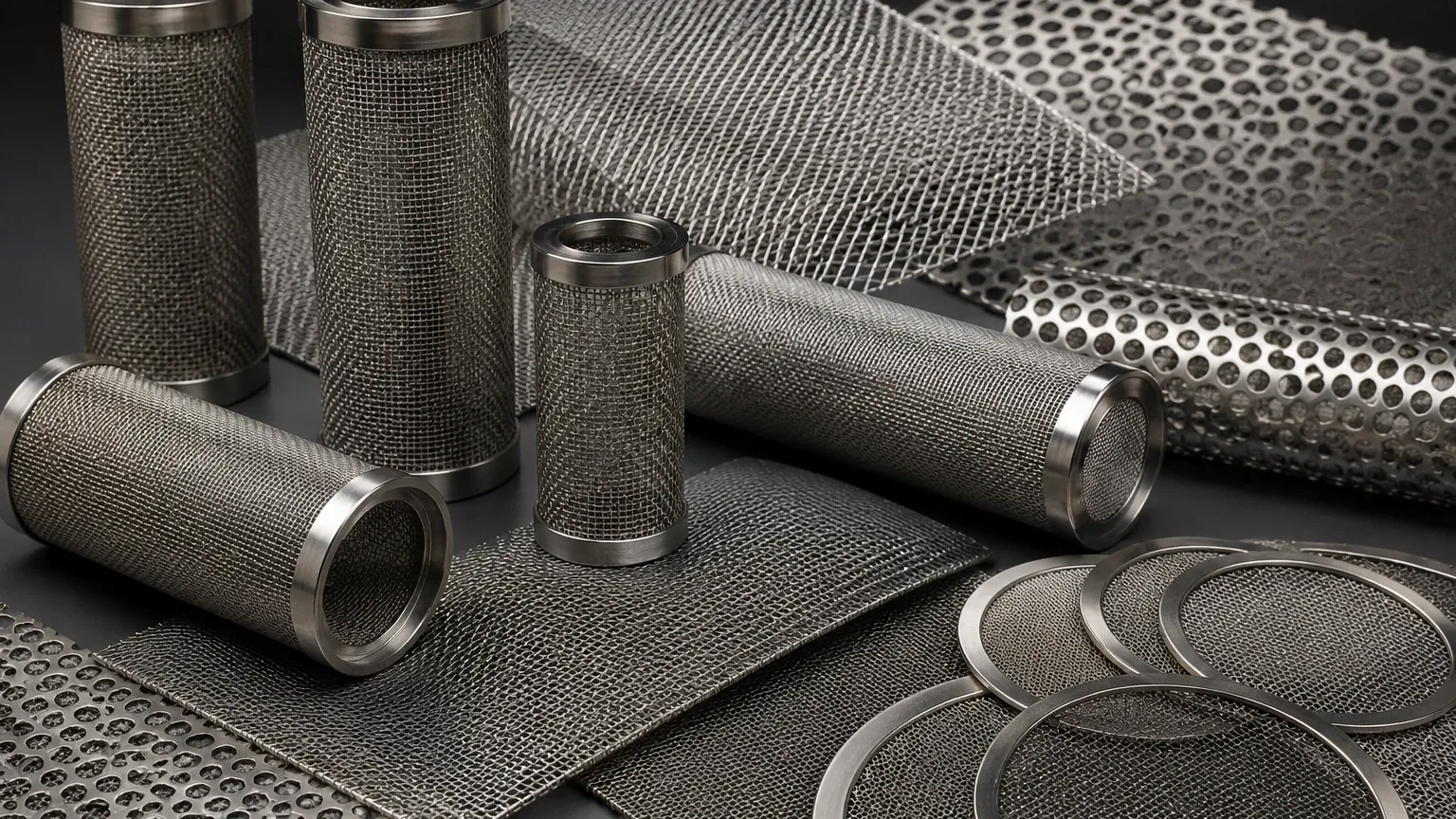
Expanded metal is often rolled into cylinders and welded to form these cores. Its high open area ensures minimal pressure drop, while the interconnected diamond structure provides the hoop strength necessary to withstand high differential pressures. By utilizing vital expanded metal as a core, manufacturers can ensure that the filter maintains its geometric integrity throughout its service life.
Pre-Filtration and Strainers
In applications involving large debris, such as raw water intake or industrial wastewater treatment, expanded metal acts as a primary strainer. The diamond pattern is effective at catching elongated particles that might pass through circular perforations of a similar size. The rigidity of the raised expanded metal also makes it suitable for vibrating screens or baskets used in dewatering processes.
Comparing Perforated and Expanded Metal
Engineers often face a choice between perforated metal and expanded metal. While both provide open area and structural support, their physical characteristics differ significantly.
| Feature | Expanded Metal | Perforated Metal |
| :— | :— | :— |
| Manufacturing Waste | Zero waste (stretched) | Significant waste (slugs from holes) |
| Strength-to-Weight | Very high due to continuous strands | Moderate to high |
| Surface Texture | Naturally textured (raised) or smooth (flattened) | Smooth |
| Cost | Generally lower for large open areas | Higher due to material waste and tooling |
| Flow Characteristics | Turbulent (raised) or linear (flattened) | Primarily linear |
Expanded metal is typically more cost-effective when high open area is required because the expansion process increases the surface area of the original sheet without adding weight or wasting material. However, perforated metal offers more precise control over hole geometry and spacing, which may be necessary for specific filtration ratings.
Performance Evaluation and Selection Criteria
When specifying expanded metal for a project, several engineering factors must be evaluated to ensure the component meets the application's demands.
1. Open Area Percentage
The open area determines the flow rate and pressure drop across the metal. In filtration, a higher open area is generally preferred to minimize energy consumption and maximize throughput. However, there is a trade-off: as the open area increases, the mechanical strength of the sheet decreases. Engineers must calculate the optimal balance based on the expected flow velocity and pressure spikes.
2. Mechanical Strength and Rigidity
The orientation of the diamonds affects the strength of the component. Expanded metal is significantly stronger when the load is applied across the Short Way of the Diamond (SWD). For cylindrical filter cores, the LWD is typically oriented around the circumference to maximize crush resistance.
3. Chemical and Thermal Compatibility
In chemical processing, the expanded metal must withstand the pH levels and temperatures of the process fluid. Stainless steel 316L is often the baseline, but the presence of certain acids or bases may require more exotic materials. Furthermore, the expansion process can introduce internal stresses; in high-temperature applications, these stresses must be considered to prevent warping or stress-corrosion cracking.
4. Fabrication Requirements
Consider how the expanded metal will be integrated into the final product. Will it be welded, formed, or framed? Flattened expanded metal is easier to weld to end caps or frames, while raised expanded metal may require specialized welding techniques to ensure a secure bond at the angled contact points.
Maintenance and Replacement Cycles
While expanded metal is highly durable, it is not immune to wear, especially in abrasive or corrosive environments. Regular inspection of the vital expanded metal components is necessary to identify signs of:
* Erosion: High-velocity fluids containing solids can wear down the strands over time, reducing the structural integrity.
* Corrosion: Pitting or rust on the bonds can lead to catastrophic failure under pressure.
* Fouling: In some applications, the diamond intersections can trap debris that is difficult to remove through backwashing, necessitating chemical cleaning or replacement.
In filtration systems, the replacement cycle of the expanded metal core is usually much longer than that of the filter media itself. However, if the core shows signs of deformation (bowing or crushing), it must be replaced immediately to prevent damage to the rest of the system.
Customization and OEM Integration
Every industrial application has unique requirements regarding filtration accuracy, flow dynamics, and spatial constraints. Standard off-the-shelf expanded metal may not always provide the optimal solution. Customization allows engineers to specify the exact strand width, opening size, and material grade needed for their specific equipment.
Kaifil specializes in providing these customized solutions, working closely with global customers to develop high-performance filtration components. From selecting the appropriate stainless steel grade to designing the precise diamond geometry for a support core, custom manufacturing ensures that the vital expanded metal component integrates seamlessly into the OEM equipment.
When consulting with a manufacturer, engineers should provide the following data points to ensure an accurate quote and design:
* Fluid type and chemical concentration.
* Operating temperature and pressure.
* Required open area percentage.
* Dimensional tolerances for the final assembly.
* Preferred finishing (e.g., pickling, passivating, or electropolishing).
Conclusion
Expanded metal is a fundamental component in modern industrial filtration and structural design. Its ability to provide significant mechanical strength while maintaining a high open area makes it an indispensable material for support cores, strainers, and protective screens. By understanding the differences between raised and flattened varieties, the importance of material selection, and the mechanical advantages of the diamond structure, technical professionals can make informed decisions that improve the efficiency and reliability of their systems.
Whether you are designing a new chemical processing unit or optimizing a hydraulic filtration system, selecting the right Perforated & Expanded Metal is a critical step in ensuring long-term operational success.
