


Wire Mesh Expanded Metal
In industrial filtration and structural engineering, the term "wire mesh expanded metal" often describes a specific category of materials that bridge the gap between traditional woven wire cloth and rigid perforated plates. While technically distinct from woven products, expanded metal serves many of the same functions in filtration systems, offering unique mechanical advantages due to its manufacturing process and monolithic structure. For engineers and procurement professionals, understanding the technical nuances of this material is essential for optimizing filtration efficiency, structural integrity, and long-term cost-effectiveness.
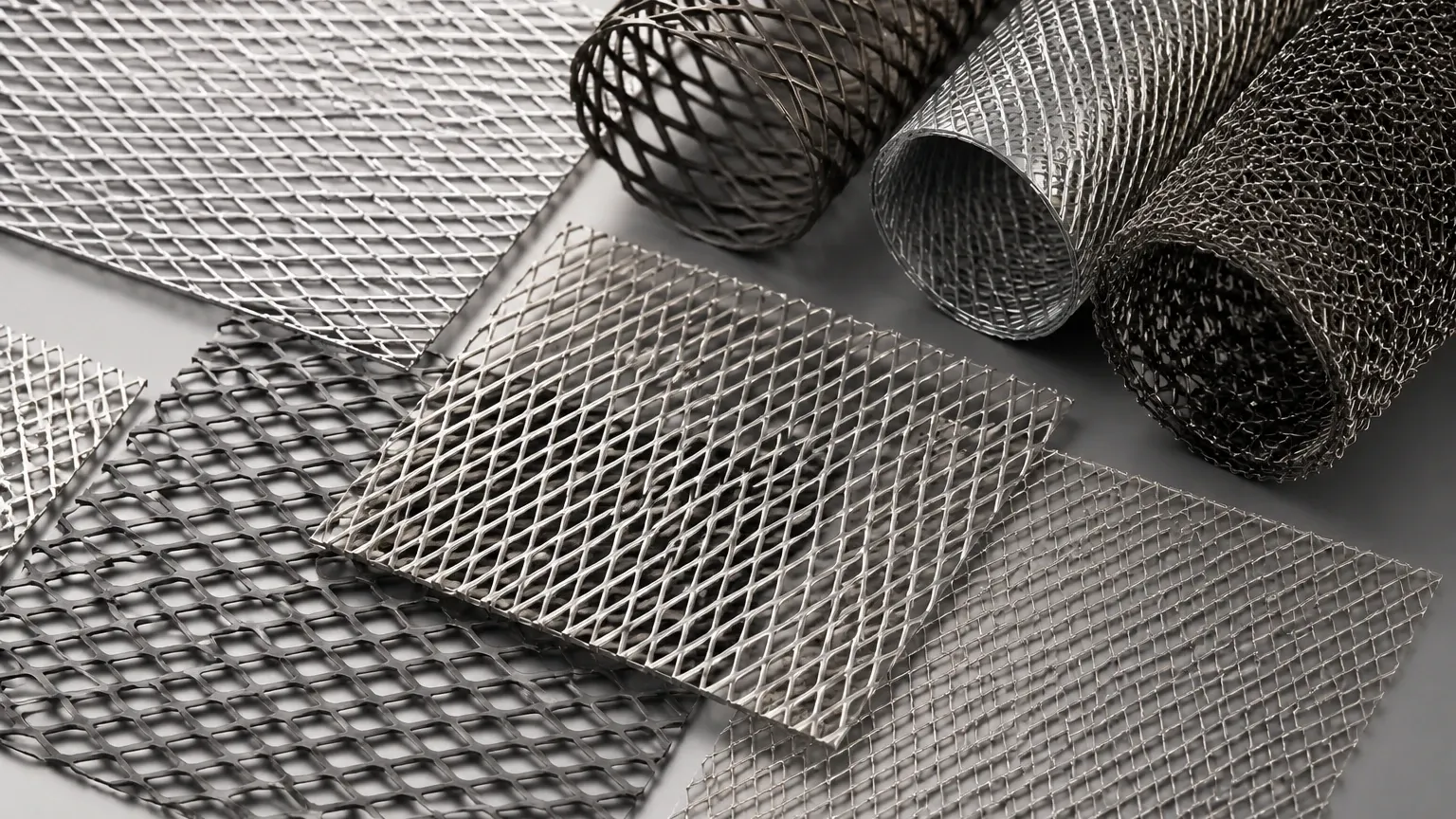
At its core, expanded metal is produced by simultaneously slitting and stretching a solid metal sheet. This process creates a diamond-shaped pattern of openings, where the "strands" and "bonds" (the intersections of the strands) are part of a single, continuous piece of metal. Unlike woven wire mesh, there are no intersecting wires that can shift or fray, and unlike perforated metal, there is virtually no material waste during production. This makes Perforated & Expanded Metal a critical component in demanding industrial environments where durability and precision are paramount.
Manufacturing Process and Structural Integrity
The production of wire mesh expanded metal is a cold-working process. A metal sheet or coil is fed through a machine equipped with a specialized knife. As the knife descends, it slits the metal and simultaneously stretches it outward. The result is a mesh-like structure with raised strands. If a flat surface is required, the expanded metal can undergo a secondary process known as "flattening," where it is passed through a cold-roll reducing mill to level the strands into the same plane as the original sheet.
From an engineering perspective, the structural integrity of expanded metal is one of its most significant benefits. Because the material is not woven or welded, it maintains its shape even when cut into irregular sizes. The bonds between the diamonds are the strongest points of the mesh, providing excellent resistance to mechanical stress and pressure. In filtration applications, this rigidity is vital for maintaining the geometry of the filter element under high flow rates or differential pressures.
Technical Specifications and Geometry
To specify wire mesh expanded metal accurately, engineers must utilize a standardized set of measurements. These parameters dictate the flow characteristics, filtration rating, and mechanical strength of the component:
* LWD (Long Way of Diamond): The distance from the center of one bond to the center of the next bond across the long axis of the diamond.
* SWD (Short Way of Diamond): The distance from the center of one bond to the center of the next bond across the short axis of the diamond.
* Strand Width: The amount of metal fed into the machine for each slit.
* Strand Thickness: The thickness of the original base metal.
* Overall Thickness: In "raised" or "standard" expanded metal, this is the total thickness of the mesh from the top of the strand to the bottom. In flattened expanded metal, this is roughly equivalent to the strand thickness.
* Open Area: Expressed as a percentage, this indicates the ratio of the openings to the total area of the sheet. This is a critical calculation for determining pressure drop across a filter.
Choosing the correct geometry involves balancing the need for high flow rates (larger open area) with the requirement for mechanical support or particle retention (smaller openings and thicker strands).
Material Selection for Industrial Environments
The performance of wire mesh expanded metal is heavily dependent on the alloy used. As a manufacturer specializing in stainless steel filtration solutions, Kaifil emphasizes the use of high-grade alloys to ensure longevity in corrosive or high-temperature environments.
Stainless Steel 304 and 304L
Grade 304 is the most common stainless steel used in industrial filtration. It offers good corrosion resistance and is suitable for most food processing, chemical, and general industrial applications. The "L" variant (304L) is used when welding is required, as its lower carbon content prevents carbide precipitation in the heat-affected zone.
Stainless Steel 316 and 316L
For more aggressive environments, such as marine applications or processes involving chlorides and acids, Grade 316 is preferred. The addition of molybdenum enhances pitting resistance. Grade 316L is the standard for pharmaceutical and high-purity chemical filtration due to its superior corrosion resistance and weldability.
Specialty Alloys
In extreme cases involving high temperatures or highly oxidizing acids, materials like Monel, Inconel, or Titanium may be used. These alloys ensure that the expanded metal structure does not degrade, which could otherwise lead to media migration and downstream contamination.
Applications in Filtration and Support
Wire mesh expanded metal is rarely used as the primary filtration medium for fine particles. Instead, it serves critical roles in the architecture of complex filtration systems:
1. Support Cores and Cages
In stainless steel filter cartridges, expanded metal often serves as the inner core or outer cage. It provides the necessary burst or collapse strength to protect finer, more delicate filter media (such as sintered mesh or fiber felt) from the forces of fluid flow. Its rigid structure ensures that the filter maintains its shape even during backwashing or high-pressure cycles.
2. Pleat Support
In pleated filter designs, expanded metal can be used as a support layer between the pleats. This prevents the pleats from pinching shut under pressure, ensuring that the entire surface area of the filter remains available for fluid processing. The angled strands of raised expanded metal can also help create turbulence, which may reduce the buildup of a filter cake in certain applications.
3. Pre-Filtration and Coarse Screening
For applications involving large debris—such as water intake screens or heavy-duty hydraulic suction filters—expanded metal acts as an effective pre-filter. It protects downstream pumps and fine filters from damage by capturing large solids, wood chips, or stones.
4. Mist Eliminators and Coalescers
In gas-liquid separation, layers of wire mesh expanded metal are used to capture fine droplets. The tortuous path created by the overlapping diamonds encourages droplets to collide, coalesce into larger drops, and eventually drain away from the gas stream.
Comparing Expanded Metal to Woven Wire Mesh
When selecting a mesh product, engineers often compare expanded metal with woven wire mesh. Each has its place in industrial design:
* Structural Stability: Expanded metal is superior in terms of rigidity. Woven mesh can experience "wire shift" if not properly secured, which changes the pore size. Expanded metal’s fixed geometry prevents this.
* Weight-to-Strength Ratio: Expanded metal is often lighter than a solid plate of the same strength, and because it is made from a single sheet, it can be stronger than woven mesh of a similar weight.
* Cost: Because the expansion process involves no material waste (unlike perforation) and is generally faster than weaving, expanded metal can be a more cost-effective solution for large-scale structural support.
* Filtration Precision: Woven wire mesh can achieve much finer filtration ratings (down to microns). Expanded metal is generally limited to coarser filtration or support roles.
Selection Criteria: Questions for Engineers
Before finalizing a specification for wire mesh expanded metal, technical teams should evaluate the following factors to ensure the component meets the application's demands:
1. What is the maximum differential pressure? This determines the required strand thickness and the choice between raised or flattened mesh. Raised mesh generally offers higher rigidity.
2. What are the chemical properties of the fluid? This dictates the alloy choice. For example, 316L is necessary for many pharmaceutical processes to prevent metallic leaching.
3. Is the flow laminar or turbulent? The orientation of the diamonds (LWD vs. SWD) relative to the flow direction can influence pressure drop and turbulence.
4. Will the filter be cleaned or replaced? Stainless steel expanded metal is highly durable and can withstand ultrasonic cleaning or chemical baths, making it a better long-term investment than disposable plastic or lower-grade metal supports.
5. What are the dimensional tolerances? Custom manufacturing allows for precise sizing, which is critical for ensuring a bypass-free fit in filter housings.
Customization and OEM Solutions
Industrial filtration requirements are rarely "one size fits all." Customization is often necessary to achieve the desired balance of flow, strength, and filtration efficiency. Kaifil provides extensive OEM capabilities, allowing for the production of expanded metal components tailored to specific dimensions, material grades, and diamond patterns.
Whether the application requires a small, precision-cut disc for a hydraulic valve or a large-diameter support cylinder for a chemical reactor, the focus remains on manufacturing accuracy. Advanced cutting, rolling, and welding techniques ensure that the final expanded metal product integrates seamlessly into the larger filtration assembly.
In conclusion, wire mesh expanded metal is a versatile and robust material that plays a vital role in modern industrial filtration. By understanding the mechanical properties and manufacturing variables of Perforated & Expanded Metal, engineers can design more reliable, efficient, and durable systems. For professionals seeking to optimize their filtration processes, focusing on material quality and precise geometric specifications is the most effective path toward reducing total cost of ownership and ensuring operational success.
