


X344 Expanded Metal
In the landscape of industrial filtration and structural support, material selection is dictated by the balance between mechanical integrity and fluid dynamics. Among the various geometries available in the Perforated & Expanded Metal category, x344 expanded metal stands out as a high-utility specification. Often utilized as a support substrate or a protective outer layer for delicate filter media, this specific expanded metal configuration offers a unique set of technical characteristics that engineers must evaluate before integration into a filtration system.
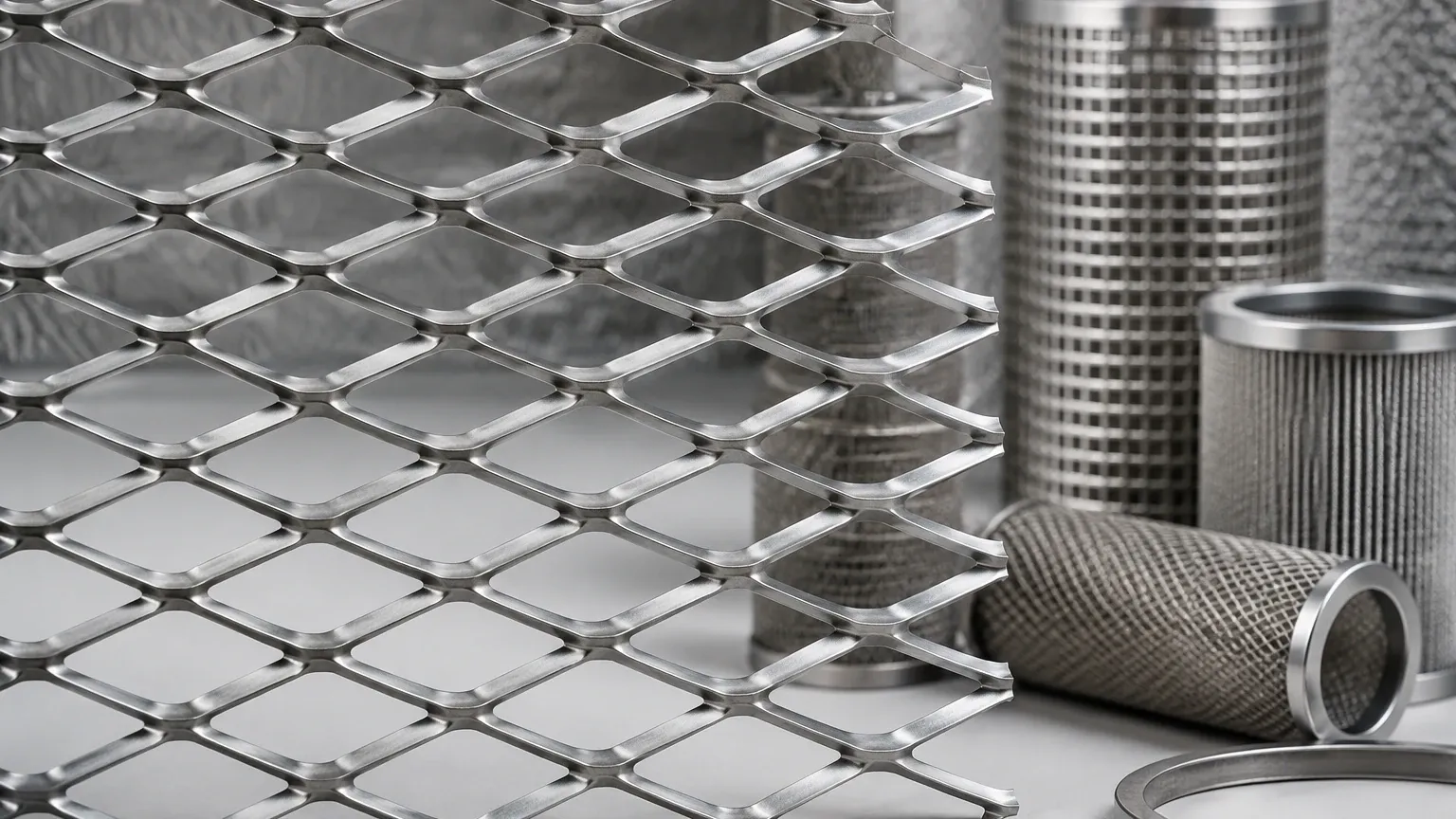
Expanded metal is manufactured by simultaneously slitting and stretching a solid metal sheet, creating a continuous mesh of diamond-shaped openings. Unlike woven wire mesh, expanded metal has no joins or welds within the mesh structure itself, providing inherent structural stability. The "x344" designation typically refers to a specific diamond size and gauge—specifically a 3/4-inch nominal diamond size in a flattened state—making it a robust choice for heavy-duty industrial applications.
Technical Specifications and Geometry of X344
To specify x344 expanded metal accurately, engineers must understand the four primary dimensions that define its performance: Long Way of Diamond (LWD), Short Way of Diamond (SWD), Strand Width, and Strand Thickness.
For a standard x344 expanded metal profile, the LWD usually measures approximately 2.0 to 2.1 inches, while the SWD is roughly 0.9 to 1.0 inches. However, the "3/4" in the designation refers to the nominal width of the diamond before the expansion process or the center-to-center distance of the bridges.
One of the most critical distinctions for x344 is whether it is "Raised" (Standard) or "Flattened."
1. Raised Expanded Metal: The strands are turned at an angle to the plane of the sheet. This provides maximum rigidity and a high-friction surface, which is excellent for walkways or heavy-duty guards but may create turbulent flow or uneven pressure points in filtration applications.
2. Flattened Expanded Metal (X-Designation): The raised mesh is passed through a cold-rolling flattening mill. This reduces the thickness of the sheet and creates a smooth, level surface. For filtration, flattened x344 expanded metal is often preferred because it provides a uniform contact surface for wire mesh or filter paper, preventing the media from being punctured or abraded under high pressure.
Material Selection for Corrosive Environments
While expanded metal can be produced from carbon steel or aluminum, industrial filtration solutions—particularly those handled by manufacturers like Kaifil—focus heavily on stainless steel. The chemical and physical properties of the base material are just as important as the x344 geometry.
Stainless Steel 304
SS304 is the standard choice for general industrial applications. It offers excellent formability and weldability, which is essential when rolling x344 expanded metal into cylindrical filter cores. It provides sufficient corrosion resistance for water treatment and many food and beverage applications.
Stainless Steel 316L
For chemical processing, pharmaceutical manufacturing, or marine environments, SS316L is the preferred specification. The addition of molybdenum enhances resistance to pitting and crevice corrosion in chloride-rich environments. In high-temperature filtration, 316L maintains better structural integrity over long-term thermal cycles.
The Role of X344 in Industrial Filtration Systems
In a complex filtration assembly, x344 expanded metal rarely acts as the primary filter medium. Instead, it serves as the "backbone" of the filter element. Its role can be categorized into three main functions:
1. Internal Support Cores
High-efficiency filter media, such as fine wire mesh or sintered metal fibers, lack the structural strength to withstand high differential pressures. An x344 expanded metal cylinder placed inside the filter provides the necessary hoop strength to prevent the media from collapsing inward as the pressure drop increases across the filter element.
2. Outer Protective Guards
In hydraulic systems or high-flow liquid processing, filter elements are susceptible to damage during installation or from large debris in the fluid stream. An outer wrap of x344 expanded metal protects the pleated or wrapped media from mechanical impact without significantly impeding the flow of the fluid.
3. Pleat Separation
In pleated filter designs, expanded metal can be used as a spacer. By maintaining uniform gaps between pleats, it ensures that the entire surface area of the filter media is utilized, preventing "pleat blinding" where the folds of the filter press together and restrict flow.
Engineering Considerations: Flow Resistance and Open Area
When selecting x344 expanded metal, engineers must calculate the percentage of open area to ensure it does not become a bottleneck in the system. The open area of x344 typically ranges between 60% and 75%, depending on the specific strand width and whether it has been flattened.
From a fluid dynamics perspective, the diamond-shaped openings of expanded metal create a different flow profile than circular perforated holes. While perforated metal offers a more predictable flow coefficient, expanded metal provides a higher strength-to-weight ratio. For a given open area, x344 is often lighter and more cost-effective than a perforated sheet of equivalent strength. However, engineers must account for the slight increase in turbulence caused by the strand edges, especially in high-velocity gas filtration.
Durability and Total Cost of Ownership (TCO)
In B2B procurement, the initial purchase price of a filter component is only one part of the equation. The durability of x344 expanded metal contributes significantly to reducing the Total Cost of Ownership.
* Resistance to Fatigue: Because expanded metal is a single piece of material without welds, it handles vibration and pressure pulsations better than woven or welded meshes. This reduces the risk of structural failure and subsequent downstream contamination.
* Cleanability: Stainless steel x344 components are highly resistant to the harsh chemicals used in Clean-in-Place (CIP) cycles. The smooth surface of flattened expanded metal allows for easier removal of accumulated cake or debris during backwashing.
* Longevity: A well-specified stainless steel support core can often outlast multiple replacements of the primary filter media, allowing for a modular design where only the mesh or paper is replaced while the expanded metal core is reused.
Common Risks and Quality Control
Not all x344 expanded metal is manufactured to the same tolerances. When sourcing these components for precision filtration, several risks must be mitigated:
* Burrs and Sharp Edges: During the slitting process, small metal burrs can form on the edges of the strands. If not properly deburred or smoothed during the flattening process, these burrs can migrate into the fluid stream or damage the primary filter media.
* Dimensional Inconsistency: Variations in the expansion ratio can lead to inconsistent diamond sizes, which affects the open area and structural uniformity. This is particularly problematic when the metal is rolled into cylinders for filter cartridges.
* Material Certification: In industries like pharmaceuticals or food processing, material traceability is non-negotiable. It is vital to confirm that the supplier provides mill test reports (MTRs) to verify the chemical composition of the stainless steel.
Procurement Guidance: What to Confirm with Manufacturers
Before finalizing a purchase order for x344 expanded metal or integrated filter components, purchasing teams and engineers should confirm the following technical details with a manufacturer like Kaifil:
1. Flattening Requirements: Explicitly state if the application requires flattened (X) or raised (S) metal. For most filtration support roles, flattened is the standard.
2. Direction of the Diamond: In cylindrical filters, the orientation of the LWD (Long Way of Diamond) relative to the axis of the cylinder affects the ease of rolling and the final strength. Usually, the LWD runs parallel to the width of the sheet for easier rolling.
3. Edge Configuration: Specify whether the sheets should have "random sheared" edges or "bond sheared" edges. Bond shearing provides a finished edge that is easier to weld and safer to handle.
4. Secondary Processing: Determine if the component requires additional treatments such as ultrasonic cleaning, passivation (to enhance corrosion resistance), or electropolishing (for high-purity applications).
By focusing on these technical boundaries, engineers can ensure that the x344 expanded metal they integrate into their systems provides the necessary balance of support, durability, and flow efficiency. Whether used in chemical reactors, hydraulic systems, or large-scale water treatment plants, the correct application of this material is a cornerstone of reliable industrial filtration.
