


Yellow Perforated Metal
In industrial engineering and facility management, the selection of materials often extends beyond mechanical properties to include functional visibility and environmental integration. Yellow perforated metal is a specialized material solution that combines the structural benefits of precision-engineered metal sheets with high-visibility finishes. Whether utilized for safety guarding, architectural accents, or specific identification in complex filtration systems, understanding the technical nuances of this material is essential for procurement and engineering teams.
As a core component of Perforated & Expanded Metal product lines, yellow-finished components serve critical roles in sectors ranging from chemical processing to heavy machinery manufacturing. This guide examines the technical specifications, coating technologies, and engineering considerations required to successfully integrate yellow perforated metal into industrial applications.
The Role of Color and Coating in Industrial Perforated Metal
The "yellow" in yellow perforated metal typically refers to a secondary finish applied to a base substrate such as carbon steel, aluminum, or occasionally stainless steel. While some alloys like brass or bronze possess a natural yellow-gold hue, industrial applications usually rely on high-performance coatings for specific functional reasons.
Safety and Visibility (OSHA Compliance)
In industrial environments, yellow is the universal color for caution. Perforated metal used in machine guards, handrails, or protective barriers is often finished in safety yellow (such as RAL 1003 or RAL 1023) to alert personnel to potential hazards. The perforation allows for airflow and visibility of the internal machinery while the color provides a clear visual boundary.
Identification and Zoning
In large-scale filtration or fluid handling systems, color-coding components can streamline maintenance. Yellow perforated metal may be specified to identify specific filtration stages, chemical lines, or pressure zones, reducing the risk of human error during replacement cycles or system audits.
Aesthetic and Architectural Integration
Beyond safety, yellow finishes are frequently used in architectural applications for sunscreens, acoustic panels, and decorative facades. The combination of the hole pattern and the vibrant finish allows for unique light diffusion and visual depth.
Material Substrates for Yellow Perforated Metal
Before a finish is applied, the choice of base material is the most critical factor in determining the component's longevity and structural integrity. At Kaifil, we emphasize matching the substrate to the operating environment.
1. Carbon Steel: The most common substrate for yellow perforated metal due to its cost-effectiveness and structural strength. It requires a robust coating (like powder coating) to prevent corrosion.
2. Aluminum: Preferred for applications requiring a lightweight solution or superior corrosion resistance in humid environments. Aluminum takes powder coatings exceptionally well and is ideal for architectural use.
3. Stainless Steel: While stainless steel is typically chosen for its natural finish and extreme corrosion resistance, it can be coated for specific high-visibility requirements in pharmaceutical or food processing environments where chemical exposure is a concern.
4. Brass and Bronze: These materials are naturally "yellow." While more expensive than coated steel, they are used in specialized filtration and decorative applications where the material's natural antimicrobial properties or non-sparking characteristics are required.
Technical Specifications: Hole Patterns and Open Area
The performance of yellow perforated metal is defined by its geometry. Engineers must calculate the "open area" to ensure the material meets airflow, light transmission, or filtration requirements.
Common Hole Patterns
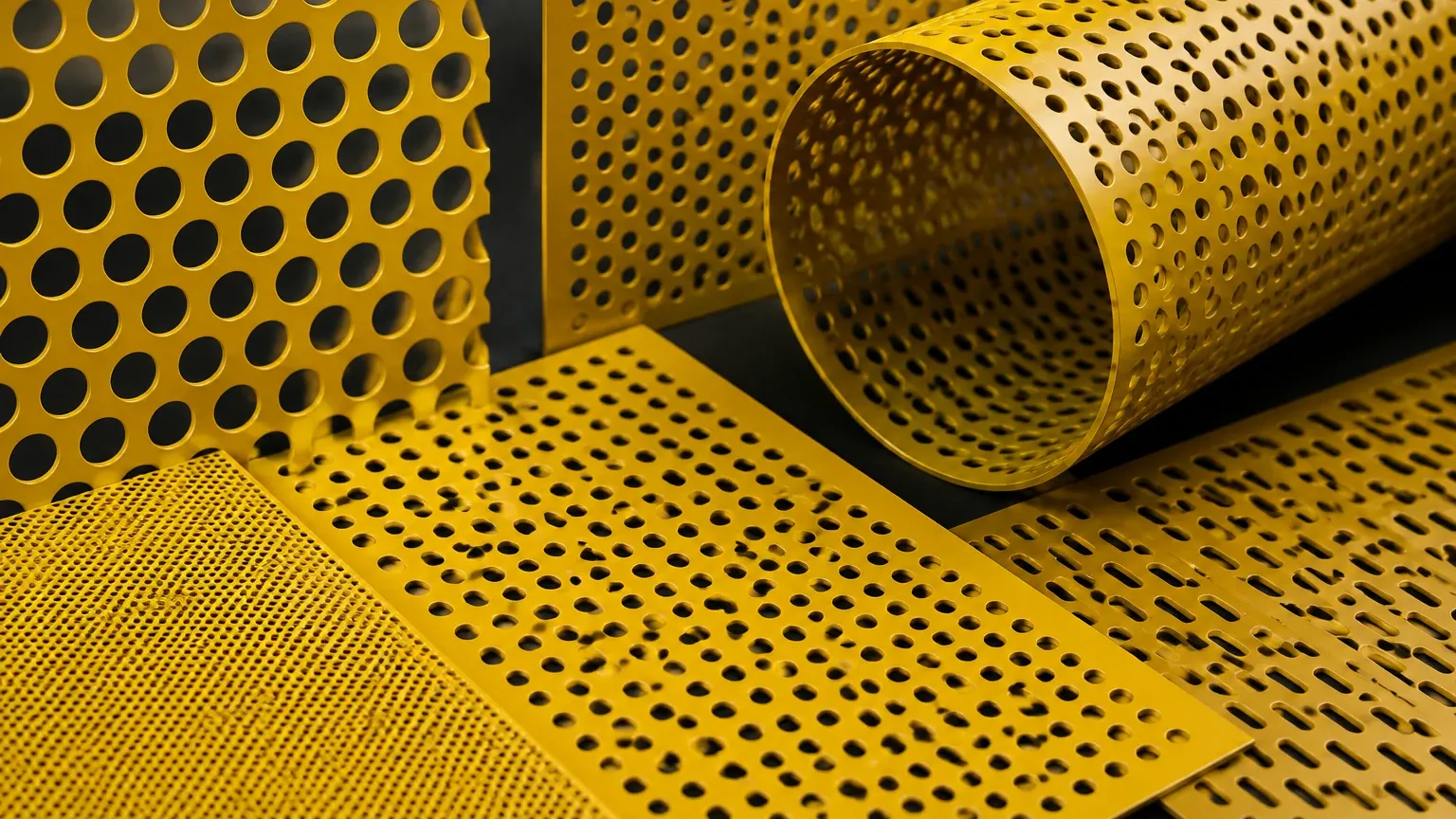
* Round Holes: The most versatile and common pattern. Available in 60-degree staggered, 45-degree staggered, or straight-line configurations. Staggered patterns are generally preferred for their superior strength and uniform open area.
* Square Holes: Often used when a higher open area is required for maximum airflow or visibility. These are common in safety guards for HVAC systems.
* Slotted Holes: Ideal for sorting and grading applications or where specific directional flow is required.
Calculating Open Area
For a standard 60-degree staggered round hole pattern, the open area percentage is calculated using the formula:
Open Area % = (D² × 90.69) / P²
*Where D is the hole diameter and P is the center-to-center pitch.*
It is important to note that the application of a yellow coating (especially powder coating) will slightly reduce the effective hole diameter and, consequently, the open area. Engineers should account for a coating thickness of typically 2 to 4 mils (0.05 to 0.10 mm) when specifying tight tolerances for filtration or airflow.
Functional Applications in Industrial Environments
Yellow perforated metal is utilized across various sectors where the intersection of mechanical filtration and visual signaling is necessary.
Machine Guarding and Personnel Safety
In the manufacturing of industrial equipment, perforated metal sheets are used to enclose moving parts. The yellow finish ensures the guard is highly visible, while the perforations allow maintenance teams to inspect belts, gears, and motors without removing the safety barrier.
Acoustic Baffling
In power plants or loud processing facilities, yellow perforated metal panels are used to house sound-absorbing materials. The perforations allow sound waves to pass into the insulation, while the yellow finish integrates with the facility’s safety color scheme.
Filtration Support Structures
In heavy-duty fluid filtration, perforated metal serves as the internal core or external cage for pleated filter media. While the internal core is rarely color-coded, external cages in multi-stage systems may be finished in yellow to indicate a specific micron rating or a particular chemical compatibility, assisting operators during high-speed changeovers.
Engineering Considerations for Coating Thickness and Tolerances
When ordering Perforated & Expanded Metal with a yellow finish, technical professionals must consider how the finishing process affects the final dimensions.
Powder Coating vs. Liquid Painting
* Powder Coating: This is the industry standard for industrial yellow finishes. It involves applying a dry powder electrostatically and curing it under heat. It provides a thick, durable, and impact-resistant layer that is far superior to liquid paint in resisting chips and scratches.
* Thermoplastic Coatings: For environments with high chemical exposure, a thicker thermoplastic coating may be applied. This provides excellent edge coverage—a critical factor for perforated metal where the sharp edges of the holes are prone to corrosion.
Edge Breaks and Margins
In custom fabrication, "margins" refer to the unperforated areas along the edges of the sheet. When specifying yellow perforated metal, it is essential to define whether the margins should be coated. Fully coated edges provide better corrosion protection, whereas unfinished edges may be required for subsequent welding or assembly processes.
Dimensional Tolerances
The punching process introduces internal stresses into the metal. While Kaifil utilizes advanced leveling equipment to ensure flatness, the subsequent heating during the powder coating process can occasionally cause minor thermal expansion. Specifying "flatness tolerances" is vital for panels intended for precision architectural or mechanical fitments.
Selection Guide: Confirming Requirements for Custom Projects
To ensure the successful procurement of yellow perforated metal, purchasing teams and engineers should confirm several key data points before production begins.
Environmental Factors
* Chemical Exposure: Will the yellow finish be exposed to caustic cleaning agents (common in food and beverage) or industrial solvents? This determines whether a standard polyester powder or a more robust epoxy-based coating is required.
* UV Exposure: For outdoor architectural applications, the yellow pigment must be UV-stabilized to prevent fading or "chalking" over time.
Mechanical Requirements
* Load-Bearing Capacity: Will the perforated sheet be walked on or subjected to pressure? This dictates the gauge (thickness) of the substrate.
* Airflow/Pressure Drop: Has the reduction in open area caused by the coating thickness been factored into the system's pressure drop calculations?
Compliance and Standards
* OSHA/ANSI: Does the yellow color meet the specific spectral requirements for safety signage in your jurisdiction?
* FDA/EU Food Contact: If used in a food processing environment, is the coating certified for indirect food contact?
The Kaifil Advantage in Custom Metal Filtration
As a manufacturer specializing in stainless steel filtration and precision metal components, Kaifil provides a bridge between raw material production and finished engineering solutions. Our expertise in Perforated & Expanded Metal ensures that the base components are manufactured to the highest standards of accuracy before the finishing process occurs.
We work closely with global customers to develop customized filtration and guarding components that meet specific application requirements. From material selection and hole pattern optimization to the final application of high-performance yellow coatings, Kaifil delivers dependable components designed for demanding industrial environments. Our focus on quality and durability ensures that your yellow perforated metal components provide both the functional performance and the long-term visibility required for safe and efficient operations.
