


How Are Sintered Filters Made
In industrial filtration, the reliability of a filter component often dictates the efficiency and safety of an entire production line. Among the various technologies available, sintered metal filters stand out for their exceptional mechanical strength, thermal stability, and chemical resistance. For engineers and procurement specialists in the chemical, pharmaceutical, and hydraulic sectors, understanding how are sintered filters made is essential for evaluating performance specifications and ensuring long-term operational success.
Sintering is a metallurgical process that bonds metallic particles or layers together through heat and pressure without reaching the melting point of the base material. This results in a porous yet rigid structure capable of withstanding extreme environments that would cause traditional polymer or paper filters to fail. This article provides a technical overview of the manufacturing stages, material considerations, and engineering variables involved in producing high-performance Sintered Metal Filters.
The Fundamental Principles of the Sintering Process
To understand how are sintered filters made, one must first grasp the physics of sintering. The process relies on atomic diffusion. When metal particles are heated to a temperature typically between 70% and 90% of their melting point, the atoms at the contact points between particles begin to migrate. This creates "necks" or bridges between the particles, transforming a loose collection of powder or mesh into a solid, cohesive matrix.
Unlike welding, which involves localized melting, sintering maintains the solid state of the material. This is critical for filtration because it allows the manufacturer to control the size and distribution of the voids—or pores—within the metal. The final product retains the chemical properties of the base alloy while gaining a precisely engineered porosity that determines its filtration rating.
Material Selection and Preparation
The manufacturing process begins with the selection of raw materials, which are chosen based on the intended application's temperature, pressure, and chemical exposure.
Common Alloys Used
* Stainless Steel (316L and 304): The industry standard for most industrial applications due to its excellent corrosion resistance and mechanical durability.
* Bronze: Often used in pneumatic systems and for flame arrestors due to its thermal conductivity and cost-effectiveness.
* Nickel-Based Alloys (Inconel, Monel, Hastelloy): Reserved for highly corrosive environments or extreme temperatures where stainless steel may undergo oxidation or stress corrosion cracking.
* Titanium: Selected for its high strength-to-weight ratio and biocompatibility, making it a staple in pharmaceutical and medical filtration.
Form of Raw Material
How are sintered filters made often depends on whether the starting material is powder, wire mesh, or metal fiber.
1. Metal Powder: Spherical or irregular particles are used to create depth filters with high precision.
2. Wire Mesh: Multiple layers of woven wire cloth are stacked and sintered to create a robust, easy-to-clean surface filter.
3. Metal Fiber Felt: Non-woven metal fibers are compressed to create a high-porosity medium with superior dirt-holding capacity.
Step-by-Step: How Are Sintered Filters Made?
The transformation from raw metal to a finished industrial filter involves several distinct stages, each requiring precise control over environmental variables.
1. Shaping and Compacting
Before sintering can occur, the metal must be formed into its "green" state—a term referring to the shaped but unsintered component. For powder-based filters, this is often achieved through Cold Isostatic Pressing (CIP) or gravity filling into a mold. In CIP, the powder is placed in a flexible mold and subjected to high fluid pressure, ensuring uniform density throughout the part. For sintered mesh, the layers are carefully aligned and mechanically pressed to ensure intimate contact between the wires.
2. The Sintering Stage
The green parts are placed into a sintering furnace. The environment inside the furnace is strictly controlled to prevent oxidation; this usually involves a vacuum or a reducing atmosphere (such as hydrogen or dissociated ammonia).
The temperature profile is divided into three phases:
* Pre-heating: Residual lubricants or binders used during compacting are evaporated.
* Sintering: The temperature is raised to the point where atomic diffusion occurs, forming the structural bonds.
* Cooling: The parts are cooled at a controlled rate to prevent thermal shock and maintain dimensional stability.
3. Post-Sintering Operations and Finishing
Once the sintering process is complete, the resulting component is a rigid porous metal part. However, most industrial applications require further processing. This may include:
* Sizing and Machining: Precision grinding or CNC machining to meet tight dimensional tolerances for housing fits.
* Welding: Sintered elements are often welded to solid metal end caps, flanges, or threaded connectors using TIG or laser welding techniques.
* Surface Treatment: Passivation or electro-polishing to enhance corrosion resistance and ensure a clean, burr-free surface.
Engineering Variables: Porosity and Permeability
A critical aspect of how are sintered filters made is the manipulation of pore geometry. Engineers must balance two competing factors: filtration efficiency (the ability to stop small particles) and permeability (the ease with which fluid flows through the filter).
* Pore Size Distribution: By selecting specific powder grain sizes or wire diameters, manufacturers can produce filters with ratings ranging from 0.1 microns to over 200 microns.
* Porosity Percentage: This refers to the ratio of void space to the total volume. Higher porosity reduces the pressure drop across the filter but may decrease the overall mechanical strength. Sintered metal powder filters typically have a porosity of 30% to 50%, while sintered fiber felts can reach up to 80%.
Quality Control and Performance Validation
To ensure that Sintered Metal Filters meet the rigorous demands of B2B industrial environments, manufacturers employ several standardized testing protocols:
Bubble Point Test (ISO 4003)
This is the most common method for determining the maximum pore size. The filter is submerged in a liquid, and air pressure is gradually increased until the first bubble appears. The pressure at which this occurs is inversely proportional to the largest pore diameter.
Air Permeability Testing
This test measures the volume of air that passes through the filter at a specific differential pressure. It is a vital metric for ensuring that the filter will not cause excessive energy consumption or pump strain in the final system.
Mechanical Integrity
Sintered filters must withstand high differential pressures without deforming. Manufacturers perform collapse pressure tests to define the operational limits of the filter element, ensuring it can handle the "dirty" pressure drop before cleaning is required.
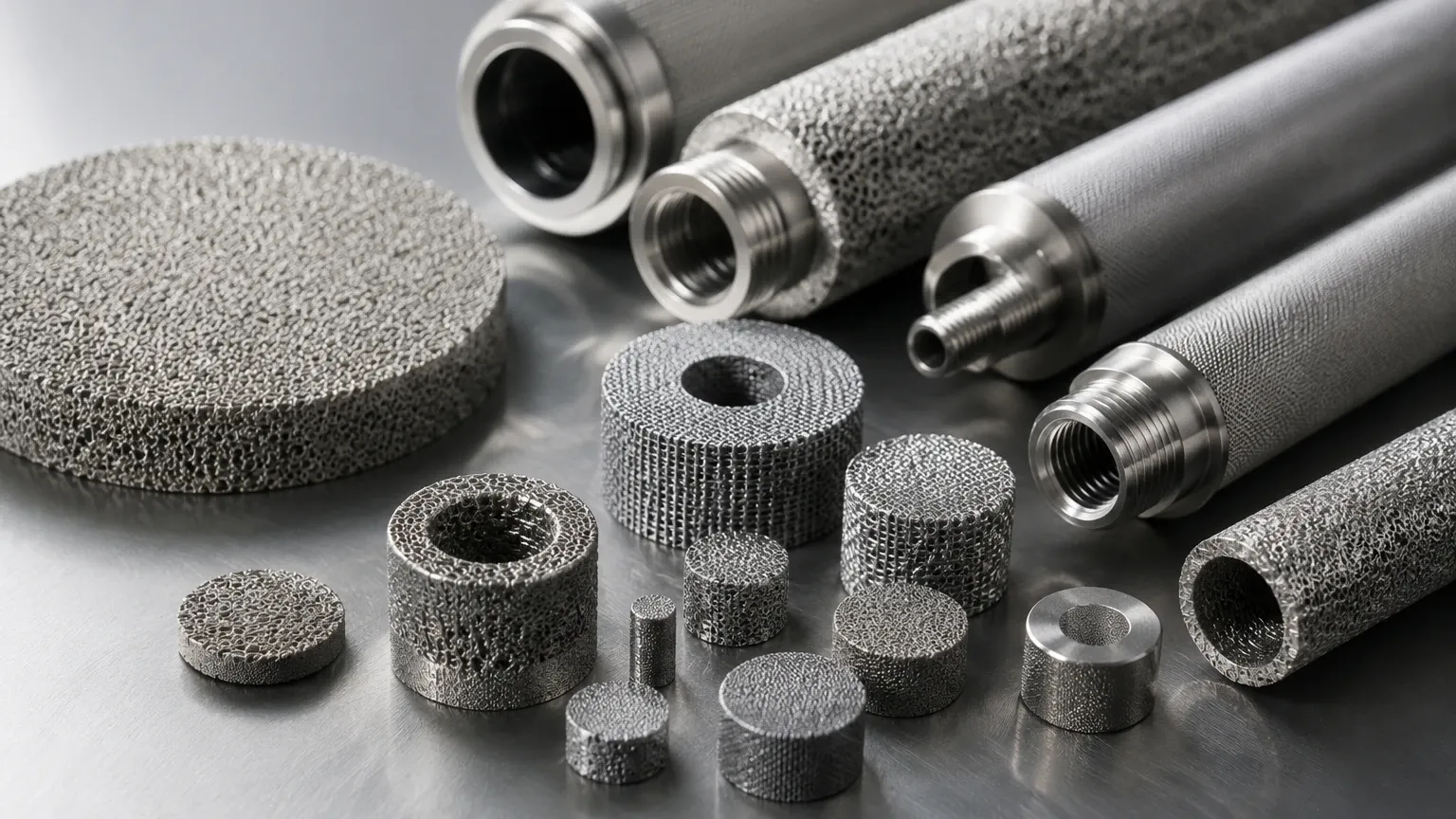
Comparison of Sintered Structures
When deciding which type of sintered filter to specify, it is helpful to compare the three primary manufacturing styles:
| Feature | Sintered Powder | Sintered Wire Mesh | Sintered Fiber Felt |
| :— | :— | :— | :— |
| Filtration Type | Depth | Surface | Depth/Hybrid |
| Permeability | Moderate | High | Very High |
| Cleanability | Moderate (Backwash) | Excellent (Ultrasonic) | Difficult |
| Strength | Very High | High | Moderate |
| Typical Use | Gas sparging, chemical | Polymer melt, hydraulics | High-temp gas, steam |
Why Choose Sintered Metal Over Traditional Media?
Understanding how are sintered filters made highlights why they are preferred in high-stakes B2B applications. Traditional media like pleated paper or polymer membranes are often disposable and fragile. In contrast, sintered metal offers:
* Longevity: These filters can be cleaned and reused multiple times, significantly reducing the total cost of ownership.
* Thermal Resistance: They can operate in temperatures exceeding 450°C (depending on the alloy), where polymers would melt or degrade.
* Structural Rigidity: Sintered filters do not require internal support cores in many applications because the media itself is self-supporting.
* No Media Migration: Unlike string-wound or fiberglass filters, the sintered bond ensures that no fragments of the filter media will break off and contaminate the downstream fluid.
Customization and OEM Considerations
For many industrial equipment manufacturers, a standard off-the-shelf filter is insufficient. Customization is a core part of the manufacturing process at facilities like Kaifil. When requesting a custom sintered solution, engineers should be prepared to confirm the following:
1. Fluid Characteristics: Viscosity, density, and chemical composition.
2. Operating Conditions: Maximum temperature and normal/surge pressure levels.
3. Target Particle Size: The specific micron rating required for process purity.
4. Flow Rate Requirements: To determine the necessary surface area and avoid excessive pressure drops.
By working closely with a manufacturer that understands the nuances of how are sintered filters made, purchasing teams can develop components that are optimized for their specific housing designs and maintenance schedules.
Conclusion
The production of sintered metal filters is a sophisticated blend of metallurgy and precision engineering. From the initial selection of high-grade metal powders to the controlled atmosphere of the sintering furnace, every step is designed to create a filtration medium that excels where others fail. Whether you are managing a chemical refinery or designing a high-pressure hydraulic system, the durability and precision of Sintered Metal Filters provide a reliable solution for the most demanding industrial challenges. Understanding the complexities of their manufacture allows for better-informed decisions, ensuring that the selected filtration technology aligns perfectly with the operational goals of the project.
