


Sintered Porous Metal Filters
In the landscape of industrial filtration, the requirement for components that can withstand extreme temperatures, corrosive environments, and high-pressure differentials is constant. Sintered porous metal filters represent a specialized class of filtration media engineered to meet these rigorous demands. Unlike traditional fabric or polymer-based filters, these components are manufactured through powder metallurgy, resulting in a rigid, self-supporting structure with a precisely controlled pore distribution. For engineers and technical procurement teams, understanding the nuances of sintered porous metal filters is essential for optimizing process efficiency and ensuring the longevity of downstream equipment.
Understanding the Sintering Process and Porous Structure
The performance of Sintered Metal Filters is fundamentally rooted in their manufacturing process. Sintering is a thermal treatment where metal powders are heated in a controlled-atmosphere furnace to a temperature just below their melting point. This causes the powder particles to bond at their contact points through a process of atomic diffusion, creating a solid matrix without completely liquefying the material.
The resulting structure of sintered porous metal filters is characterized by a "tortuous path"—a complex network of interconnected pores. This geometry is critical for depth filtration, where particles are trapped not just on the surface but within the thickness of the filter media. The pore size, porosity, and permeability of the final product are determined by several factors: the initial particle size of the metal powder, the shape of the particles (spherical vs. irregular), the compaction pressure applied before sintering, and the specific temperature-time profile of the sintering cycle.
By manipulating these variables, manufacturers can produce filters with micron ratings ranging from sub-micron levels up to 200 microns or more. This level of precision allows for the customization of filters to meet specific flow rate and particle retention requirements, making them indispensable in high-precision industrial applications.
Material Selection for Industrial Sintered Metal Filters
The choice of material is perhaps the most significant factor in determining the chemical and thermal compatibility of a filter. While various metals can be sintered, stainless steel remains the industry standard due to its balance of mechanical strength, corrosion resistance, and cost-effectiveness.
1. Stainless Steel 316L: This is the most common material for sintered porous metal filters. The "L" denotes low carbon content, which improves weldability and resistance to intergranular corrosion. It is highly effective in organic solvents, mildly acidic environments, and high-temperature gas filtration.
2. Stainless Steel 304: Often used in less aggressive environments where cost is a primary concern but high mechanical strength is still required.
3. Nickel and Nickel-Based Alloys: Materials such as Monel, Inconel, and Hastelloy are utilized for extreme conditions. Hastelloy, for instance, is preferred for highly corrosive chemical processing involving strong acids or chlorides, while Inconel is selected for high-temperature oxidation resistance.
4. Titanium: Sintered titanium filters offer an exceptional strength-to-weight ratio and superior corrosion resistance in seawater and chlorine-based environments. They are also widely used in medical and pharmaceutical applications due to their biocompatibility.
5. Bronze: Sintered bronze is frequently used in pneumatic systems for muffling and basic oil/gas filtration where the operating temperatures are moderate.
Selecting the correct alloy ensures that the filter does not suffer from premature failure due to pitting, stress corrosion cracking, or thermal degradation, which are common risks in aggressive industrial cycles.
Key Performance Metrics: Permeability, Strength, and Efficiency
When evaluating sintered porous metal filters, engineers must look beyond the nominal micron rating. Three primary metrics define the operational success of these components:
Permeability and Pressure Drop
Permeability refers to the ease with which a fluid (liquid or gas) passes through the porous medium. In industrial systems, a high pressure drop (ΔP) across the filter can lead to increased energy consumption and reduced flow rates. Sintered metal filters are designed to provide a high void volume (porosity), typically between 30% and 50%, which helps maintain high flow rates while minimizing initial pressure drop. Understanding Darcy’s Law is essential here, as it relates flow rate to the fluid's viscosity, the thickness of the filter media, and the pressure differential.
Mechanical Integrity
One of the primary advantages of sintered metal is its structural rigidity. These filters can withstand high differential pressures—often exceeding 20-30 MPa depending on the design—without deforming or experiencing media migration. This is a critical safety feature in high-pressure hydraulic systems or high-velocity gas streams where the release of filter fibers or particles into the downstream flow would be catastrophic.
Filtration Efficiency
Efficiency is often categorized into nominal and absolute ratings. Nominal ratings refer to the filter's ability to retain a specific percentage of particles of a certain size, while absolute ratings indicate the pore size at which 99.9% (or higher) of particles are captured. Because of the tortuous path within sintered porous metal filters, they often exhibit higher-than-expected efficiency for particles smaller than their rated pore size due to mechanisms like Brownian motion and inertial impaction.
Comparing Sintered Porous Metal Filters with Alternative Media
To make an informed purchasing decision, it is helpful to compare sintered metal with other common filtration technologies:
* Wire Mesh Filters: While wire mesh offers excellent surface filtration and is easy to clean, it lacks the depth filtration capabilities of sintered powder. Sintered metal is generally more robust and can handle finer filtration tasks than standard single-layer mesh.
* Sintered Metal Fiber Felt: Metal fibers offer higher porosity and lower pressure drops than metal powders. However, sintered powder filters are generally more rigid and better suited for applications requiring high crush resistance and precise pore size control in small footprints.
* Polymer/Ceramic Filters: Polymer filters are inexpensive but fail at high temperatures and in many chemical solvents. Ceramic filters handle heat well but are brittle and prone to thermal shock. Sintered metal bridges this gap, offering the thermal resistance of ceramics with the ductility and impact resistance of metals.
Engineering Selection Criteria and Design Considerations
Specifying a sintered metal filter requires a comprehensive understanding of the operating environment. Engineers should confirm the following parameters before finalizing a design:
* Fluid Characteristics: Is the fluid a gas or a liquid? What is its viscosity at operating temperature? Is it Newtonian or non-Newtonian?
* Operating Conditions: What is the normal operating temperature and the maximum possible temperature excursion? What are the system pressure and the maximum allowable pressure drop before cleaning is required?
* Contaminant Profile: What is the nature of the solids being removed? Are they hard, abrasive particles or soft, deformable gels? What is the particle size distribution?
* Cleaning Requirements: Will the filter be cleaned in-situ (backpulsing/backwashing) or removed for external cleaning (ultrasonic/chemical)?
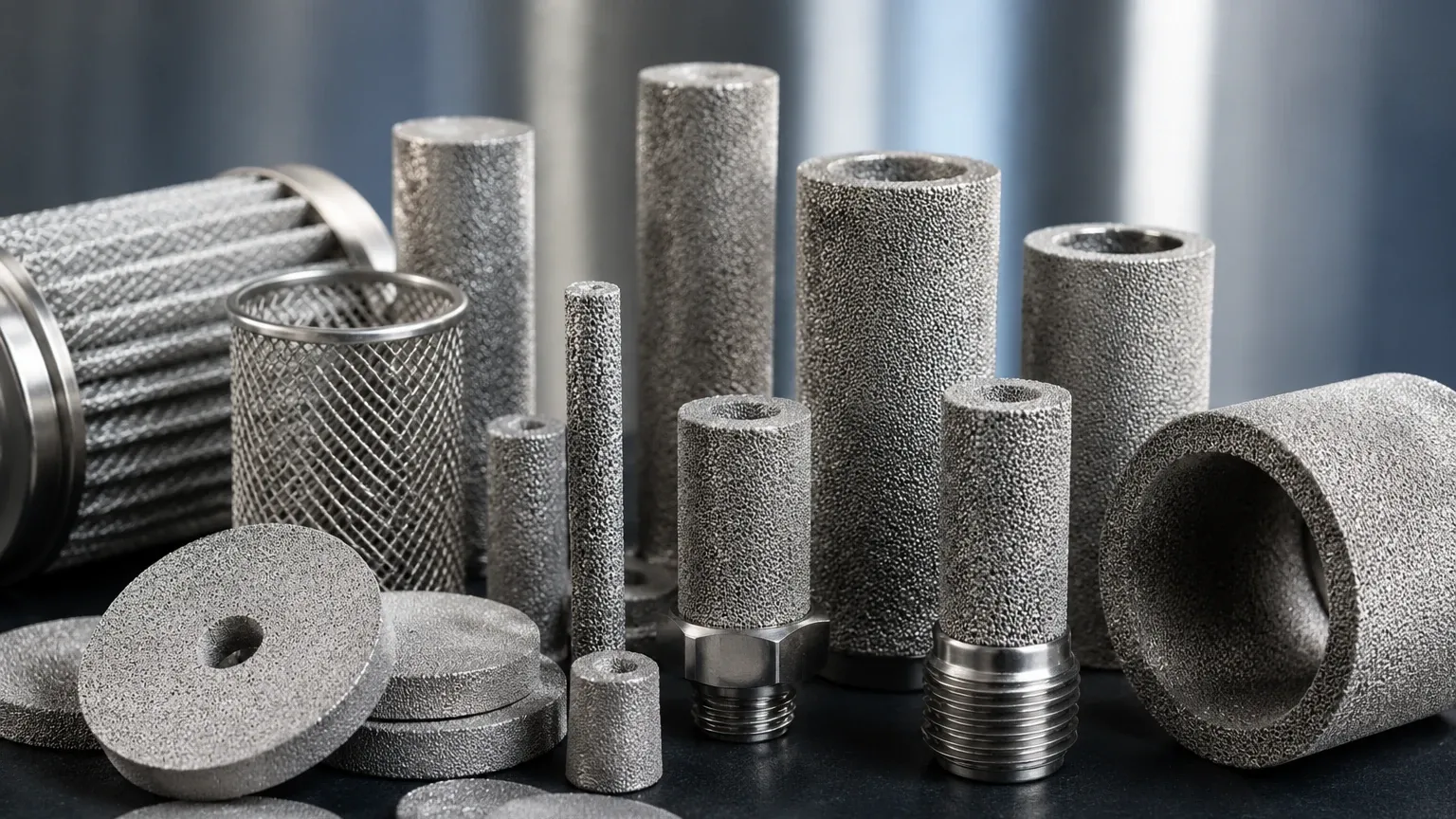
Customization is a hallmark of sintered metal manufacturing. Filters can be produced in various geometries, including seamless tubes, flat discs, conical shapes, and complex pleated cartridges to increase surface area. Integration with hardware is also a key consideration; sintered components can be welded or brazed to stainless steel fittings, flanges, or threaded connectors to ensure a leak-proof assembly.
Industrial Applications and Operational Environments
The versatility of sintered porous metal filters allows them to be used across a broad spectrum of industries:
Chemical and Petrochemical Processing
In these sectors, filters are used for catalyst recovery, monomer filtration, and the removal of impurities from aggressive solvents. The ability of 316L or Hastelloy filters to resist corrosion while maintaining structural integrity at 400°C+ is vital for continuous process plants.
Food and Beverage Production
Sintered metal is ideal for steam filtration (culinary steam) and carbonation processes. Because the material is non-shedding and can be sterilized, it meets the stringent hygiene standards required for food contact. It is also used for filtering frying oils and clarifying beverages.
Pharmaceutical Manufacturing
In pharmaceutical synthesis, sintered filters are used for solvent purification and gas sparging. The smooth surface finish and ability to undergo repeated Autoclave or SIP (Sterilization-in-Place) cycles make them a preferred choice for sterile environments.
Power Generation and Aerospace
Sintered metal components serve as flame arrestors, vent breathers, and hydraulic fluid filters in aircraft and power plants. Their reliability under extreme vibration and thermal cycling is a key safety factor.
Maintenance, Cleaning, and Service Life Optimization
One of the most significant total cost of ownership (TCO) advantages of sintered porous metal filters is their cleanability. Unlike disposable filters, these units can be regenerated multiple times, significantly reducing waste and long-term procurement costs.
Cleaning Methods
* Backpulsing/Backwashing: Used primarily in gas and liquid systems respectively, this involves reversing the flow of the fluid to dislodge particles from the filter surface. It is highly effective for surface-loaded contaminants.
* Ultrasonic Cleaning: The filter is submerged in a cleaning solvent, and high-frequency sound waves create cavitation bubbles that reach deep into the porous matrix to remove embedded particles.
* Chemical Cleaning: The use of surfactants, acids, or caustic solutions to dissolve organic or inorganic deposits. This is common in the food and chemical industries.
* Thermal Cleaning (Burn-off): In cases where the filter is clogged with organic polymers or carbonaceous deposits, heating the filter in a controlled oven can oxidize the contaminants, leaving the metal matrix intact.
Determining Replacement Cycles
While sintered filters are durable, they are not infinite. Over many cleaning cycles, the "residual pressure drop" (the ΔP of a cleaned filter) may gradually increase. This occurs when sub-micron particles become permanently lodged in the pore structure. Monitoring the rate of ΔP increase over time allows maintenance teams to predict the end-of-life and schedule replacements during planned shutdowns, avoiding emergency downtime.
In conclusion, sintered porous metal filters offer a robust, high-performance solution for the most demanding industrial filtration challenges. By selecting the appropriate material, pore size, and mechanical design, engineers can achieve precise filtration, long service life, and a lower total cost of ownership compared to disposable alternatives. Whether the application involves high-temperature gas sparging or high-pressure hydraulic filtration, the unique properties of sintered metal provide a level of reliability that is essential in modern B2B industrial operations.
